The Commodity Core Comes First: What Mountain Hazelnuts Tells Us About Financing Nature-Based Solutions
Mountain Hazelnuts spent seventeen years building the commodity leg before carbon entered the model. That sequence is the underwriting lesson for frontier NbS in the Global South.
Case Study · NbS Project Finance · 4 August 2026
The Commodity Core Comes First: What Mountain Hazelnuts Tells Us About Financing Nature-Based Solutions
Mountain Hazelnuts spent seventeen years and roughly USD 30M of concessional and quasi-equity capital building the commodity leg in Bhutan before the carbon layer entered the model in 2026. That sequence is the underwriting lesson for frontier NbS in the Global South. The commodity is the base of the capital stack. Carbon comes second.
Mountain Hazelnuts was founded in Bhutan in 2009 as the country’s first fully foreign-direct-investment-funded business.2 Seventeen years and roughly USD 30M of committed capital later, it is finally moving to add a carbon revenue stream on top of an agroforestry commodity operation that has been built with patient concessional support at every stage. That sequence is the point. It is the underwriting lesson for anyone financing nature-based solutions (NbS, the family of forestry, mangrove, agroforestry, and soil-carbon interventions that generate a carbon tonne as a co-product of a land-use decision) in frontier Global South markets. The commodity leg is not a garnish on a carbon project. In these markets, it is the base of the capital stack. Carbon comes second.
The mental model to hold is this. Every NbS project in a frontier market has two revenue lines. The first is the commodity line, which is the sale of the underlying agricultural or forestry product. The second is the carbon line, which is the sale of removal or reduction credits generated by the land-use activity. In a mature market with a proven commodity, the commodity line underwrites project debt and the carbon line is upside. In a frontier market with an unproven commodity, the commodity line has to be built first with concessional patience and only then does the carbon line have something to sit on top of. Mountain Hazelnuts is a seventeen-year proof of that ordering. It also shows what a well-designed concessional capital stack looks like when a project financier respects the ordering rather than trying to compress it.
What Actually Sits in the Capital Stack?
Mountain Hazelnuts entered Bhutan on a thirty-year Memorandum of Understanding with the Royal Government, targeting the planting of roughly ten million hazelnut trees on fallow and degraded mountain slopes across eight eastern dzongkhags.2 The economic model asks smallholder families to plant hazelnut trees on their own fallow land under a locked buyback price arrangement with Mountain Hazelnuts as the sole aggregator and processor. The current buyback price is BTN 150 per kilogram. The company is contractually the offtaker; the farmer is the operator; the land stays with the household.
That structure carries two structural obligations at the underwriting stage. The first is agronomic uncertainty on a crop with no established production history in Bhutan; hazelnuts had not been cultivated at commercial scale in the country before Mountain Hazelnuts started. The second is a fixed offtake obligation on that agronomy. A locked buyback price is a floor for the farmer, which is the point of the model socially, but it is a fixed liability for the company. That combination is precisely the shape a concessional stack is designed to underwrite. It is not the shape a commercial senior lender underwrites first.
The capital came in blended layers accordingly. The International Finance Corporation and the Asian Development Bank each committed USD 3M in equity in 2015.5 The Global Agriculture and Food Security Program’s Private Sector Window matched that with a USD 6M quasi-equity package structured as cumulative redeemable preferred shares.2 The Mirova-managed Land Degradation Neutrality Fund followed with a USD 9M profit-sharing loan on a ten-year tenor, structured so that repayment would key off orchard productivity rather than a fixed amortisation schedule.4 Mirova itself later took an equity stake through the same platform.
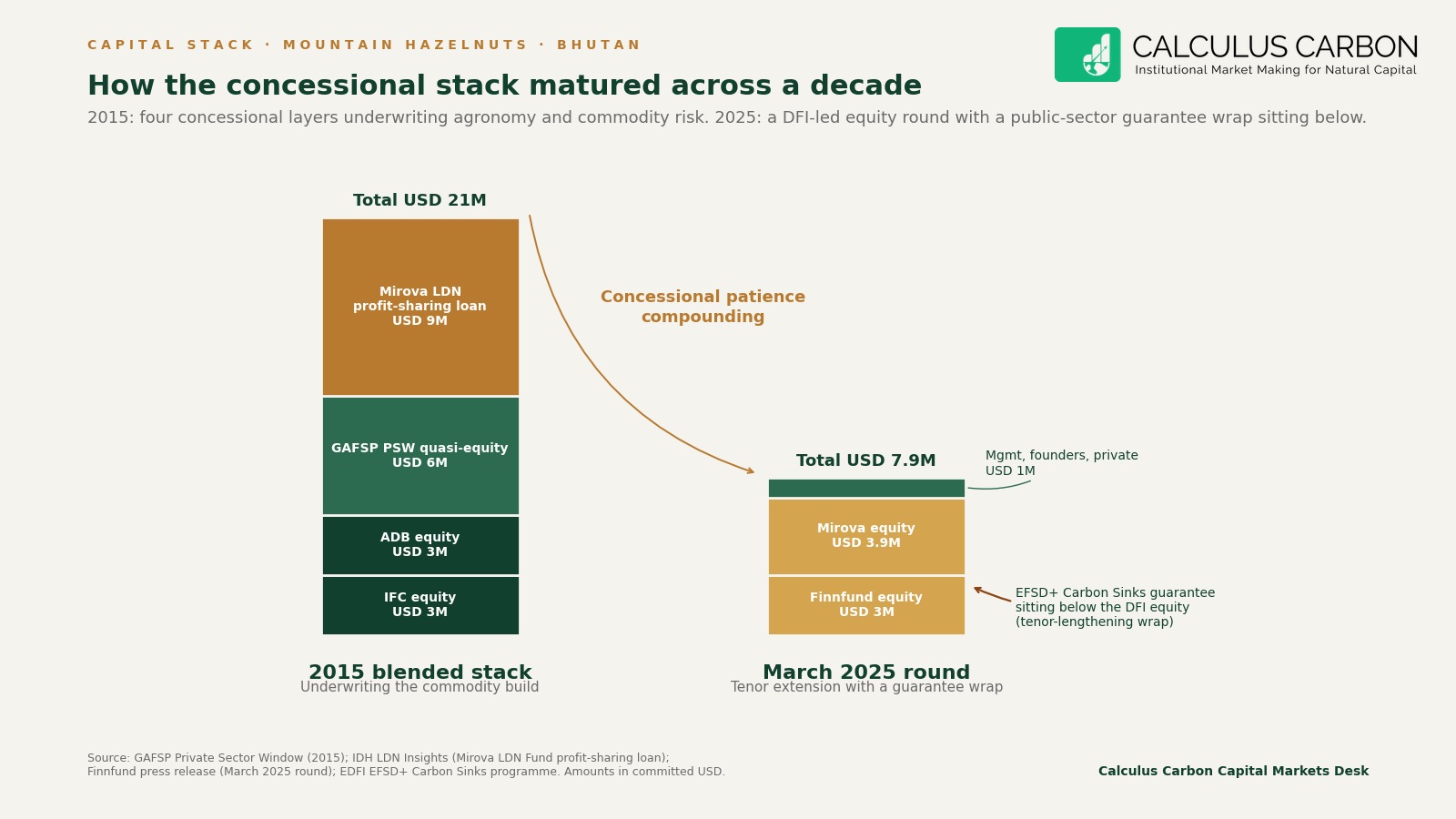
The point of the layering is not the roster of names. It is the shape of the obligations. Concessional equity absorbed the agronomic uncertainty. Quasi-equity absorbed the early-stage cash-flow risk without a hard repayment schedule. A profit-sharing loan absorbed the productivity risk by tying repayment to orchard performance. Not one of those instruments would sit inside a commercial senior debt package on a project this shape. Each was designed to give the commodity leg the room it needed to prove out its underwriting weak spots.
How Was the 2025 Round Structured, and Why Does the Shape Matter?
The March 2025 round is the second decisive project-finance move to study. Finnfund and Mirova returned with a USD 7.9M equity round, split USD 3.9M from Mirova and USD 3M from Finnfund with the balance from management, founders, and a private investor.1 The round was executed with support from the European Fund for Sustainable Development Plus and used an EFSD+ guarantee under the Carbon Sinks programme managed by EDFI Management Company.7
The stated purpose of the round was a five-year runway extension: completing the climate-adaptation grafting programme, expanding the processing factory, and securing Rainforest Alliance and Organic certifications. That framing is important on its own, but the more instructive project-finance detail is the EFSD+ Carbon Sinks guarantee. It is the mechanism that made the round underwriteable for Finnfund and Mirova at the tenor and price it landed at. A public-sector guarantee sitting alongside a DFI equity cheque changes the risk-adjusted return calculation for the DFI. Without the guarantee, the round is either smaller, more expensive, or does not close. With the guarantee, the round closes at the shape the sponsor actually needs.
That is the codified project-finance takeaway from the 2025 layer. When a concessional stack needs to extend runway on a long-tenor commodity build, a public-sector guarantee sitting below DFI equity is a tenor-lengthening instrument in disguise. It lets the DFI take the equity risk and lets the public-sector body take the tail risk. The two together produce a five-year commitment that neither could have produced alone. That is the kind of structural move a project financier looks for in a frontier NbS stack.
When Does the Carbon Layer Actually Enter?
Only now, in 2026, is Mountain Hazelnuts moving to carbon. The company is developing a roughly 2,300-hectare agroforestry project involving 9,000 of its farmer partners, targeting registration under the Isometric Agroforestry Protocol v1.0.6 The first issuance target is modest by design: 4,000 to 5,000 tonnes as a proof-of-concept crediting event before year-end. Development costs are split between Mountain Hazelnuts, which funds field operations and farmer engagement, and a specialist carbon project partner, which covers methodology work and technical monitoring, reporting, and verification.
The Isometric protocol is a useful lens on why this ordering makes sense. The protocol requires that agricultural production be a primary component of the project, demonstrated by either the majority of the land or a minimum of five hundred hectares being dedicated to at least one non-timber commodity.6 It also requires species diversity thresholds (three species minimum for smaller blocks, scaling to five species for blocks above one hundred hectares) and applies a default twenty per cent buffer-pool contribution against reversal risk. The eligibility bar is deliberately built around a functioning agricultural system, not around a carbon opportunity in isolation. A project that has not first established the commodity operation cannot clear that bar.
Mountain Hazelnuts can. The 2,300-hectare block that anchors the carbon project is a subset of the same orchards that have been operating for seventeen years. The trees are already in the ground. The farmers are already contracted. The commodity revenue is already flowing. The carbon layer is being placed onto operating infrastructure that concessional capital paid to build. The USD 3 per tonne of arithmetic that a carbon-first thesis would produce (roughly 4,500 tonnes at maybe USD 30 per tonne of premium removal price, netted against a substantial development cost) is not the revenue line that justified the seventeen years of patience. It is a modest add-on that the operating platform can now support.
That is the read on ordering. The carbon layer is not the reason the project exists. It is the reason a project like this can, seventeen years in, start looking like a candidate for project-financed expansion rather than a permanent recipient of concessional support.
What Does This Mean for How We Underwrite the Next One?
The diligence sequence follows from the ordering. When Calculus Carbon looks at a new NbS transaction in a frontier Global South market, the first question is not what the carbon methodology looks like or what the removal price is. It is whether the commodity leg is real and whether it has been given the patient concessional support it needs to be real. Three atoms carry that diligence.
The first atom is the commodity underwriting. What is the crop? What is its production history in the geography? Who is the offtaker? What is the price mechanism? Is there a locked buyback, and if so, is the counterparty balance sheet good for it? A locked buyback is a farmer protection, but it is also a company liability. That liability has to be sized and funded before the carbon revenue enters.
The second atom is the concessional layer. Who is in the equity? Who is in the quasi-equity? What is the profit-sharing loan structure, if there is one? Is there a public-sector guarantee tucked below the DFI cheques that extends the effective tenor of the stack? Is the DFI base broad enough to bridge a valley, or is it a single-relationship dependency? The Mountain Hazelnuts stack held through a decade-long build because it had four to five concessional counterparties in various layers and a guarantee mechanism underneath the most recent round.7 A single-DFI stack is fragile in a way that a diversified concessional stack with a guarantee wrap is not.
The third atom is the carbon shape. Only after the first two atoms clear does the carbon layer come into view. What methodology? What buffer pool? What issuance timeline? What buyer? At what price? A 4,000-tonne proof-of-concept issuance on an Isometric protocol at a specialist buyer premium is a different animal from a 400,000-tonne Verra REDD+ issuance sold into voluntary spot. The two carbon revenue lines have different bankability profiles and different diligence overhead. Both are legitimate. Neither substitutes for a working commodity leg.
The Read for Institutional Capital
For a DFI or an impact-oriented allocator sitting in the concessional layer, the Mountain Hazelnuts arc is a data point on how long a frontier commodity leg needs to be underwritten for. Seventeen years, four to five financing rounds, and a guarantee-wrapped bridge on year sixteen. An allocator underwriting this asset class should size the concessional runway in decades, not years, and should assume the capital stack will need a structural refresh (guarantee mechanic, tenor extension, blended layer expansion) at least once during the build.
For a commercial lender or a carbon-first buyer looking at the next project, the Mountain Hazelnuts arc is a template for what a mature NbS commodity operation looks like at the point a carbon layer becomes underwriteable. Trees in the ground for a decade. Farmers under long-tenor buyback contracts. Aggregation and processing infrastructure built and running. A methodology partner in place. That is the shape of asset a carbon-forward capital stack can actually attach to. The presence of a functioning commodity leg is not a nice-to-have. It is the condition precedent.
In frontier NbS, the commodity comes first, and the capital stack has to know it. Mountain Hazelnuts is a seventeen-year data point on how long that ordering actually takes and what concessional patience looks like in practice.
This piece pairs with a Calculus Carbon company page short-form scheduled for W32.
Sources
- [1] Finnfund, Mountain Hazelnuts secures landmark international investment strengthening Bhutan’s sustainable agriculture sector (USD 7.9M equity round, March 2025). finnfund.fi
- [2] GAFSP, Blending Happiness with Hazelnuts in Bhutan (USD 6M quasi-equity via cumulative redeemable preferred shares). gafspfund.org
- [3] Convergence, Blended finance case studies. convergence.finance
- [4] IDH, LDN Insights: Mountain Hazelnuts (USD 9M profit-sharing loan, ten-year tenor). idhsustainabletrade.com
- [5] Asian Development Bank, Hazelnut Value Chain Development Project (project brief). ewsdata.rightsindevelopment.org
- [6] Isometric, Agroforestry Protocol v1.0 (methodology). registry.isometric.com
- [7] EDFI Management Company, EFSD+ Carbon Sinks programme (public-sector guarantee mechanism supporting the March 2025 round). edfi.eu