The Missing Template: Why Global South Nature-Based Working-Farm Agroforestry Sits in a US$40 to 80 Million Financing Sandwich
The San Miguel US$81 million capital stack is the template Global South nature-based working-farm agroforestry has been waiting for. Half development-finance, half commercial bank, one facility.
Project Finance · Nature-Based Solutions · 27 July 2026
The Missing Template: Why Global South Nature-Based Working-Farm Agroforestry Sits in a US$40 to 80 Million Financing Sandwich
The San Miguel US$81 million capital stack is the template Global South nature-based working-farm agroforestry has been waiting for. Half development-finance, half commercial bank, one facility.
Inside the San Miguel Structure
The more consequential signal in last week's US$81 million San Miguel financing is not that the world's largest lemon processor got a large ticket done. Global commodity players close large debt facilities every quarter. The consequential signal is the shape of the capital stack itself. Half development-finance senior debt with preferred-creditor treatment. Half commercial bank debt syndicated by the same development-finance institution, sitting under the same preferred-creditor umbrella. One facility, eight-year tenor, two-year grace, final maturity in June 2034. The template lands squarely in the US$40 to 80 million zone where Global South nature-based working-farm agroforestry programmes actually live but rarely find capital.1,3
That zone has been under-served for years. San Miguel is the first published transaction that shows the sandwich structure can hold up for a commodity-adjacent borrower with a real offtake buyer and a multi-year investment programme. The template is not new. The commercial bank now writing the second half of the ticket is what is new.
On 23 July 2026 the International Finance Corporation, IDB Invest, and Rabobank closed a US$81 million secured financing for San Miguel, an Argentine and Uruguayan lemon processor with an added subsidiary guarantor in South Africa.1 The IFC and IDB Invest each provided an A-loan of US$20.25 million. An A-loan is development-finance senior debt where the lender is a multilateral institution and the debt carries what is known as preferred-creditor treatment. In practical terms, that treatment means the country cannot restrict foreign-currency debt service to the multilateral, which lowers the sovereign risk premium the borrower would otherwise carry on foreign-denominated debt.
Rabobank sat on top of the two A-loans with two commercial B-loans of up to US$20.25 million each. A B-loan is commercial bank debt that the multilateral itself syndicates to the private lender. The commercial bank sits alongside the multilateral under the same loan agreement and the same preferred-creditor umbrella, but the multilateral remains the lender of record.2 The instrument was invented by the IFC in 1959 to allow commercial banks to participate in the IFC's own emerging-market lending.2 It has been the standard mobilisation tool for the better part of seven decades.
The tenor matters. Eight years with a two-year grace period, final maturity June 2034.3 That gives the borrower time to complete an investment programme that runs 2025 to 2027, refinance short-term debt maturing in the near window, and land the debt-service curve after the working-capital cycle has stabilised. Citrus trees take roughly five years to produce export-quality fruit, so the industry has historically required longer-dated debt than most commercial banks would write on their own.3 The A-B structure is the bridge. The multilateral extends the tenor. The commercial bank rides alongside.
Why the US$40 to 80 Million Zone Matters for Global South Nature-Based Working-Farm Agroforestry
The Global South working-farm nature-based space has been stranded in a financing dead zone for years. Working-farm here means cocoa in West Africa, coffee in Central America, cashew in Sub-Saharan Africa, coconut in Southeast Asia, paulownia in South Asia, sugar in East Africa, macadamia in Southern Africa. These are commodity systems that already have a global buyer, a global spot market, and a global processing footprint. Layer on the carbon or biodiversity revenue and each hectare carries two revenue streams. The commodity premium sits on one side of the ledger. The carbon or biodiversity credit sits on the other. Both revenues attach to the same field, the same trees, and the same farmers.
Two capital sources currently write into this space. Neither one lands cleanly in the zone where the underlying projects actually sit.
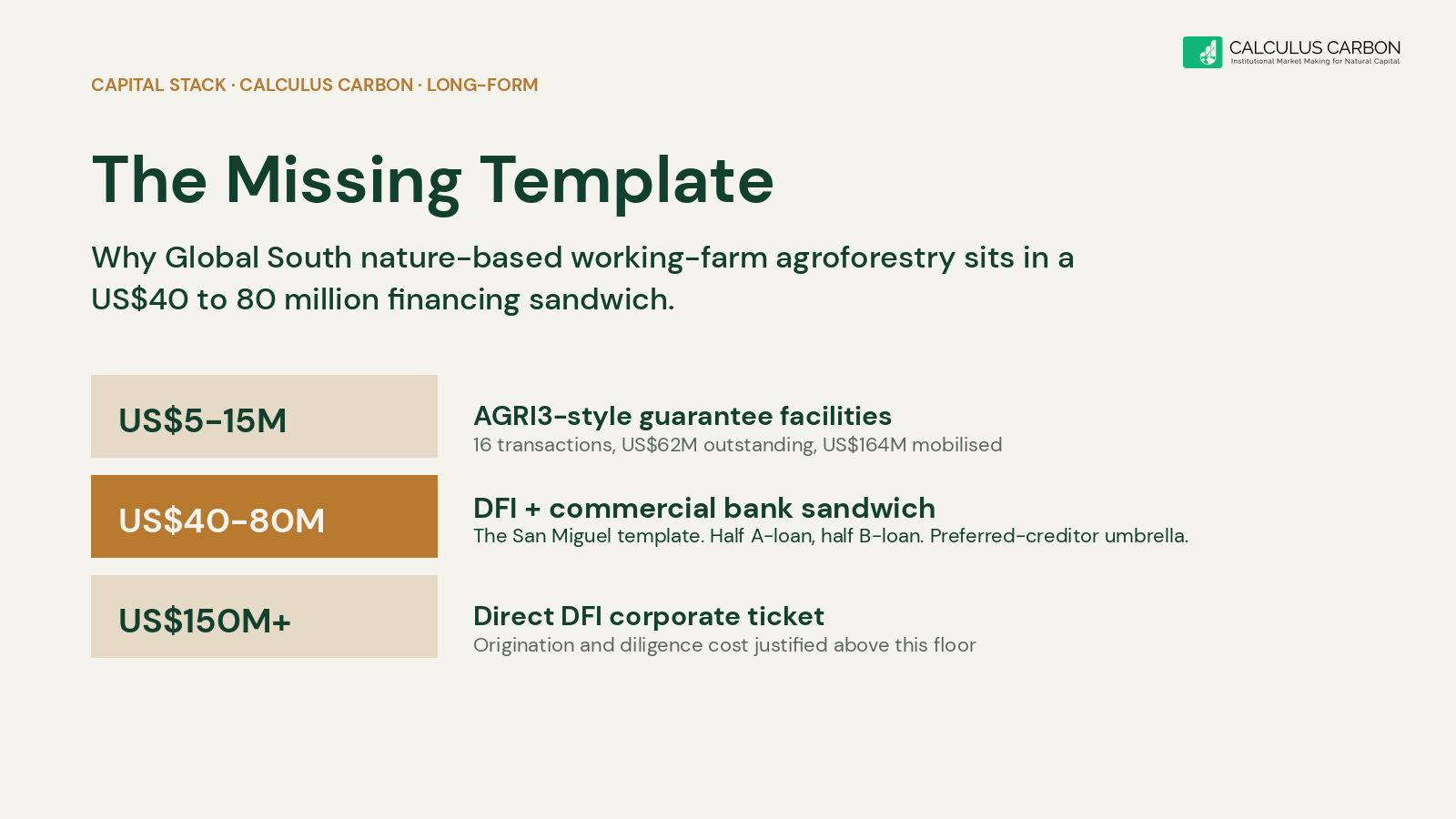
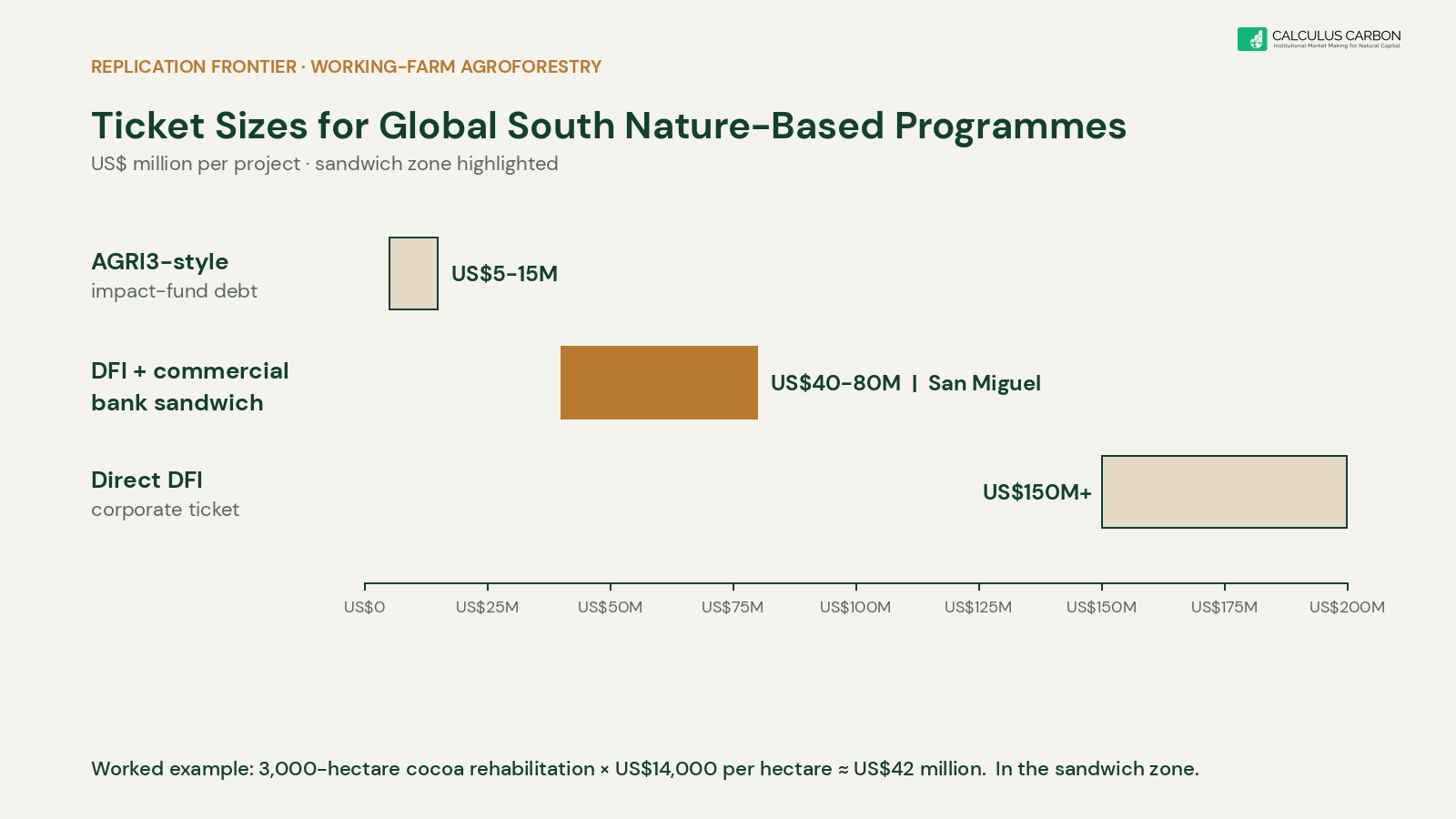
The first source is impact-fund debt or blended-finance vehicles. The AGRI3 Fund is the reference case. AGRI3 is a partial-risk guarantee facility with the Dutch Government as anchor investor. Its target ticket range is US$5 to 15 million per project.4,5 As of 2024 it held a portfolio of sixteen transactions with US$62 million in outstanding guarantees, mobilising roughly US$164 million in commercial-bank financing behind those guarantees.6 Deals in this cohort are catalytic and important. They are also small relative to what a working-farm nature-based programme needs when it graduates past pilot phase. AGRI3's average ticket at first close was around US$3.6 million and the fund has needed the guarantee wrap to catalyse commercial capital that would otherwise not write into agroforestry at all.7 The AGRI3 zone is the on-ramp. It is not the mainline.
The second source is direct development-finance-institution lending. The IFC's own agribusiness ticket often carries a floor near US$50 million on the A-loan alone, and the origination and diligence cost sits above US$150 million on a total-facility basis for many DFI corporate transactions.8 The reason is simple. A multilateral or a national DFI has to run its full risk and E and S diligence, its board-approval process, and its post-close monitoring for the life of the loan. The fixed cost of running that machinery does not scale down to a US$40 million total ticket. So the DFI's direct commodity-agriculture and agribusiness portfolio tends to sit above the US$150 million zone and rarely below the US$100 million zone on a total-facility basis.
Between US$15 million and roughly US$100 million there is a gap. That gap is where most Global South working-farm nature-based programmes with a real offtake buyer and a real replication trajectory actually live. A 2,000-hectare cocoa rehabilitation programme in Cote d'Ivoire. A 3,000-hectare coffee agroforestry landscape in Colombia. A 1,500-hectare cashew value-chain restoration in Ghana. A 4,000-hectare macadamia and native-tree intercrop in Kenya. Each of these programmes needs somewhere between US$40 million and US$80 million to reach the scale where the offtake buyer is willing to sign a multi-year contract. Below US$40 million the offtake buyer treats the project as a pilot and hedges accordingly. Above US$80 million the origination and diligence complexity accelerates. The sweet spot is narrow.
The Cocoa Rehabilitation Worked Example
Consider the cocoa rehabilitation case in West Africa. The Winrock and Partnerships for Impact and Environmental Restoration report on smallholder cocoa rehabilitation in Ghana pegs the financing requirement at roughly US$14,000 per hectare over the first four years, covering planting material, capacity-building, agronomic support, and the shade-tree overstorey that carries the biodiversity and carbon claim.9 A 3,000-hectare cocoa rehabilitation programme therefore sits at approximately US$42 million. That number is right in the middle of the US$40 to 80 million zone. It is too large for AGRI3-style guarantees to underwrite comfortably on their own. It is too small for a direct DFI ticket. It requires the sandwich.
Now overlay the San Miguel structure on that number. An IFC A-loan of US$10.5 million. An IDB Invest or comparable DFI A-loan of US$10.5 million. A commercial bank B-loan of US$21 million syndicated by the IFC, held by a Rabobank equivalent that already writes cocoa trade finance across West Africa. That gives the developer a US$42 million eight-year facility with a two-year grace period, preferred-creditor treatment on the A-portion, and a commercial-bank participant whose relationship-banking calendar matches the delivery calendar of the cocoa cooperative. The offtake premium routes into the debt-service coverage. The carbon or biodiversity revenue routes into a reserve account or a mezzanine layer. The developer's cash flow at issuance is not loaded with the full working-capital burden because the tenor absorbs the delivery lag.
The math holds because the sandwich, not the ingredients, is the innovation. Every one of the ingredients was already available. The missing piece was a published template showing the ingredients can be assembled around a commodity-adjacent Global South borrower with a working-farm profile, a large-corporate anchor, and a multi-year investment programme.
Three Shifts Under This Transaction
Three shifts sit under this transaction that have not sat under previous DFI-plus-commercial-bank agribusiness deals of similar size.
- The commercial bank writing the second half is a commodity specialist. Rabobank is not a generalist commercial bank underwriting a commodity risk it does not understand. It is one of the deepest agri and food-and-agri lenders in the world, with a global commodity trade-finance book that already sees the physical movement of citrus, cocoa, coffee, sugar, and pulses through its own relationships. The B-loan structure lets Rabobank participate in longer-dated capital-expenditure debt on preferred-creditor terms without having to write the sovereign risk directly on its own book.
- The borrower structure is a working-farm processor with a multi-country footprint. San Miguel's structure runs through Argentina, Uruguay, and a South African subsidiary guarantor.10 That mirrors how a cocoa or coffee working-farm programme typically sits, with the borrowing vehicle in one jurisdiction, the primary production in another, and the offtake counter-party or trading arm in a third.
- The transaction is not badged as a carbon or biodiversity transaction. It is badged as an industrial-transition investment programme. That framing is important. The nature-based revenue does not need to be the sole thesis of the debt facility. It can sit alongside the commodity revenue, as a second income stream on the same field, and the debt is underwritten primarily on the commodity cash flow with the nature-based revenue treated as upside. That framing is more bankable, because the commercial B-loan participant is not being asked to take the carbon-price risk. The developer is.
The Read for Institutional Capital
For allocators, DFI staff, and commercial-bank agri-desks watching this space, three implications land from the San Miguel transaction.
The first is that the US$40 to 80 million zone is now underwritten by a published template with a real commercial-bank participant. The template is public. The structure is documented in filings and legal advisories. Any DFI-plus-commercial-bank pair that wants to write into this zone can now point to San Miguel as the reference deal.
The second is that the commercial bank writing into the sandwich needs to be a commodity specialist, not a generalist. That narrows the counter-party universe to roughly six to ten banks globally with the underwriting capacity, the sovereign-risk appetite, and the relationship-banking depth to sit in the B-loan seat. Rabobank in agri. Standard Chartered in Africa and Asia trade. Societe Generale in West African commodity finance. BNP Paribas in Latin America. ING and DBS in select geographies. That is the shortlist.
The third is that the working-farm nature-based programmes that fit this template need to look and behave like operating agribusiness borrowers, not like grant-funded pilots. That means the borrowing vehicle is a corporate. The offtake is a signed multi-year contract with a global buyer. The E and S framework meets multilateral standards from day one. The debt is serviced primarily by commodity revenue with the carbon or biodiversity credit as an upside layer. Programmes that carry a grant-funded operating model or a project-vehicle structure without a corporate borrower will not fit this template. Programmes that carry a corporate borrower and a bankable offtake will.
The template is not new. The commercial bank now writing the second half of the ticket is what is new. That is the shift worth pricing into the next five years of Global South nature-based deal flow.
This piece extends the LinkedIn post scheduled 27 July 2026. Analysis by Neelesh Agrawal.
Sources
- [1] IFC press release, World Bank Group's IFC, IDB Invest, and Rabobank support San Miguel's transition, 23 July 2026. ifc.org
- [2] IFC B-Loans overview, syndicated loans and mobilisation. ifc.org
- [3] La Nacion, San Miguel refinance structure and tenor coverage, 10 July 2026. lanacion.com.ar
- [4] Green Finance Institute, AGRI3 Fund case study. greenfinanceinstitute.com
- [5] IDH, AGRI3 Fund landscape page. idhsustainabletrade.com
- [6] AGRI3 TA Facility 2024 portfolio review, sixteen transactions and US$62 million in guarantees. aliancasojasustentavel.org
- [7] Netherlands Government, Evaluation of the AGRI3 Fund 2020 to 2022. government.nl
- [8] IFC, Climate Business and agribusiness portfolio ticket-size disclosures. ifc.org
- [9] Winrock and PIER, Financing Smallholder Cocoa Rehabilitation in Ghana, interim report. winrock.org
- [10] Bruchou Funes de Rioja, advisory note on San Miguel refinance structure, 16 July 2026. bruchoufunes.com