The Offtake as Collateral: How the Carbon VC Contraction Is Reshaping Project Finance
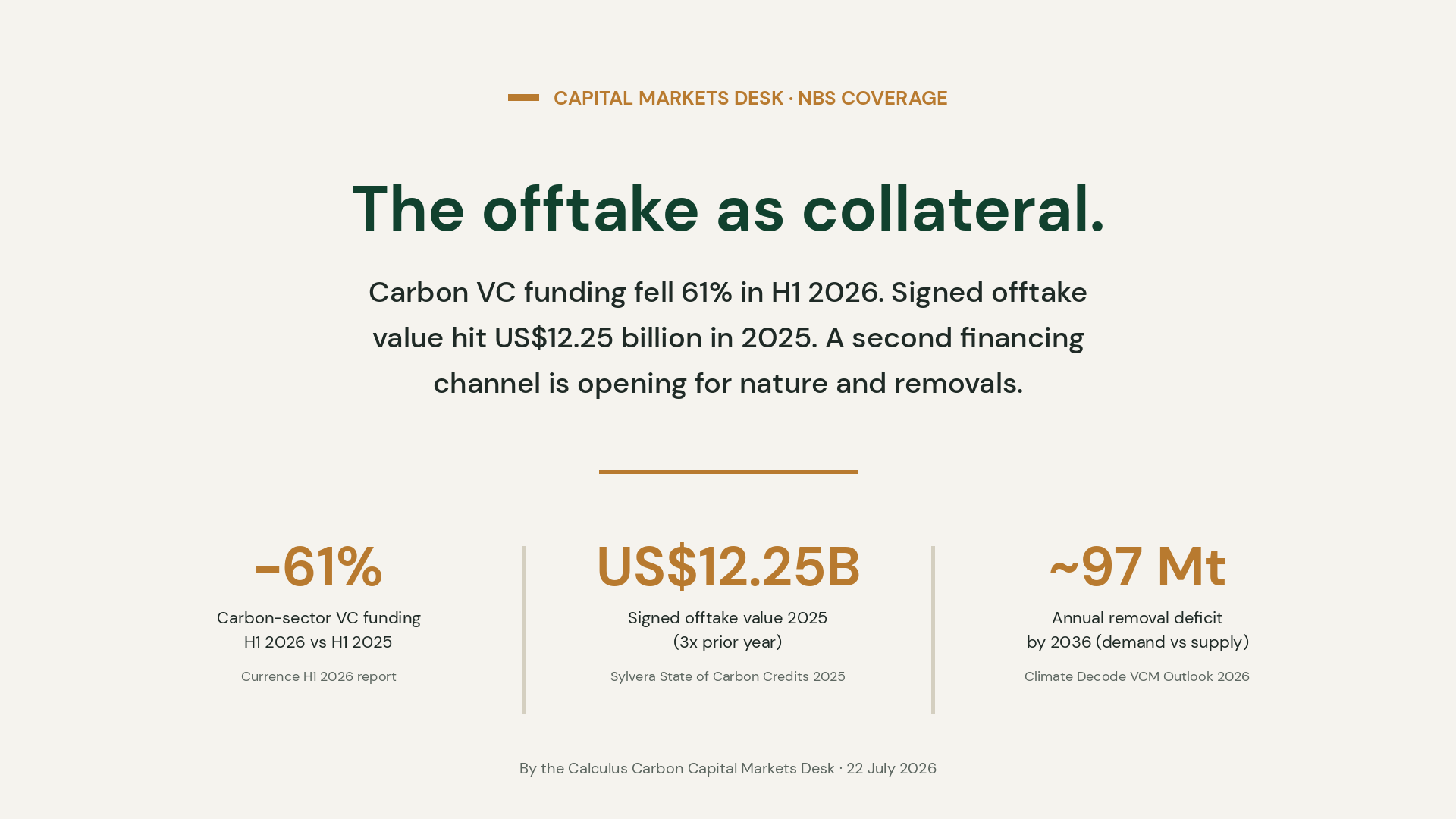
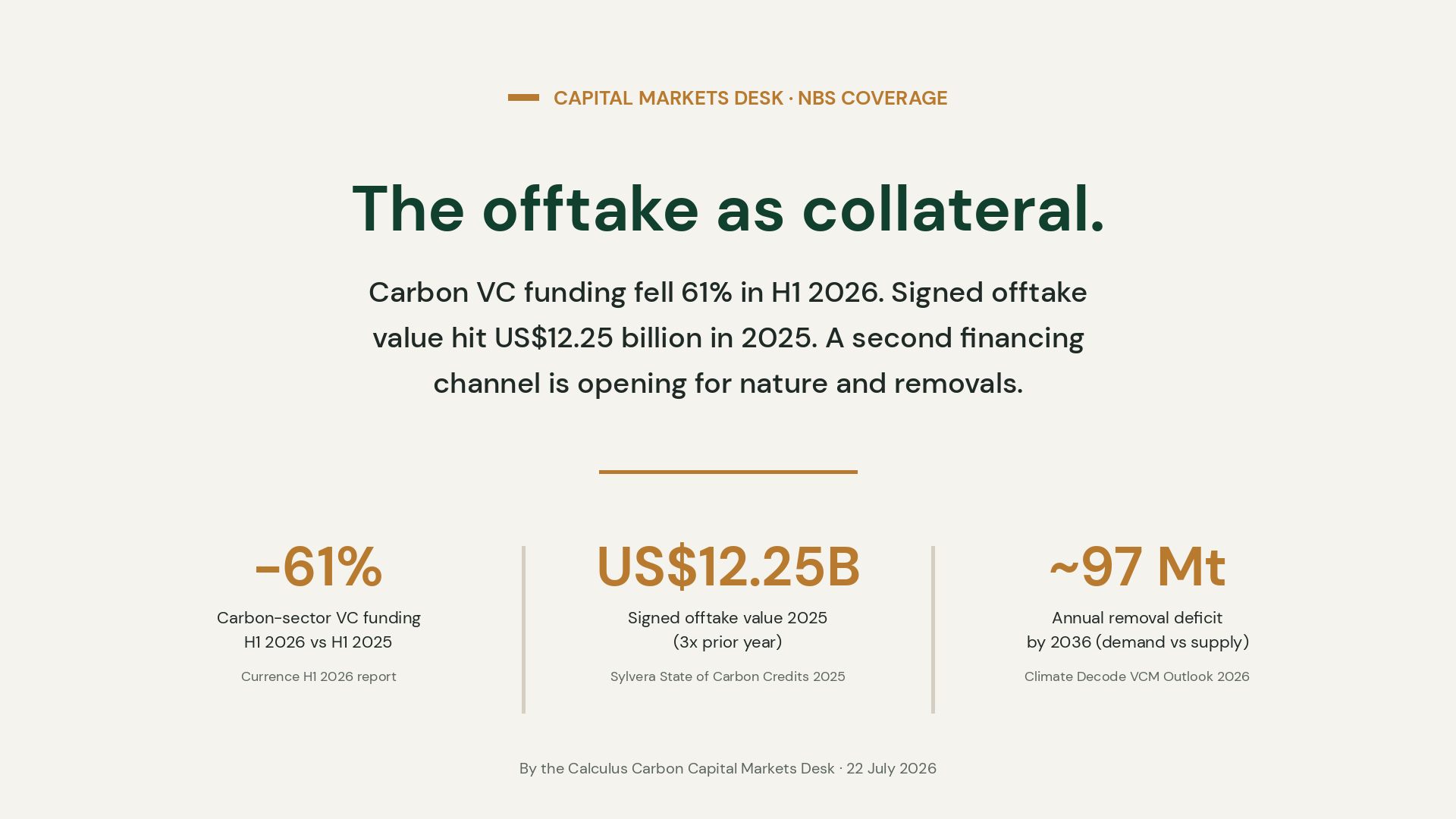
Carbon VC funding fell 61 percent in H1 2026. Signed offtake value hit US$12.25 billion in 2025. Hedge funds, commodity trading firms, and private credit are now underwriting against long-tenor offtake contracts.
Capital Markets Desk · NbS Coverage
The Offtake as Collateral: How the Carbon VC Contraction Is Reshaping Project Finance
Carbon VC funding fell 61 percent in H1 2026. Signed offtake value hit US$12.25 billion in 2025. Hedge funds, commodity trading firms, and private credit are now underwriting against long-tenor offtake contracts.
The Thesis
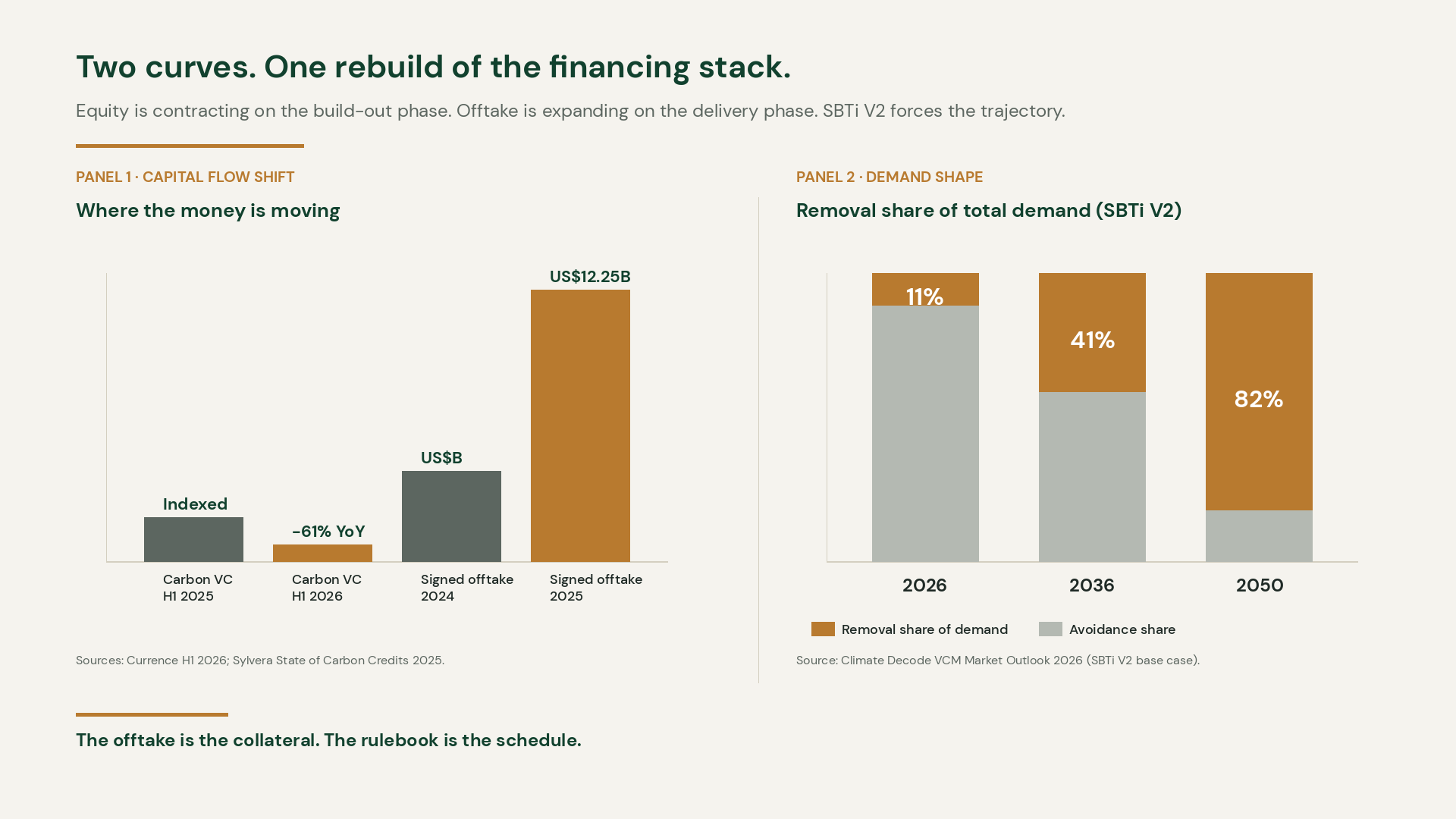
The financing engine behind nature-based and removal-heavy carbon projects is being rebuilt in real time. Carbon-sector venture capital fell 61 percent in the first half of 2026, marking its weakest half since 2020, even as total climate tech VC rose 55 percent year on year to US$26.1 billion.1 In the same window, signed offtake value hit US$12.25 billion in 2025, roughly three times the prior year.2 Hedge funds, commodity trading firms, and private credit are stepping into positions traditionally held by equity investors. The offtake contract is becoming the collateral. This is not a cyclical dip in one financing channel. It is a structural reallocation of who underwrites nature and removals, on what terms, and against what security.
Why Has Carbon Equity Capital Pulled Back?
The Currence H1 2026 Climate Tech Investment Report shows the shift in stark terms. Total climate tech VC surged 55 percent year on year to US$26.1 billion, the strongest first half since 2022. But the growth was concentrated. Low-carbon data centres alone made up 34 percent of the half's investment, with just two deals (DayOne at US$4.5 billion and NScale at US$2 billion) accounting for roughly a quarter of the total. Deal count fell 25 percent. The ten largest rounds captured 42 percent of all funding.1
Carbon-sector equity funding was the clearest casualty of that concentration. Down 61 percent to its weakest half since 2020. Low-carbon fuels were down 56 percent as US subsidies sunset and European buyers wait for 2027 policy reviews. What remains of climate VC is chasing AI-driven power infrastructure, firm generation, and grid capacity. Integrity questions on carbon projects, which have dominated market discourse since 2023, have not helped the equity thesis either.1
The upstream story is broader. Sightline data (now Currence) shows that climate-tech venture and growth capital compressed to under 8 percent of total climate capital in 2025. The average climate VC fund shrank from US$174 million to US$160 million. VC close rates fell to 39 percent, the lowest of any climate fund type. Pre-seed and seed activity hit a five-year low. The equity channel that historically bridged carbon projects from registration to first issuance is no longer priced to absorb multi-year build-out risk.1
What Is Filling the Gap?
The Sylvera State of Carbon Credits 2025 report captures the offtake side of the shift. Signed offtake value in 2025 reached US$12.25 billion, delivering roughly US$2 billion in annual revenue from less than 10 percent of current retirement volumes. Sylvera estimates that if this pricing extends across the broader market, it implies a threefold growth in market value.2
This is not a marginal increase in forward procurement. It is a change in what the offtake is functionally doing in the capital stack. A long-tenor, high-integrity offtake with a credible counterparty is now underwrite-able as collateral in a way that a three-year buyer commitment never was.
The Symbiosis Coalition transactions are the clearest example. In March 2026, Living Carbon signed offtake agreements with Symbiosis members Google, McKinsey, and Meta covering 131,240 tonnes of CO2 removal over ten years.5 Symbiosis Coalition minimum contract terms are ten years. That tenor changes the arithmetic. A ten-year contract with three tier-one hyperscaler counterparties, priced above US$35 per tonne on high-rated ARR credits, becomes an instrument a lender can size a facility against.
J.P. Morgan demonstrated the mechanic in August 2025 when it arranged a US$210 million credit facility for Chestnut Carbon, structured directly against forward offtake contracts.7 That transaction was not a one-off. It was a template. Once one tier-one bank has priced offtake-collateralised debt at scale, the underwriting frameworks propagate across the desks that follow.
Who Is Showing Up to Underwrite These Deals?
The buyer and lender universe expanding into this space is materially different from the equity investors it is replacing. Three categories are visible in current transactions.
Hedge funds and specialist carbon funds are taking positions in the forward curve, using long-tenor offtake contracts as the underlying exposure. Their return profile matches the credit-margin economics of an offtake spread better than the terminal-value bets equity investors make.
Commodity trading firms (Trafigura, Vitol, and their peers, along with agricultural trading houses on the commodity-linked NbS side) are underwriting against physical delivery of credits. This is the same muscle they use in oil, gas, and grain markets, translated to the carbon vintage curve. The credit is the deliverable. The offtake is the forward.
Private credit funds are structuring facilities against pools of offtake receivables. The structure resembles project-finance debt in renewables, with the offtake carrying the credit rating rather than a power purchase agreement. Tenor, counterparty concentration, delivery risk, and integrity risk on the underlying credits are the diligence axes.
Each of these categories is priced differently, but the common feature is that none of them are equity. They are all underwriting against contract, not against terminal enterprise value. The cost of capital for developers with strong offtake books collapses accordingly.
What Is the SBTi Rulebook Doing to Future Demand?
The Climate Decode VCM Market Outlook 2026 provides the demand-side anchor that makes the offtake collateral thesis structural rather than cyclical. On the SBTi V2 rulebook, base-case demand for carbon credits reaches roughly 290 Mt by 2036, and roughly 1,190 Mt by 2050. Within that total, removals climb from approximately 11 percent of demand today to approximately 41 percent by 2036 and approximately 82 percent by 2050.3
That trajectory is the load-bearing beam. It is not a market forecast. It is a schedule imposed by the corporate net-zero standard that the largest corporate buyers use to structure their claims. If a buyer signs a science-based target under SBTi V2, the removal share of their offset portfolio must rise on that curve. Removal demand is not optional; it is mechanically required by the rulebook they have committed to.
Against that demand, Climate Decode puts current removal supply at roughly 23 Mt per year, against approximately 120 Mt of demand, a roughly 97 Mt annual deficit with no inventory buffer behind it. Nature removal alone (the largest near-term category) shows supply of approximately 12 Mt per year meeting demand climbing toward approximately 72 Mt by 2036. Durable engineered removal is tighter still. Approximately 2 Mt exists all-time against durable demand of approximately 48 Mt by 2036.3
A supply-demand gap of that magnitude is not a market that clears on spot pricing. It is a market that clears on forward commitment. Buyers who need removal credits in 2032 cannot wait for 2032 to procure them. The credits do not exist yet. They have to be underwritten now, into projects that will deliver over the next seven-to-ten years. That is the demand signal creating the offtake pipeline.
Which Developers Get Access to the New Channel?
Not all developers benefit equally from this shift. The offtake-as-collateral channel opens for a specific subset. Three criteria matter.
First, contract tenor. Offtakes below five years generally cannot support debt structures. The Symbiosis floor at ten years is the workable minimum for most private credit and bank structures. Hedge fund and commodity-trading-firm structures can price shorter tenors, but at wider spreads.6
Second, counterparty quality. A pool of offtake contracts anchored by tier-one hyperscalers, investment-grade corporates, or CORSIA-facing airlines carries a materially different credit profile from a pool anchored by voluntary buyers of unrated quality. Lenders will size facilities off the weighted-average counterparty rating.
Third, credit-quality rating on the underlying instruments. Sylvera notes that high-rated (BB+ and above) credits grew from 44 percent to 50 percent of retirements and from 61 percent to 70 percent of total spend in 2025. BBB+ credits experienced their third consecutive year of deficit. Lenders will not size against a book of offtakes if the underlying credits do not clear a quality threshold. High-rated ARR projects trade above US$35 per tonne; lower-rated equivalents trade below US$20. That price split is now the boundary between offtake-financeable and equity-only.2
Projects that clear all three criteria (long tenor, credible counterparty, high-rated credits) now have a second financing channel available at materially lower cost of capital. Projects that do not clear the criteria still need equity. That subset will feel the VC contraction acutely.
The Read for Institutional Capital
The carbon finance channel is not shrinking. It is bifurcating. Equity capital is contracting on the high-risk build-out phase because the return profile no longer matches what climate VC funds are set up to price. Debt and structured capital are expanding on the delivery phase because a subset of the market now looks like project finance in every material respect: long-dated contracts, credible counterparties, quality-rated deliverables, and a demand curve mechanically anchored by SBTi V2.
For allocators, the operational implication is that exposure to the removals build-out no longer requires a venture-style equity position. It can be taken through offtake-backed private credit, through hedge fund exposure to the forward carbon curve, or through commodity trading firm-structured products. Each carries a different risk profile from the one an equity investor would price, and each is now available at scale.
For developers, the implication is sharper still. A project without a long-tenor, high-quality offtake book is priced against a shrinking pool of climate VC capital. A project with an offtake book that clears the three criteria has access to a materially cheaper channel of capital that did not exist for this asset class two years ago.
The offtake is the collateral. That was true in project finance long before it became true in carbon. What is new is that the carbon market has enough tenor, quality, and counterparty depth for the same underwriting framework to work.
The offtake is the collateral. The channel is open. The bar to enter it is high.
This piece extends the Calculus Carbon LinkedIn short-form scheduled for 22 July 2026. Analysis by the Capital Markets Desk.
Sources
- [1] Currence, H1 2026 Climate Tech Investment Report (CTVC). ctvc.co
- [2] Sylvera, State of Carbon Credits 2025. sylvera.com
- [3] Climate Decode, VCM Market Outlook 2026. climate-decode.com
- [4] AlliedOffsets, 2025 VCM Overview Report. alliedoffsets.com
- [5] Living Carbon, Symbiosis Coalition Offtake Announcement (March 2026). livingcarbon.com
- [6] Symbiosis Coalition and CrossBoundary, Carbon Offtake Guide. symbiosiscoalition.org
- [7] J.P. Morgan, US$210 Million Credit Facility for Chestnut Carbon (August 2025). jpmorgan.com
- [8] ESG Today, Currence H1 2026 Report Coverage. esgtoday.com