Contracted Durability: Who Pays for Carbon That Sits Decades Past Loan Tenor?
Contracted durability names the tail-liability gap sitting decades beyond loan tenor. Who pays, and when, determines whether project finance for carbon deepens or stalls.
Carbon Markets · Project Finance · 28 July 2026
Contracted Durability: Who Pays for Carbon That Sits Decades Past Loan Tenor?
Contracted durability names the tail-liability gap sitting decades beyond loan tenor. Who pays, and when, determines whether project finance for carbon deepens or stalls.
The Design Question Behind Contracted Durability
The commercial project-finance market is starting to underwrite carbon projects against offtake agreements. The Nature Bond that Ecobank Transnational structured in late 2025, the biodiversity-linked working capital that Rabobank has begun writing against cocoa cooperatives, the biochar tolling deal that a European utility priced against a ten-year offtake. All of these depend on a single unresolved design question. The question is contractual liability for the carbon after the crediting period ends. The industry now has a name for that question. It is called contracted durability.1,2
Two frameworks published in June 2026, one from RMI, the American Forest Foundation, and the Beyond Alliance, and one from Yale and The Nature Conservancy through the nature4climate consortium, both propose the same underlying answer. The tail liability needs to sit somewhere, and it needs to be priced, and the pricing decision determines whether the underwriting momentum of the last eighteen months continues or stalls.1,2
A carbon credit issued today, whether from an afforestation programme, a soil-carbon initiative, or a biochar plant, carries a claim about how long the carbon it represents will stay out of the atmosphere. Registries handle the near-term reversal risk with a buffer pool. Every credit issued sets aside a portion of tonnes into a shared pool, and if a project experiences a fire, a pest outbreak, or a hurricane during its crediting period, the buffer pool cancels tonnes to make the buyer whole.3,4 The mechanism has worked reasonably well for the crediting period itself, which is typically twenty to forty years depending on the methodology and the project type.
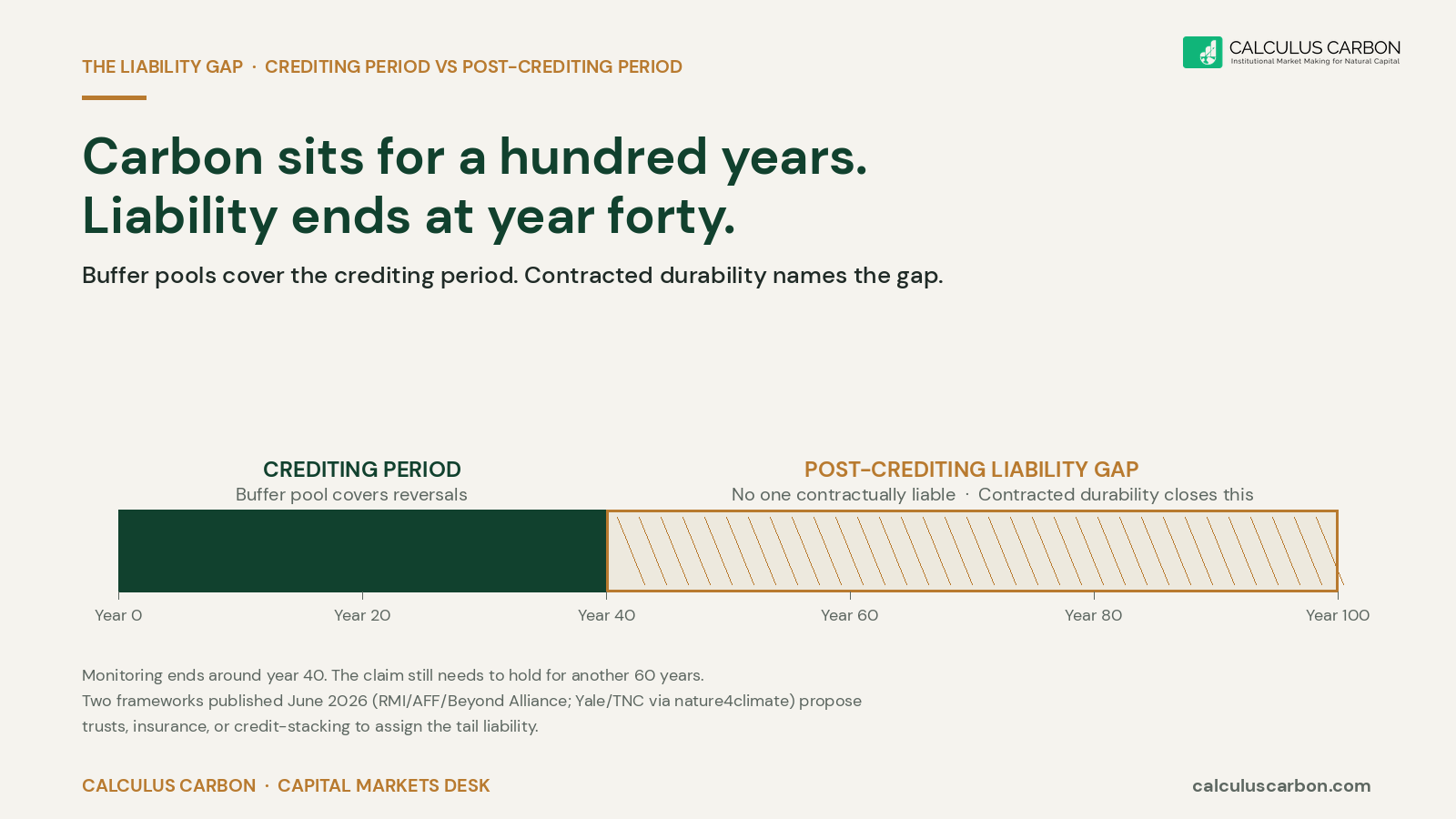
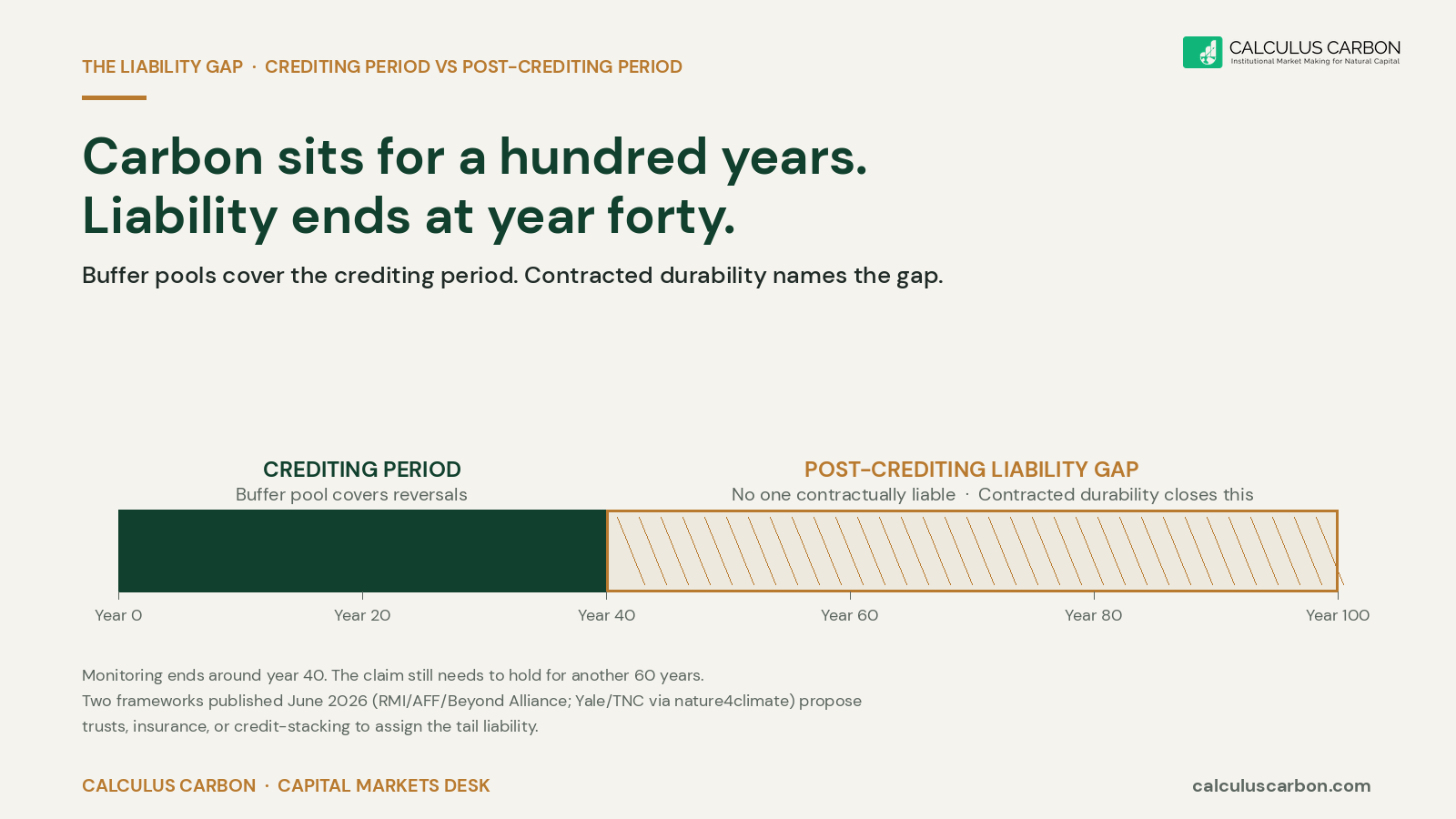
The problem sits after the crediting period ends. Monitoring stops, the registry closes the file, and the buffer pool no longer covers reversals for that project. Yet the carbon claim, and the corporate net-zero claim that depends on it, is meant to hold for a hundred years or longer. During those decades between year forty and year one hundred, no one is contractually liable for what happens to the tonnes. If a working farm switches ownership, a fire clears an old forestry block, or a soil-carbon programme loses its practice-adoption momentum, the buyer's claim has already been priced into a corporate report and there is no one to make the reversal good.
Contracted durability names that gap. It proposes three routes to close it. Trusts, structured to hold reserve funding for tail liability decades past the crediting period. Insurance, priced by specialist reinsurers or mutualised across a portfolio of projects. Credit-stacking, where the durability layer is a separate credit sold alongside the underlying carbon credit, with its own tenor and its own pricing.1
Registry and Standards-Body Movement
Registries are already moving. Verra is piloting insurance as a buffer-pool alternative for select methodologies.4 The Integrity Council for the Voluntary Carbon Market has a working group on durability and permanence, and the Core Carbon Principles framework is being extended to name post-crediting-period liability as an integrity criterion.5 The Paris Agreement Crediting Mechanism, the compliance-market successor to the Clean Development Mechanism, is building durability tooling into the Article 6.4 design at the UNFCCC level.6 On the buyer side, the Science Based Targets initiative published Version 2 of its Corporate Net-Zero Standard in 2026, and the standard now differentiates between long-lived and short-lived removals.7 A concentrated buyer coalition, led by Frontier Climate on the engineered-removal side and the Symbiosis Coalition on the nature-based side, is writing multi-year offtake contracts that are starting to name durability terms explicitly.8,9
The direction of travel is clear. The unresolved question is who pays for it.
The Three Routes and What Each One Costs
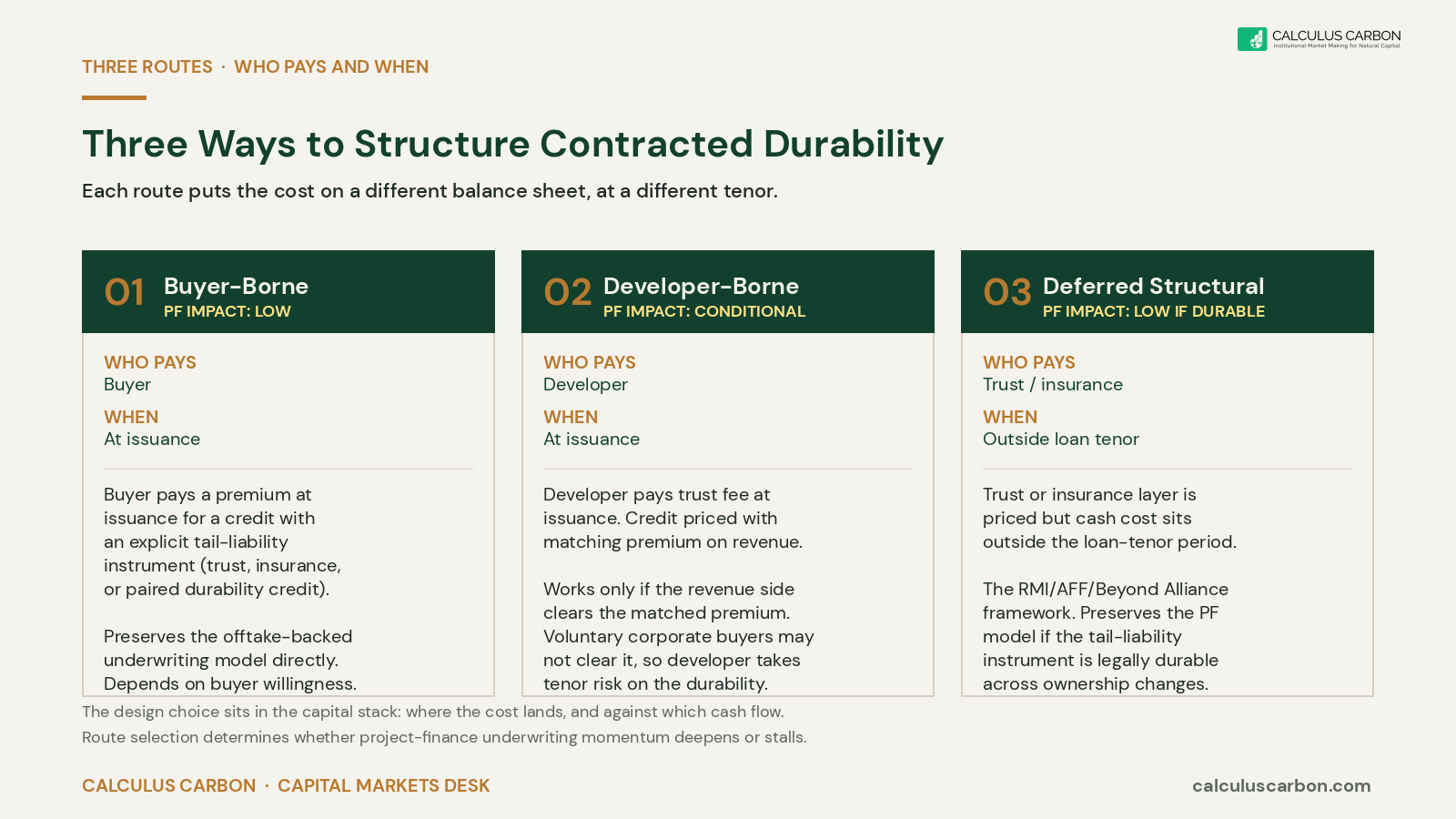
The first route is buyer-borne. The buyer pays a premium at issuance for a credit that carries an explicit long-tail liability instrument, whether that is a trust, an insurance wrapper, or a paired durability credit. The premium flows directly to the durability instrument. The developer's cost of capital and cash flow at issuance are not affected. This route is the cleanest from a project-finance perspective. It preserves the offtake-backed underwriting model that lenders have started to accept. It also depends on buyers being willing to pay the premium, and that willingness is still an open question. Concentrated, sophisticated buyers such as those in Frontier and Symbiosis are more likely to pay.8,9 Compliance buyers under Article 6 authorisation may accept the premium if the regulator prices it in. Voluntary corporate buyers with tight net-zero budgets may not.
The second route is developer-borne with matching revenue. The developer pays the trust fee or insurance premium at issuance, but the credit itself is priced to carry a matching premium so that the incremental revenue on the credit covers the incremental cost of the durability instrument. This route works only if the revenue side actually clears the premium. The concern is that the premium is priced in cost terms decades before the credit clears in revenue terms, so the developer takes tenor risk on the durability itself. If buyers do not pay the matched premium, the developer is left carrying the durability cost against a credit that clears at the market-average price.
The third route is deferred structural. The trust fund, the insurance premium, or the credit-stack layer is priced and structured in but the cash cost sits outside the loan-tenor period. This is the route that RMI, the American Forest Foundation, and the Beyond Alliance propose most explicitly in their June 2026 framework.1 It preserves the developer's cash flow inside the loan tenor. It preserves the project-finance underwriting model. It puts the liability on a separate balance sheet that carries the tail exposure through a mechanism that is legally durable across ownership changes and jurisdictional shifts. It is the most complex to structure. It is also the one that maps cleanest to how commercial banks are willing to underwrite.
The Project-Finance Underwriting Implication
Project finance has spent the last eighteen months learning to trust offtake-backed carbon underwriting. Commercial banks now sit alongside development finance institutions on eight-year to ten-year facilities for working-farm agroforestry programmes, biochar plants, and improved forest management projects. The offtake is a multi-year signed contract with a global buyer. The credit is the primary or a secondary revenue stream. The debt-service coverage runs off the commodity or the biochar tolling fee, with the carbon credit sitting on top as an upside layer or, in some structures, as a matching layer.
A trust fee or insurance premium charged to the developer at issuance is a cash cost during the loan tenor. It is a direct hit to debt-service coverage. The liability it addresses sits decades past the loan repayment date. That mismatch is exactly the tenor problem that project finance was designed to solve, and yet the contracted-durability instrument, if structured badly, reintroduces the mismatch in a new form. A developer that has just cleared a commercial-bank facility for a US$50 million agroforestry programme cannot absorb a US$5 million trust-fee cost at issuance without eroding the coverage ratios that the lender underwrote against. If the credit does not carry a matching premium on the revenue side, the developer takes a direct hit to the cash flow that services the loan.
The design question is therefore not whether contracted durability is the right instrument, but where in the capital stack the cost sits, and against which cash flow it is priced. Route one, buyer-borne, protects the project-finance model directly. Route two, developer-borne with matching revenue, protects it conditionally. Route three, deferred structural, protects it if the trust or the insurance layer is legally durable across the ownership horizon that the tail liability spans.
The Buyer Side and the Willingness-to-Pay Question
The question of whether buyers will pay is not evenly distributed across the buyer universe. Sophisticated concentrated buyers, the Frontier and Symbiosis cohort, care most because their reputational exposure to a claim that does not hold up under scrutiny is highest. They are also the buyers whose contracts have started to price durability explicitly. A multi-year Frontier contract for a biochar programme now carries durability terms in the term sheet. A Symbiosis contract for a working-farm agroforestry programme now names post-crediting-period liability as a schedule item.8,9
Compliance buyers under Article 6 authorisation are on a different path. The willingness to pay depends on the host-country regulator and the corresponding-adjustment framework. If the regulator prices a durability premium into the authorisation, the buyer pays. If the regulator does not, the buyer is likely to route the durability question into a discount on the credit price rather than a paid premium.6
Voluntary corporate buyers with tight net-zero budgets sit in the least willing position. Their exposure to a durability failure is lower because their claim is one of many corporate net-zero claims, and their willingness to pay a matching premium at issuance is capped by internal carbon-budget frameworks that do not yet price durability separately from underlying tonnes. This buyer segment is the one that, if left uncorrected, will drive the market toward developer-borne durability by default, because the demand-side premium will not clear.
Frontier, Symbiosis, and SBTi: What Each Actually Does
Frontier is a technology-agnostic advance market commitment that has crossed US$1.8 billion in contracted purchases across engineered and nature-based removals.8 Symbiosis is a nature-based-only buyer coalition led by four US technology companies with a stated ambition to purchase twenty million tonnes of nature-based removals by 2030.9 SBTi Version 2 is a framework the buyer applies to its own claim, not to the credit itself.7 The three, layered together, define the front of the durability-willingness curve. Buyers in that cohort will pay. Buyers outside it, in the middle of the corporate voluntary market, likely will not without a regulatory nudge or a paired-credit product that lets them pay for durability separately from underlying carbon.
The Read for Institutional Capital
For lenders underwriting project-finance facilities against carbon offtake, and for allocators positioning across the deal flow, three implications land from the contracted-durability design conversation.
The first is that the design decision is a project-finance decision, not only a registry-design decision. The location of the cost in the capital stack, and the cash flow it is priced against, determines whether the underwriting momentum of the last eighteen months continues. Registries and standards bodies are moving. Lenders need to move with them, or the debt-service coverage assumptions that underwrote the last cohort of facilities will not hold on the next cohort.
The second is that the buyer-borne route is the one that preserves the offtake-backed underwriting model most cleanly. A buyer premium routed to the durability instrument at issuance does not touch the debt-service coverage. The deferred-structural route preserves the model if the tail-liability instrument is legally durable. The developer-borne route puts the underwriting at risk unless the credit clears a matching premium on the revenue side, and the current premium signal from voluntary corporate buyers is not yet at that level.
The third is that the buyer coalitions are where the design conversation now needs to concentrate. Frontier, Symbiosis, and the sophisticated compliance buyers under Article 6 authorisation are the counterparties whose willingness to pay defines the price signal for the rest of the market. A project developer targeting the working-farm agroforestry space, the biochar market, or the improved forest management pool needs to underwrite its offtake against those buyer segments if the durability premium is going to clear. The contracts that do not price durability explicitly today will be repriced within the next two crediting-review cycles. The lenders that anchor their underwriting to the Frontier and Symbiosis contracting conventions will find that their facilities continue to close. The lenders that anchor their underwriting to a generic voluntary market average price will find that the coverage ratios erode as the durability premium arrives on the developer side.
Contracted durability is not a threat to project-finance underwriting of carbon. It is a design conversation whose outcome determines whether the underwriting deepens or stalls.
This piece pairs with the Calculus Carbon LinkedIn short-form scheduled 28 July 2026. Analysis by the Calculus Carbon Capital Markets Desk.
Sources
- [1] RMI, American Forest Foundation, and the Beyond Alliance, Contracted Durability: A Framework for Performance-Based Carbon Removal, June 2026. rmi.org
- [2] Yale School of the Environment and The Nature Conservancy, via nature4climate, The need for common language and synthesis in reversal-risk compensation and mitigation approaches, June 2026. nature4climate.org
- [3] Trellis, Buyer's guide: managing carbon credit reversal risk, 2025. trellis.net
- [4] Verra, Verified Carbon Standard programme page. verra.org
- [5] Integrity Council for the Voluntary Carbon Market, Core Carbon Principles. icvcm.org
- [6] UNFCCC, Article 6.4 Supervisory Body and Paris Agreement Crediting Mechanism. unfccc.int
- [7] Science Based Targets initiative, Corporate Net-Zero Standard. sciencebasedtargets.org
- [8] Frontier Climate, advance market commitment portfolio. frontierclimate.com
- [9] Symbiosis Coalition, nature-based carbon removal buyer coalition. symbiosiscoalition.org