The Two 50s: How Asset-Level DFC Guarantees and Outcome-Gated Carry Make Indonesian Agri Debt Underwritable
Blended Finance · Project Finance · 3 August 2026
The Two 50s: How Asset-Level DFC Guarantees and Outcome-Gated Carry Make Indonesian Agri Debt Underwritable
ADM Capital’s Asia Climate-smart Landscapes Fund closed last week at USD 48M. The mechanic inside the vehicle is more interesting than the headline. Two structural design choices, each set at fifty per cent, work on opposite sides of the capital stack to make Indonesian smallholder agri debt underwritable at private credit desk speed without abandoning outcome discipline.
The Two 50s
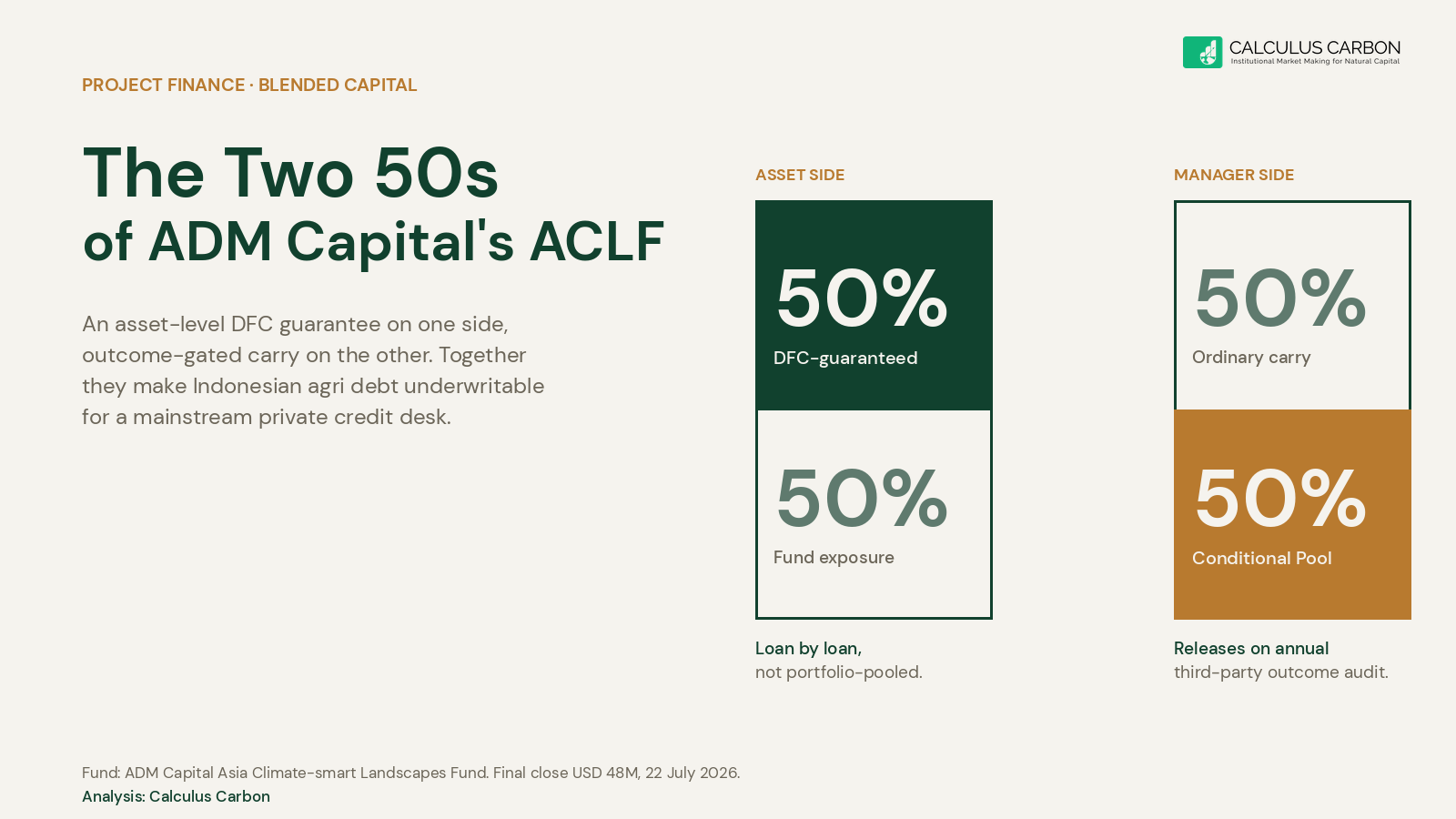
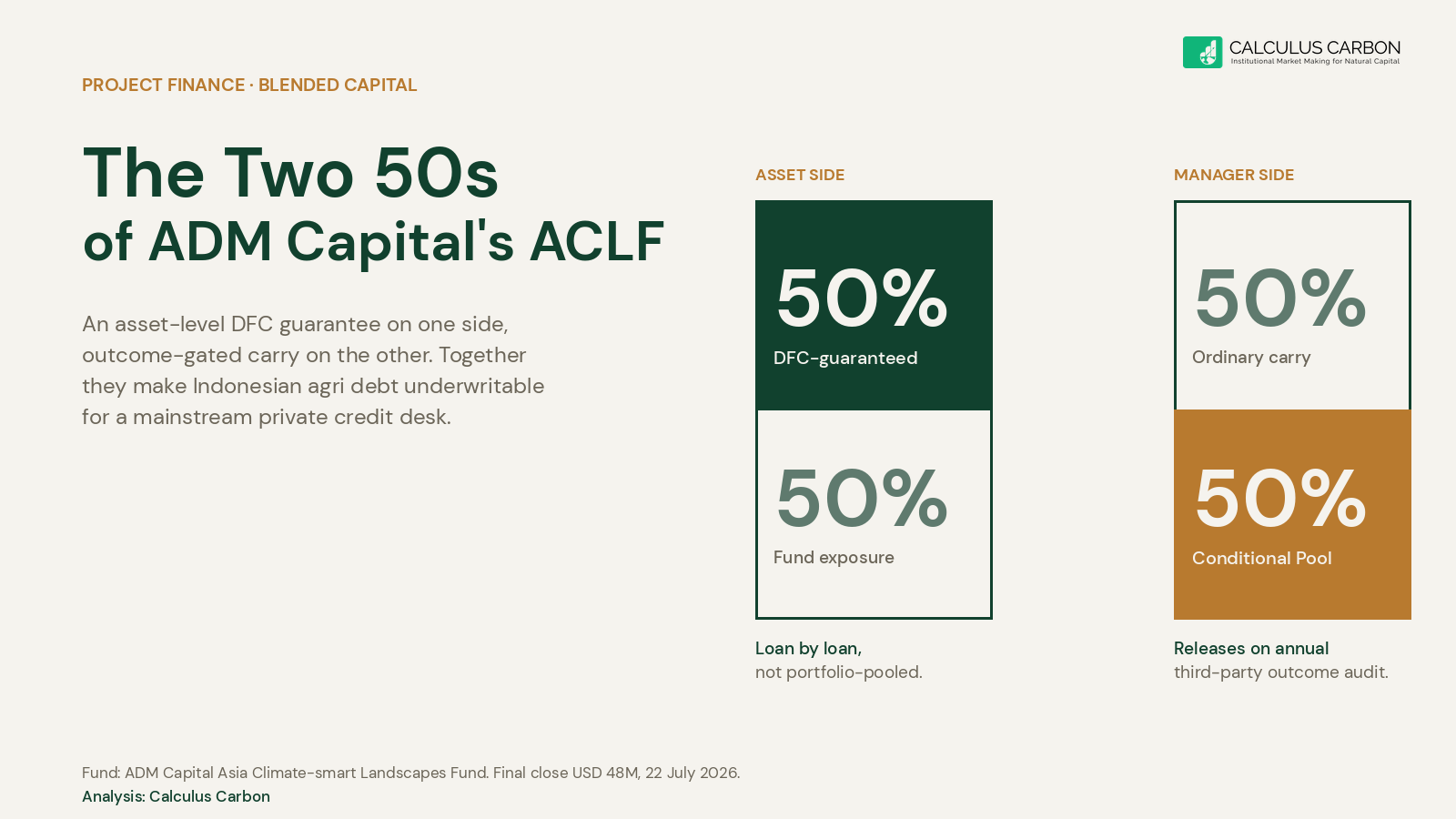
ADM Capital’s Asia Climate-smart Landscapes Fund reached final close last week at USD 48M1, and the mechanic inside the vehicle is more interesting than the headline number. The fund is built around two structural design choices, each pegged at fifty per cent, working on opposite sides of the capital stack. On the asset side, every dollar the fund lends carries a fifty per cent guarantee from the US Development Finance Corporation, applied loan by loan rather than pooled across the portfolio.2 On the manager side, fifty per cent of the general partner’s carried interest sits in a Conditional Carry Pool that only releases when a third-party auditor certifies annual impact outcomes.1,3 Together the two 50s answer a question that has held mainstream private credit desks out of Indonesian smallholder agri debt for a decade. The question is whether a diligence-heavy asset class can be underwritten at private credit desk speed without abandoning the outcome discipline that makes the asset class legitimate.
Why This Design Matters Now
Indonesian farming, agroforestry, and aquaculture businesses sit at the intersection of two large capital markets that rarely touch each other. On one side is the mainstream private credit desk, sitting on a mandate to deploy medium-term senior-secured debt at a target unlevered yield of low-double-digits, with covenant packages that assume audited financials, benchmarked collateral, and standardised credit committee memos. On the other side is the outcome-linked climate capital pool, which prices for additionality, delivery certification, and long-tenor structural change, but which has historically been staffed by impact investment teams rather than credit teams. The two sides do not speak the same language. The private credit desk wants a facility that clears its investment committee in four weeks and prices to a benchmark. The outcome pool wants a diligence process that measures carbon, biodiversity, and livelihoods over multi-year horizons and prices for delivery risk.
The Asia Climate-smart Landscapes Fund is a design experiment in whether the two languages can be reconciled without either side giving up what it needs. The fund lends medium-term senior-secured facilities to Indonesian small and medium-sized enterprises operating in sustainable agri, agroforestry, aquaculture, and forestry.1,3 The borrower shape is the sort a mainstream private credit desk would ordinarily decline in a single meeting, both because the diligence burden is heavy and because the borrower’s cash flows depend on transition activities the credit team cannot benchmark against a comparable set. The fund’s design moves those two objections out of the way.
The Asset-Side 50: Loan-by-Loan Guarantee, Not Portfolio-Level
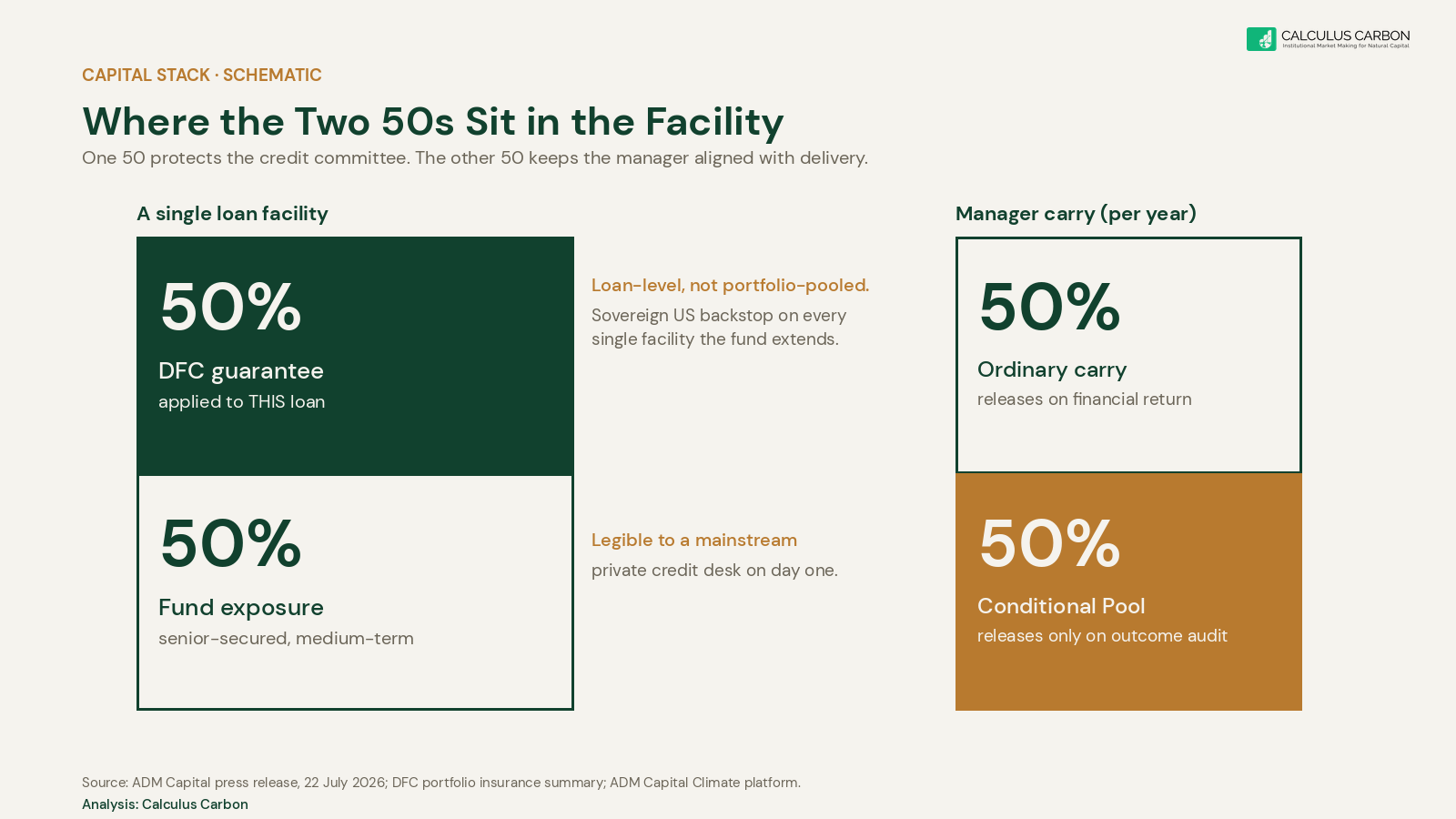
The first 50 sits on the asset side. The US Development Finance Corporation provides a fifty per cent guarantee that applies to each individual loan the fund extends, not to the portfolio in aggregate.2 This distinction is where the design does most of its work. A portfolio-level guarantee is a familiar instrument, and its familiarity is a feature rather than a bug for the fund manager, but it does not solve the problem the borrower or the eventual co-investor cares about. A portfolio-level guarantee makes the fund manager’s downside less painful. It does not change the credit profile of any single loan on any single day.
A loan-by-loan guarantee is different. On the exact facility the borrower draws, the credit committee looking at the facility sees the DFC balance sheet sitting behind fifty per cent of the exposure. If the fund manager wants to syndicate that facility to a mainstream commercial bank or a private credit fund in year two, the syndicate partner sees the same fifty per cent. If a rating agency ever assesses the facility, the collateral behind fifty per cent of the exposure is the sovereign credit of the United States, not a diversified pool of Indonesian smallholder cash flows. The loan-level structure is what makes the facility legible to a private credit desk that has never underwritten an Indonesian aquaculture borrower before.
Contrast this with the more common Global South agri-guarantee model, which the AGRI3 fund pioneered from 2020 onwards. AGRI3 provides partial credit guarantees to commercial banks in Latin America, Africa, and Asia to help them extend loan tenors, grow ticket sizes, and finance transition activities that traditional risk frameworks decline. That model works, and it has proved out across a set of programmes including Renova Pasto in Brazil.4 It sits, however, at a different point in the capital stack. AGRI3 helps a commercial bank lend to a farmer directly. The Asia Climate-smart Landscapes Fund helps a private credit fund lend to a small or medium-sized enterprise that then finances the farmer. Each model unlocks a different pool of capital. The DFC’s loan-level design in ACLF is aimed specifically at the private credit desk, which sits one layer up from the commercial bank in the same capital chain.
The Manager-Side 50: Half the Carry Gated on Delivery
The second 50 sits on the manager side. Standard private credit fund economics carry between fifteen and twenty per cent of profits to the general partner above a hurdle rate that typically sits in the eight to ten per cent range.5 The general partner earns the carry once the fund clears the hurdle. In practice, the carry pays out over time as facilities amortise and the fund realises returns. There is no delivery gate on the carry beyond the financial return itself.
The Asia Climate-smart Landscapes Fund inverts this in a specific way. Fifty per cent of the manager’s carried interest is not paid on financial return alone. It sits in a Conditional Carry Pool that only releases when a third-party auditor certifies the fund’s impact outcomes for that year.1 The certification is annual, not one-off. The general partner’s economics are therefore split down the middle. Half the carry follows the ordinary private credit playbook, releasing as the financial return clears the hurdle. Half the carry follows a separate line, releasing only if the annual outcome audit signs off on the delivery. If the outcome audit fails in a given year, the conditional half of the carry for that year is deferred or forfeited, depending on how the audit trigger is written.
The reason this matters is not moral. It is structural. In a diligence-heavy asset class where the borrower’s economic proposition is bound up with the outcome the fund is trying to deliver, the general partner is the operator closest to the underwriting decision. If the general partner’s incentives point in one direction and the outcome mandate points in another, the drift over a ten-year fund life is significant. Outcome-gated carry is the design move that closes that drift without needing a heavy governance overlay from limited partners.
What the Design Unlocks for Institutional Capital
The read for institutional capital is that the two 50s convert a diligence-heavy asset class into one that a mainstream private credit desk can underwrite without abandoning the outcome discipline. Every dollar of exposure carries a sovereign-backed fifty per cent cushion on the asset side. Every dollar of manager economics carries an outcome-linked fifty per cent cushion on the alignment side. The private credit desk sees a facility with a legible credit profile. The impact-linked limited partner sees a manager whose carry cannot fully release without delivery certification. Neither side has to give up what it needs.
The specific limited partner base already sitting inside the fund is instructive on this point. The Australian Government has invested USD 8M through Sarona Asset Management. Minderoo, the Paul Ramsay Foundation, and the LEEAF Foundation have collectively invested USD 8.65M through ADI Climate Partners.1 These are limited partners who have taken outcome-linked exposure in Global South agriculture before, so their willingness to sign into a private credit fund with a conditional carry pool is a signal about whether the design reads as credible to the outcome-linked pool. The fund’s Jakarta-based team of three, co-managed by ADM Capital’s Lisa Genasci and Ben Falloon, operates the diligence and portfolio management from the country where the borrowers sit.1 The team shape matters because outcome-gated carry only works if the auditor has a real operating trail to audit against, and that trail lives in the country office not the head office.
The Broader Template
The reason to walk through the mechanic in this much detail is that the design is portable. The specific asset side and manager side numbers, both set at fifty per cent, are calibrated to the Indonesian sustainable-agri asset class. Different Global South asset classes will land at different calibrations. The structural principle is the part that travels. On the asset side, apply the guarantee loan by loan rather than portfolio by portfolio, because the loan-level structure is what makes the facility legible to a mainstream private credit desk one syndication layer up. On the manager side, gate half the general partner’s carry on annual outcome certification, because the outcome-gated half is what keeps the general partner’s operating decisions inside the mandate over a ten-year fund life.
The two 50s in the Asia Climate-smart Landscapes Fund are the first cleanly executed version of a design that private credit desks have discussed for years as a way to enter diligence-heavy Global South climate debt. The design is now closed and funded. The next several vintages of similar funds will show whether the mechanic scales beyond USD 48M and whether the outcome-audit signature releases cleanly year on year. The template exists.
The Read for Institutional Capital
For a mainstream private credit desk that has held Global South smallholder climate debt out of scope for underwriting reasons rather than mandate reasons, the Asia Climate-smart Landscapes Fund is a template worth reading closely. The two 50s do not solve every constraint. They do solve the two constraints that mattered most, and the primary sources on the fund’s design are public. The template is quotable into the next investment committee that asks why the desk does not have a South East Asia sustainable-agri sleeve. The answer used to be that the asset class is diligence-heavy and hard to underwrite at desk speed. The answer now is that a design exists which makes it underwritable, and the LPs who have to price outcome risk have signed into it.
The two 50s in ACLF are the first cleanly executed version of a design private credit desks have discussed for a decade. The mechanic is portable. The next vintages will show whether it scales past USD 48M and audits clean year on year.
This piece pairs with a Neelesh Agrawal LinkedIn short-form scheduled for W32.
Sources
- [1] ADM Capital, Final close of Asia Climate-smart Landscapes Fund at USD 48M. admcapital.com
- [2] US International Development Finance Corporation, ACLF loan portfolio guarantee (Board memo 9000104718). dfc.gov
- [3] ADM Capital, ADM Capital Climate strategy overview. admcapital.com
- [4] Convergence, AGRI3 blended finance case study. convergence.finance
- [5] Growth Equity Interview Guide, Carry in private equity primer. growthequityinterviewguide.com