Idemitsu and InPlanet: A Fund Investor Became the Lender, but a Microsoft Contract Made the Loan Possible
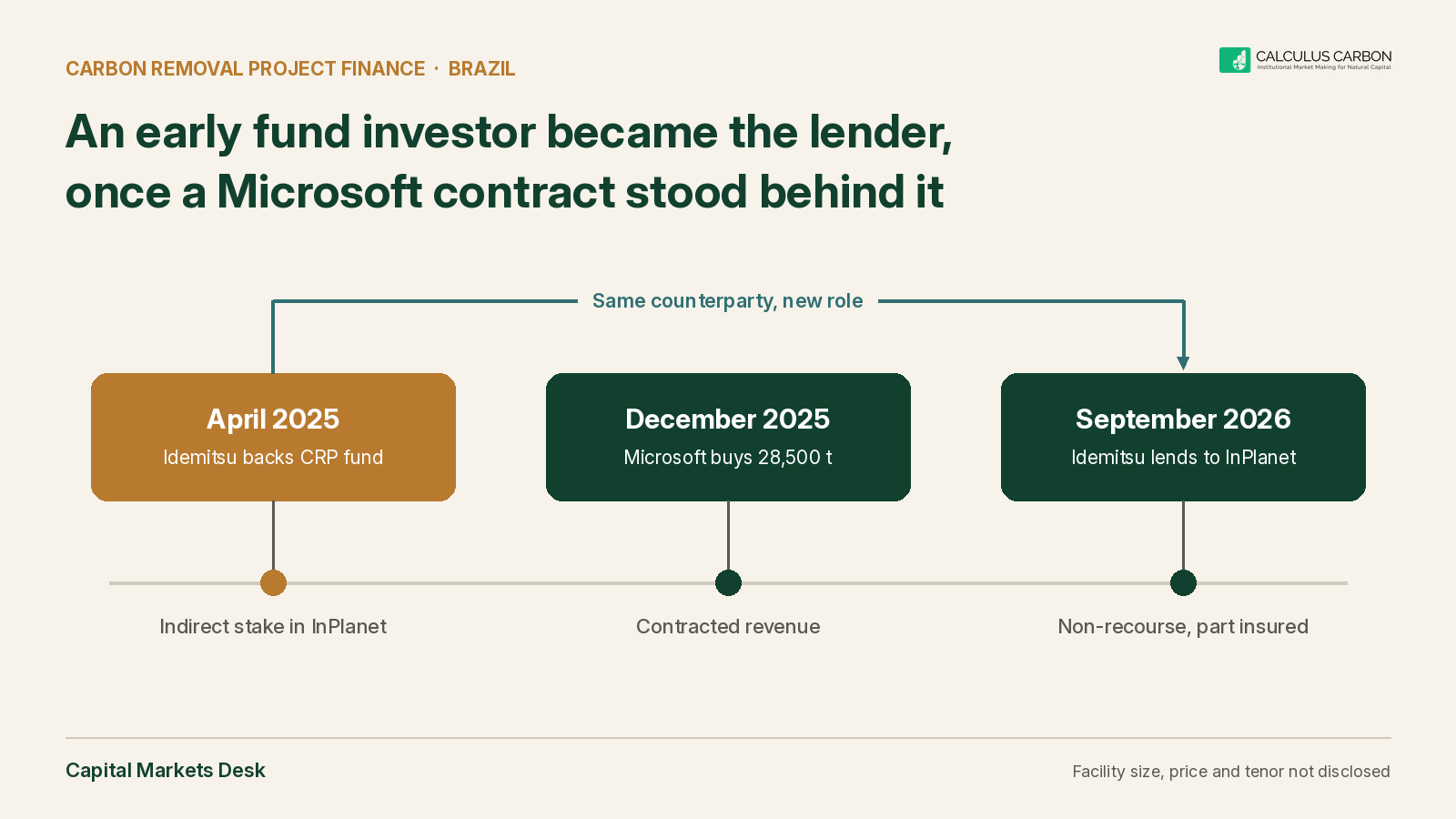
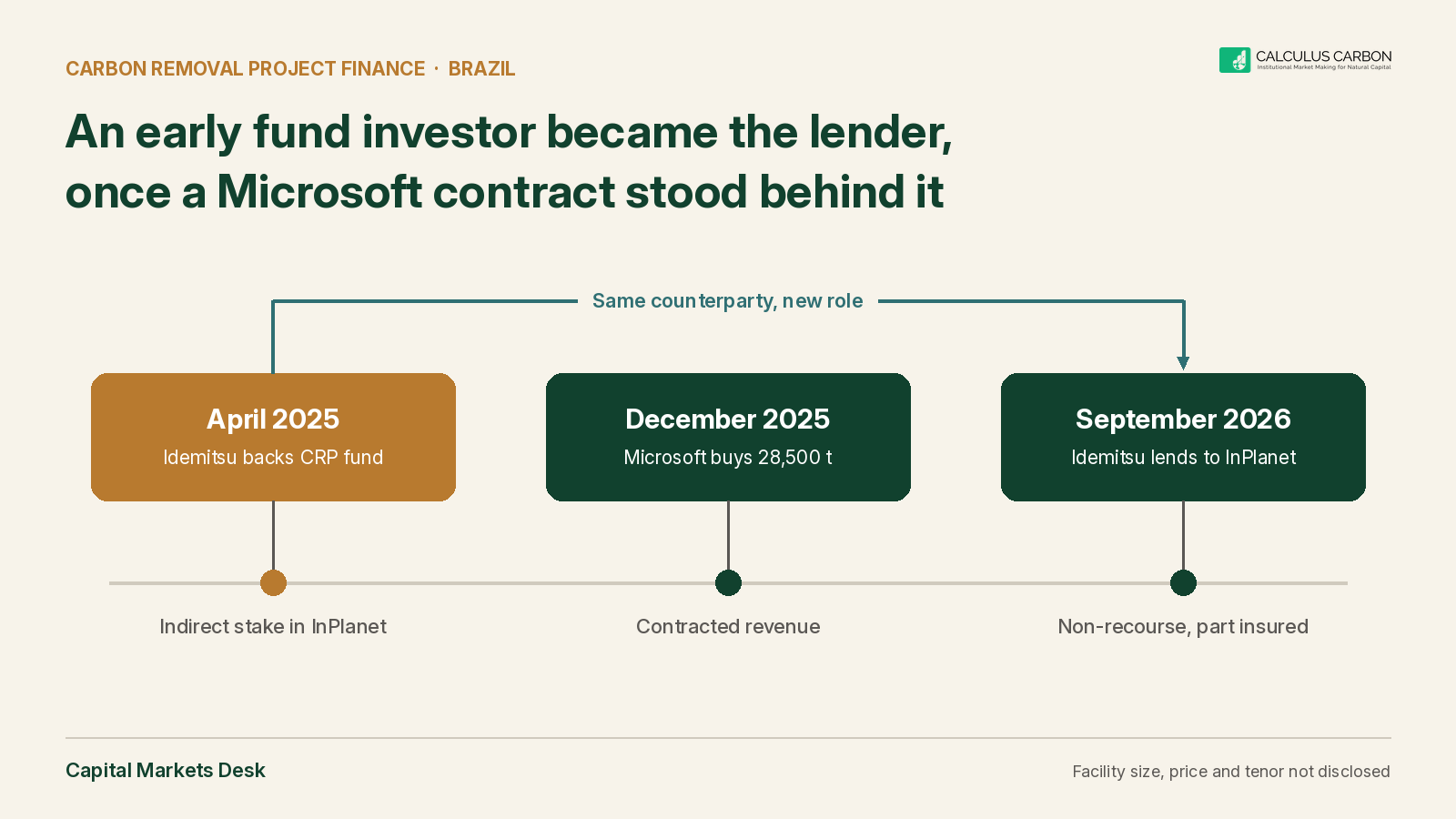
Idemitsu committed to a carbon removal fund holding InPlanet in April 2025, then closed a non-recourse facility to InPlanet in September 2026. Its finance team still required contracted revenue, which a Microsoft agreement for more than 28,500 tonnes supplied.
Carbon Removal Project Finance · Enhanced Rock Weathering, Brazil
Idemitsu and InPlanet: A Fund Investor Became the Lender, but a Microsoft Contract Made the Loan Possible
Idemitsu first came to know InPlanet through a carbon removal fund, then lent to it on a non-recourse basis. The relationship lowered the price of the loan. A Microsoft purchase contract and delivery insurance decided whether there could be a loan at all.
The Read
Idemitsu's non-recourse loan to InPlanet is an interesting practice in project finance within carbon removal, and one which could serve as a model for future transactions. A company that first came to know a developer through a fund holding came back as its lender, and could offer cheaper money than a lender meeting the developer for the first time.1,2,5 Familiarity did not replace the usual test. Idemitsu's finance team still required contracted revenue, and InPlanet had it in a Microsoft purchase agreement for more than 28,500 tonnes delivered between 2026 and 2028.4,5 This note separates the investor relationship from the loan, sets out what the lender relied on and what remains undisclosed, and screens the market for comparable deals.
Is Idemitsu an Investor in InPlanet?
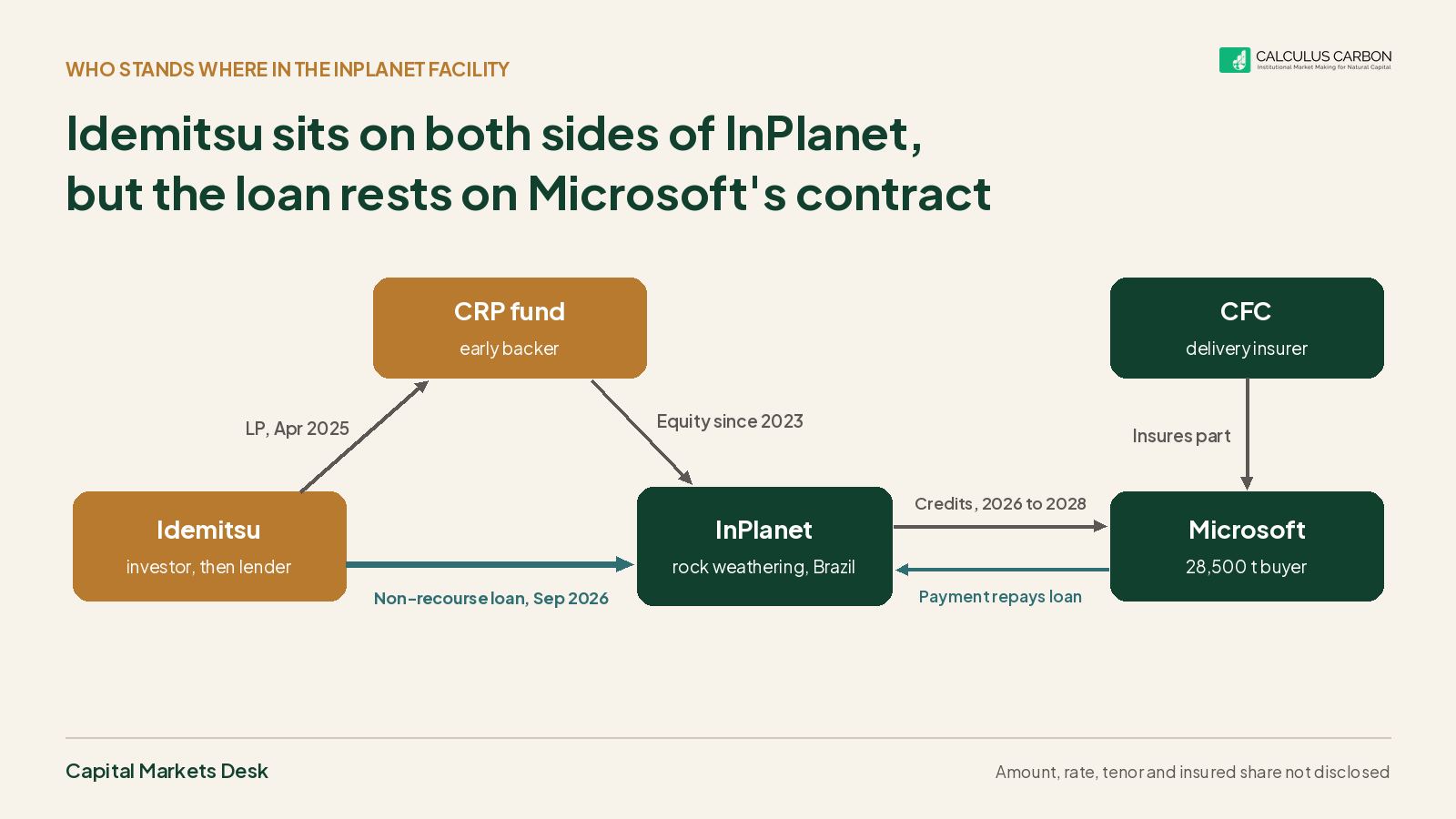
Only indirectly, and the distinction matters. On 28 April 2025 Idemitsu Kosan, the Japanese energy group, announced a commitment to Carbon Removal Partners Systemic Ventures I, a venture capital fund for carbon dioxide removal managed by Zurich based Carbon Removal Partners, made through its US subsidiary Idemitsu Americas Holdings.1 The release did not state the amount. It listed InPlanet among the fund's portfolio companies, alongside Climeworks, CO280, Greenlyte, Heirloom and Spiritus.1
Carbon Removal Partners had backed InPlanet from its early days. It joined the EUR 1.2M pre-seed round in January 2023 and invested again in the EUR 4.3M seed round later that year.6,7 Idemitsu therefore held its exposure as a limited partner, meaning an investor in the fund, rather than as a shareholder on InPlanet's own register. A limited partner typically receives portfolio reporting and talks to the fund manager, but does not vote the portfolio company's shares or sit on its board.
Ambika Rustagi, of Idemitsu's corporate venture capital team in Silicon Valley, described the group's usual approach on the Carbon Weekly News podcast in November 2026: it takes equity positions in carbon removal companies to learn the market, and it treats the companies it has backed as portfolio companies it wants to support.5 For a future lender, the useful asset from this relationship was information, gathered over about seventeen months between the fund commitment and the loan.
Does Familiarity Lower the Price of a Loan?
It can, and in this case it was the stated reason for lending. InPlanet operates in Brazil, where the central bank's benchmark rate, the Selic, has stood at 13.75 percent a year since September 2026 and was held there on 4 November.8 Borrowing for a young company using a new technology costs more than that base rate. Rustagi said the high cost of capital InPlanet faced was understandable for a generalist lender that did not know the company, but Idemitsu knew InPlanet, believed its technology had been proven, and judged that Brazilian market volatility mattered less to the investment than it might appear.5 Idemitsu was, in her words, able to provide capital at a lower cost to help InPlanet meet a very sure commitment, its large offtake with a creditworthy corporate buyer.5
The logic is familiar in project finance. A lender's price has two parts: the cost of its own money, and a margin for the risks it cannot measure. An investor that has watched a developer through a fund already holds part of the information a new lender would charge for, so it can measure more of the risk and needs less margin for what remains unknown. Enhanced rock weathering, the method of spreading crushed silicate rock on farmland so that it absorbs carbon dioxide as it weathers, is young enough that this information gap is wide. InPlanet delivered the first independently verified credits from the method in December 2024 and has applied more than 200,000 tonnes of rock across Brazilian farmland, a record Idemitsu could weigh at first hand.2,3
The facility's interest rate, size and tenor have not been disclosed, so the saving cannot be measured from public sources.2,3,5
Is Contracted Revenue Still the Gate?
Yes, and this is the most useful boundary in the case. Rustagi said Idemitsu's finance team examined the facility and required a very clear financial reason for investing.5 She was specific about what counted. InPlanet needed revenue it knew was coming through the door; an option to buy or a soft commitment to buy was not a strong case, whereas contracted revenue was something the team could work with.5
That revenue came from Microsoft. In December 2025 InPlanet agreed to deliver more than 28,500 tonnes of removals to Microsoft between 2026 and 2028, with credits issued under Isometric's Enhanced Weathering Protocol and listed on the Isometric Registry.4 The price was not published.4 InPlanet's release describes the facility as funding delivery of those contracted tonnes, with downside protection backed by the existing agreement.2
A second layer sits on top. The financing includes carbon delivery insurance from CFC, a specialist insurer, covering specified project delivery risks for a defined portion of the delivery, with Howden Broking Group acting for InPlanet.2 Calculus Carbon's earlier note on delivery insurance sets out why this matters: a lender sizes debt on the tonnes it expects to be delivered rather than the tonnes contracted, and insurance lets more of the contract count.13 The insured share has not been disclosed.
The relationship therefore changed who was willing to lend and at what price. It did not change what the loan had to rest on.
Does Non-Recourse Change What Idemitsu Is Exposed To?
It does. A non-recourse loan is repaid from the cash flows of the financed activity, here the Microsoft deliveries, and the lender has no claim on the developer's wider balance sheet if those cash flows fall short. InPlanet described the facility as one of the first non-recourse project financings in enhanced rock weathering.2
Separating the pieces helps. The protected part is that the loan is serviced from a contract with a creditworthy buyer, and a defined portion of delivery risk is insured. The part at risk is any shortfall in tonnes outside the insured portion, any slippage beyond 2028, and the verification of each tonne under the Isometric protocol, since payment depends on delivered credits. The undisclosed part is the facility amount, interest rate, tenor, insured share, contract price and any reserve or cash sweep arrangements. Without those terms, the headline size of the Microsoft contract cannot be read as the amount the facility lends against.
Holding two roles also raises a governance point. As a fund investor, Idemitsu gains if InPlanet's equity value rises; as a lender, its claim on the financed deliveries ranks ahead of that equity. Because the stake sits inside a fund managed by Carbon Removal Partners rather than on InPlanet's register, the tension is diluted. An allocator reviewing a similar structure would still ask how the lender's rights interact with any equity interest if deliveries fall short.
Is This a Pattern or a Single Case?
On public evidence it is a single case of a fund investor becoming a developer's non-recourse lender. The screen for comparable deals found adjacent role changes, but not the same one.
The closest is JPMorgan Chase and Charm Industrial, which converts plant waste into bio-oil and injects it underground. The bank bought 28,500 tonnes from Charm in 2023 and, in June 2026, signed a second purchase of 61,500 tonnes alongside a separate USD 20M venture debt facility to expand Charm's Colorado operations.9 There the earlier role was buyer rather than investor, and the loan is venture debt to the company rather than project debt against a contract, as Calculus Carbon noted at the time.10 U.S. Bank's first removal purchase, from the biochar developer Carba in September 2026, sits earlier on the same path: a buyer learning the asset class, with no loan yet.11,12
Other recent removal facilities came from lenders with no earlier role in the developer. Vaulted Deep's USD 35M facility from Mediobanca, arranged by CFP Energy, was secured by long-term purchase contracts.14 Terradot's USD 34M term loan from HASI rested on two fixed-price Frontier offtakes and delivery insurance.15 These show contracted revenue and insurance recurring as the basis for debt across lenders. The investor-to-lender step itself has been disclosed once.
Should Developers Cast a Wide Net Early?
The case supports it, with a caveat. Corporate investors often reach carbon removal through funds rather than direct stakes, so a developer's most useful relationships may sit one layer removed, among the limited partners of the funds on its register, as well as among its buyers. Idemitsu's interest was also strategic. It buys credits for compliance in Japan and Australia, and Rustagi linked its interest in enhanced rock weathering to a possible Article 6 connection between Brazil and Japan and to the group's agricultural activity overseas.5 Both companies say they intend to use the facility as a template for further financings across new projects, new buyers and the compliance markets forming in Japan and Brazil, and that additional lenders can join on the same basis.2
The caveat is the one Idemitsu's finance team applied. A friendly investor may price a loan more cheaply, but it still needs a signed purchase contract, ideally with delivery insurance, before it lends. A developer that cultivates investors and buyers without converting at least one buyer into a binding contract has relationships, not collateral. The practice merits repeating where three conditions hold together: the prospective lender has watched the developer's operating data, a creditworthy buyer has signed for the tonnes, and delivery risk is at least partly insured.
The Read for Institutional Capital
A developer's earlier investors and buyers can return as its lenders, and Idemitsu's loan to InPlanet shows the benefit: an informed lender can price technology risk more cheaply than a stranger, which counts for more in a high-rate market such as Brazil. The loan still rested on a Microsoft contract and partial delivery insurance, so familiarity changed the price rather than the test. Allocators assessing similar facilities should credit relationship lenders with better information, while checking that repayment rests on contracted, insured tonnes and that any equity interest does not blur the lender's rights. One disclosed case does not make a market practice, but its logic deserves to be repeated.
Idemitsu's familiarity with InPlanet lowered the price of the loan; the Microsoft contract and delivery insurance made the loan possible.
This note is for information only and is not investment advice.
Sources
- [1] Idemitsu Kosan, “Idemitsu Invests in Fund Focused on Carbon Dioxide Removal”, 28 April 2025. idemitsu.com
- [2] InPlanet, “InPlanet and Idemitsu Americas Holdings Close Non-Recourse Debt Facility, Setting a New Standard for Financing ERW Carbon Removal”, 17 September 2026. inplanet.earth
- [3] Idemitsu Kosan, “Idemitsu closes debt facility with InPlanet, a CO2 removal (CDR) company”, 17 September 2026. idemitsu.com
- [4] InPlanet, “InPlanet secures agreement to deliver 28,500 enhanced rock weathering credits to Microsoft”, 17 December 2025. inplanet.earth
- [5] Carbon Weekly News, “Buffer Pools Lock Up 40% of Credits, Insurance Costs 1% a Year”, episode 11, with Ambika Rustagi of Idemitsu Americas, 12 November 2026. cwn.show
- [6] InPlanet, “InPlanet raises EUR 1.2M in pre-seed round for enhanced rock weathering in the tropics”, January 2023. inplanet.earth
- [7] Munich Startup, “InPlanet seed financing”. munich-startup.de
- [8] Banco Central do Brasil, “Copom maintains the Selic rate at 13.75% p.a.”, 282nd meeting, 4 November 2026. bcb.gov.br
- [9] Charm Industrial, “Charm Industrial Secures 61,500-Ton Carbon Removal Purchase and $20 Million Debt Financing to Catalyze Growth”, 4 June 2026. charmindustrial.com
- [10] Calculus Carbon, “Same Bank on Both Sides: The Charm-JPMorgan Prototype for Carbon Project Finance”, 10 August 2026. calculuscarbon.com
- [11] Carbon Pulse, “US Bank buys first carbon removal credits from biochar developer”, 3 September 2026. carbon-pulse.com
- [12] Calculus Carbon, “Before a Bank Underwrites Carbon Removal, It Buys It. The US Bank Carba Offtake Is a Diligence Move.”, 8 September 2026. calculuscarbon.com
- [13] Calculus Carbon, “Contracted Is Not Delivered: How Delivery Insurance Changes What A Lender Will Lend Against A Carbon Removal Offtake”, 20 October 2026. calculuscarbon.com
- [14] Vaulted Deep via PR Newswire, “Vaulted Deep Secures $35 Million in Debt Financing to Expand Nationwide”, 21 September 2026. morningstar.com
- [15] Calculus Carbon, “Two Offtake Books, One Loan: How Terradot Reached an Institutional Debt Ticket”, 3 November 2026. calculuscarbon.com