One Route in NbS Project Finance: Concessional Money Through a National Development Bank, Lent on the Forest's Timetable
The World Bank and the Climate Investment Funds will lend USD 147M to BNDES for forest restoration in Brazil's Arc of Restoration. BNDES blends the money into sub-loans for private restoration companies, in a USD 488M operation that expects USD 241M of commercial capital.
Project Finance · Forest Restoration · 16 November 2026
One Route in NbS Project Finance: Concessional Money Through a National Development Bank, Lent on the Forest’s Timetable
An emerging practice in project finance within nature-based solutions is to pass concessional multilateral money through a national development bank, which then lends to private restoration companies on tenors and grace periods that match a forest's slow payback. The World Bank's USD 488M Arc of Restoration operation in Brazil, announced on 10 November 2026, is the largest recent example.
The Read
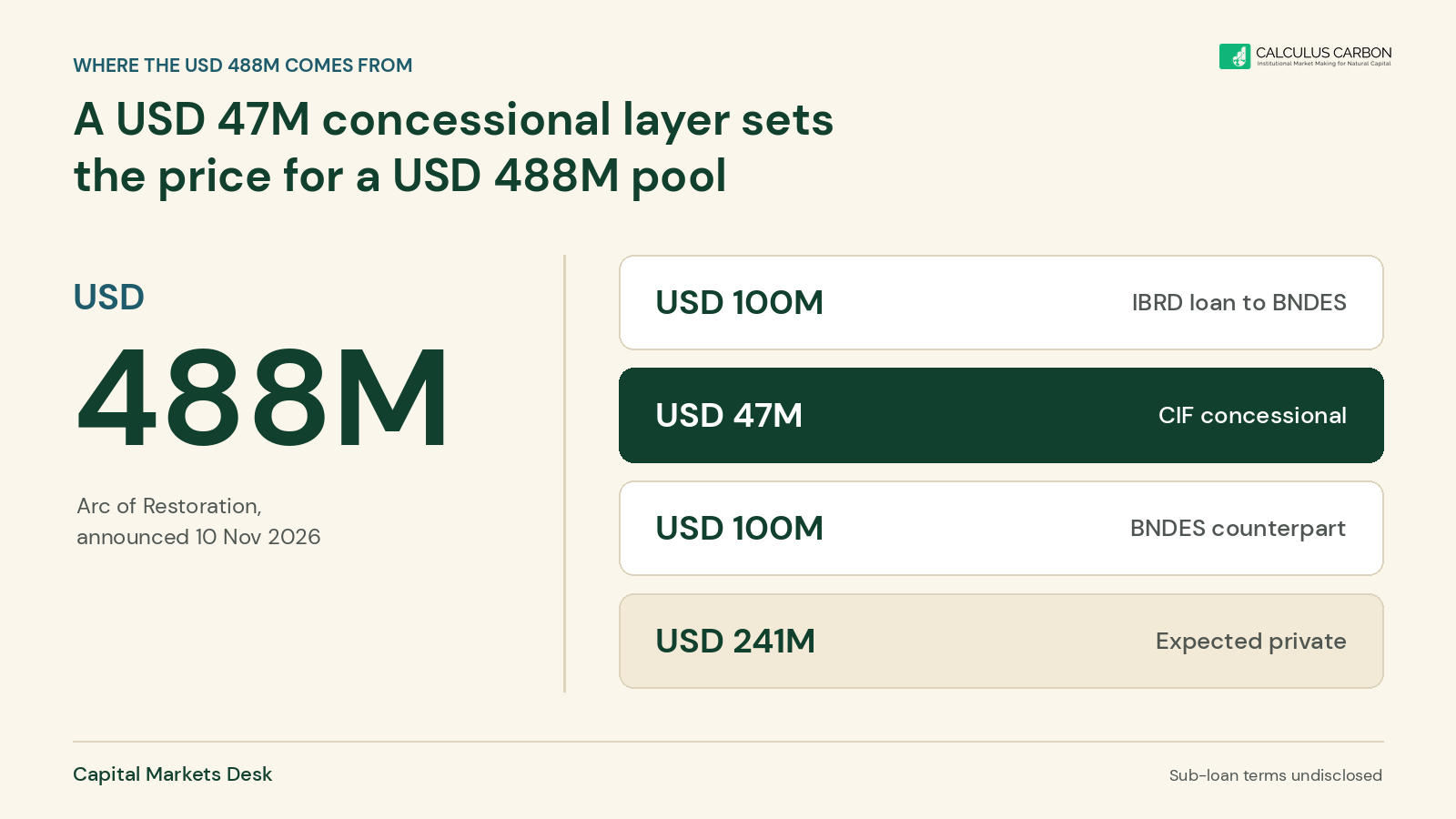
An emerging practice in project finance within nature-based solutions, meaning projects that restore or protect ecosystems, is to pass concessional multilateral money through a national development bank, which then lends to private restoration companies on tenors and grace periods that match a forest's slow payback. On 10 November 2026, the World Bank announced the Arc of Restoration Project in Brazil, a USD 488M operation along the deforestation frontier between the Amazon and the Cerrado.1 The International Bank for Reconstruction and Development (IBRD), the World Bank's main lending arm, provides USD 100M, and the Climate Investment Funds (CIF), a multilateral climate fund, provide USD 47M.1 The Brazilian Development Bank (BNDES) adds USD 100M of its own money and will lend the combined pool to private companies as sub-loans, with at least USD 241M of commercial financing expected alongside.1 BNDES confirmed the USD 147M of multilateral funding, about R$808.5M, at COP31 in Antalya on 12 November 2026.3
Is This Project Finance or Corporate Lending?
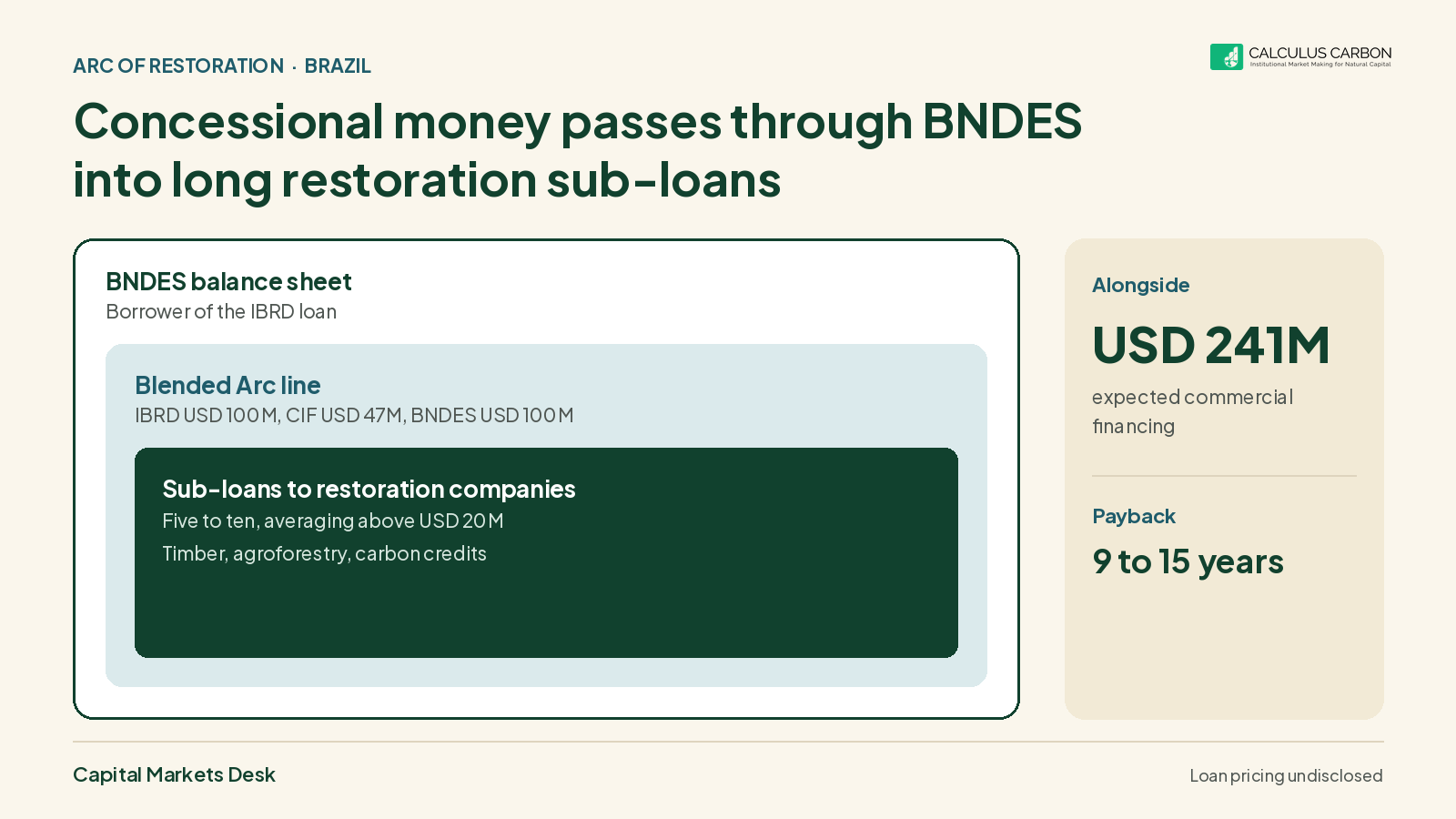
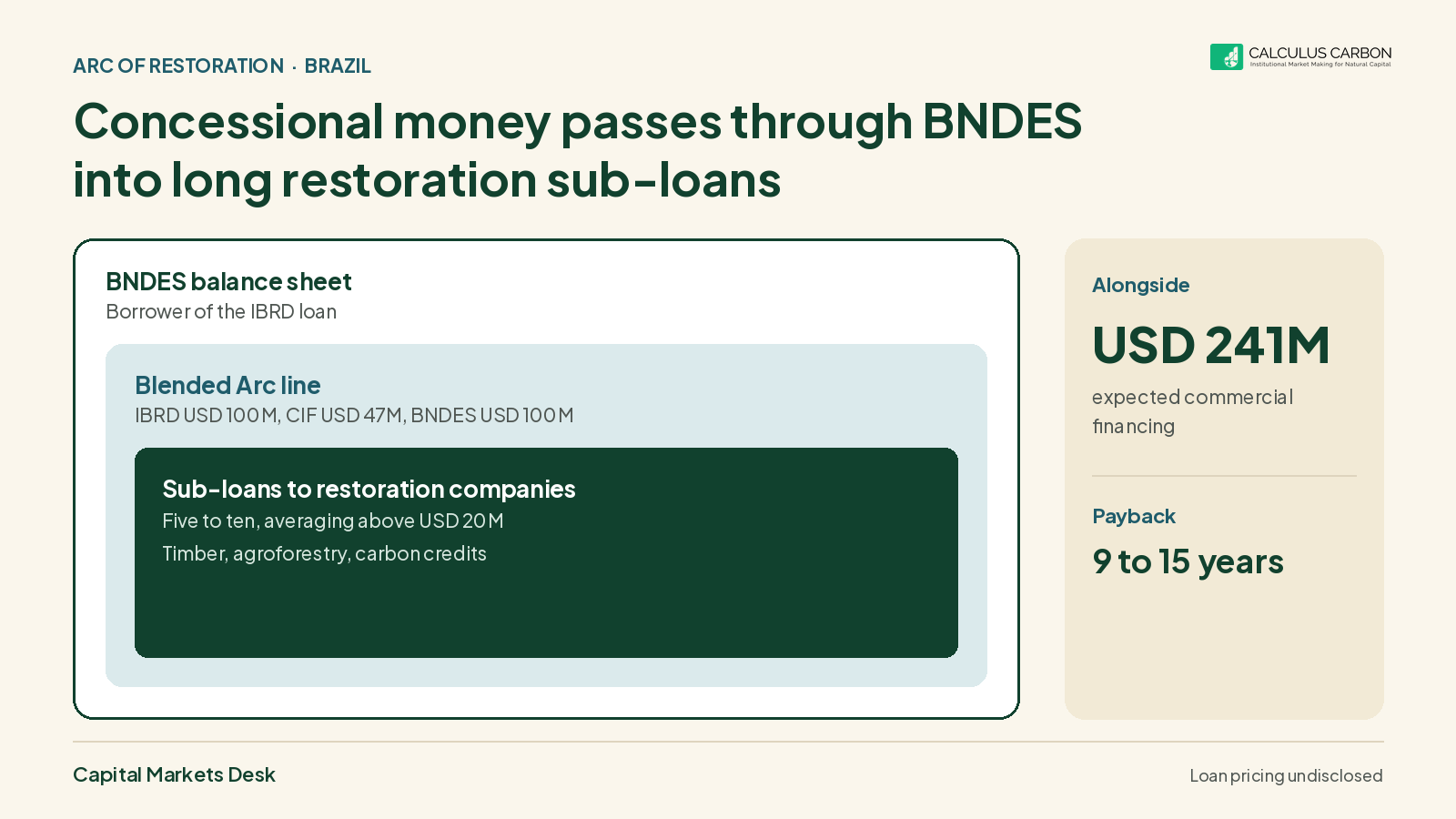
It is both, at different layers, and the layering is the point of the structure. At the top, BNDES is the borrower of the IBRD loan and the implementing agency, so the World Bank's credit exposure is to BNDES rather than to any forest.2 The CIF investment plan presentation described the IBRD piece as a sovereign-guaranteed loan to BNDES, although the project information document we reviewed does not name a guarantor.2,4
Below that layer, BNDES integrates the IBRD and CIF resources into its capital base and on-lends them as sub-loans to private companies undertaking large-scale restoration, mainly in the Tocantins-Araguaia Basin.2 On-lending means that BNDES borrows the money and then makes its own loans with it. Each sub-loan is appraised against BNDES's eligibility criteria and environmental and social rules, and that layer is where project credit risk sits.2 The sub-projects are expected to be large, with average financing above USD 20M, and the operation targets at least five and up to ten of them.2
The arithmetic of the operation is roughly one public dollar for each private dollar. USD 247M comes from the IBRD, the CIF and BNDES, against at least USD 241M expected from private sources, which in practice means sponsor equity and commercial debt sitting alongside the BNDES sub-loans.1 The documents do not say how that private money ranks against BNDES in repayment or security. The loan also allows retroactive financing of up to 20% of its amount for eligible payments made in the 12 months before signing, so some spending already under way can be refinanced into the programme.2
Does the Blend Change the Price for Borrowers?
It does, and the documents say so directly. Inside the Arc of Restoration, IBRD and CIF money is blended to produce terms more attractive than BNDES's standard credit lines, with the full funding cost advantage of the CIF money passed through to sub-borrowers.1,2 Outside the Arc, the IBRD money is lent through a standalone line with no blend.2 The result is tiered pricing: one price for restoration inside the priority region and a less favourable price elsewhere.
The size of the discount has not been published. The IBRD loan's maturity and interest rate, the CIF terms, and the rates and tenors on the sub-loans do not appear in the press release or the project information document.1,2 The CIF investment plan says only that the conditions would be attractive, with long repayment and grace periods, and with disbursements adjusted to the progress of each project.5 A grace period is the opening span of a loan during which the borrower pays interest only, or nothing, before principal repayment begins.
Can Restoration Cash Flows Repay the Principal?
They can, provided the tenor is long enough. The World Bank puts restoration payback periods at 9 to 15 years, with high upfront establishment costs and still-maturing carbon and ecosystem service markets.1,2 A conventional five to seven year loan would fall due before most of the trees produce revenue, which is the gap that patient concessional capital is meant to close.
The principal and the return come from different places at each layer. BNDES repays the IBRD and CIF from its own balance sheet, and private restoration companies repay BNDES from the cash flows of their projects. Those cash flows come from native timber, non-timber forest products, agroforestry harvests and, for most sub-projects, carbon credits.1,2 At least 60% of sub-projects are expected to obtain certification under Verra's Verified Carbon Standard, a widely used carbon crediting standard, by project closing, with carbon revenue described as integral to their financial viability.2 The documents do not state how sub-loan losses would be shared, or how currency risk is handled between a US dollar loan and real-denominated sub-loans, although project disbursements are made mainly in reais.2
Is the Practice Recurring or a One-Off?
It is recurring, which is why we call it an emerging practice. Before settling on that wording, we looked for comparable recent loans in which BNDES lends concessional money to private restoration companies on long tenors, within the Arc programme or its wider Climate Fund lending.
Several stand out. On 19 October 2026, BNDES approved R$250M from its Climate Fund for Belterra to convert 4,000 hectares of degraded Amazon land into cocoa agroforestry, on a 15-year term including five years of grace, as part of the Arc of Restoration.6 In September 2026, Mombak said its second Amazon reforestation fund would have access to a R$200M Climate Fund credit line from BNDES.8 BNDES reported in November 2025 that its Climate Fund was lending to Arc projects at a financial cost of 1% a year with terms of up to 25 years, and had approved more than R$700M for them; the same release listed a new R$250M restoration loan to re.green.7 Most recently, in a release issued during COP31 in November 2026, BNDES disclosed a Climate Fund approval of up to R$200M for Grupo Symbiosis to plant 4,400 hectares of productive native Atlantic Forest in southern Bahia, with a sawmill in Porto Seguro.9 An earlier R$77M Climate Fund loan to Symbiosis Florestal was backed by bank guarantees, the first issued by Santander, which shows one way BNDES places sub-borrower credit risk with commercial banks.10
The new operation adds two elements to that pattern. It brings multilateral money into BNDES's restoration lending, the first direct IBRD operation with BNDES since the 1990s according to BNDES, and it makes the concessional discount explicit through tiered pricing.3 Only USD 47M of the USD 488M, under 10%, is CIF money, so a small concessional layer is being used to set the price for a much larger pool.1
Should Other Markets Copy the Structure?
Provided three conditions hold, the logic travels. The country needs a national development bank with the appraisal capacity to lend to restoration companies at scale, and a balance sheet that multilateral lenders will accept. The pipeline needs sponsors large enough for sub-loans in the tens of millions, which BNDES has built over several years of Arc lending.2,7 The projects need revenue that does not rely on carbon alone, so that timber, cocoa or other products carry part of the repayment.
The limits are equally clear. The structure favours large, established developers, because sub-loans averaging above USD 20M exclude most smallholder and community projects.2 Concentration is also a risk, with five to ten sub-projects carrying the whole pool. For the Arc of Restoration specifically, the open items are the IBRD and CIF pricing, the sub-loan tenors and rates, and the allocation of credit and currency risk, none of which has been disclosed.1,2
The Read for Institutional Capital
The route of channelling concessional multilateral money through a national development bank, which lends it on to restoration companies with long tenors and grace periods, is an emerging practice in project finance within nature-based solutions. The Arc of Restoration operation follows Belterra, Mombak, re.green and Symbiosis in that pattern, and adds an IBRD loan and explicit tiered pricing.1,6,7,8,9 For a commercial lender or investor looking at the USD 241M of expected co-financing, the questions to ask are which loan comes first in repayment, what tenor the sub-loan carries against a 9 to 15 year payback, and how much of the debt case still works without carbon revenue.
A restoration loan becomes bankable when its repayment schedule follows the growth of the forest, and a national development bank holding a thin concessional layer is one practical way to set that schedule.
This note is for information only and is not investment advice.
Sources
- [1] World Bank, World Bank Group Supports Large-Scale Forest Restoration in Brazil, press release, 10 November 2026. worldbank.org
- [2] World Bank, Brazil: Arc of Restoration Project (P510691), Project Information Document, appraisal stage, 25 June 2026. documents1.worldbank.org
- [3] Agência BNDES de Notícias, Na COP 31, BNDES anuncia captação de R$ 808,5 mi com Banco Mundial e CIF para restauro florestal, 12 November 2026. agenciadenoticias.bndes.gov.br
- [4] Climate Investment Funds, From the Arc of Deforestation to the Arc of Restoration in the Tocantins-Araguaia Basin, Brazil Investment Plan presentation, February 2025. cif.org
- [5] Climate Investment Funds, Nature, People and Climate Investment Plan for Brazil, January 2025. cif.org
- [6] Valor International, Brazil's development bank approves R$250m for Belterra investment, 19 October 2026. valorinternational.globo.com
- [7] Agência BNDES de Notícias, Arco da Restauração mobiliza R$ 2,4 bi em recursos, o dobro do valor contratado pelo BNDES para a região, 12 November 2025. agenciadenoticias.bndes.gov.br
- [8] Reuters, Brazil's Mombak raises new fund, adds Salesforce as carbon credit buyer, 21 September 2026. reuters.com
- [9] Agência BNDES de Notícias, COP31: BNDES já alavancou R$ 16 bi em investimentos para setor de florestas nativas e bioeconomia desde 2023, November 2026. agenciadenoticias.bndes.gov.br
- [10] Negócios BA, BNDES desembolsa R$ 26 milhões para projeto da Symbiosis na Bahia, April 2026. negociosba.com.br