Singapore's Two Article 6 Routes: A Buyer Without Authorisation, and Authorisation Without a Buyer
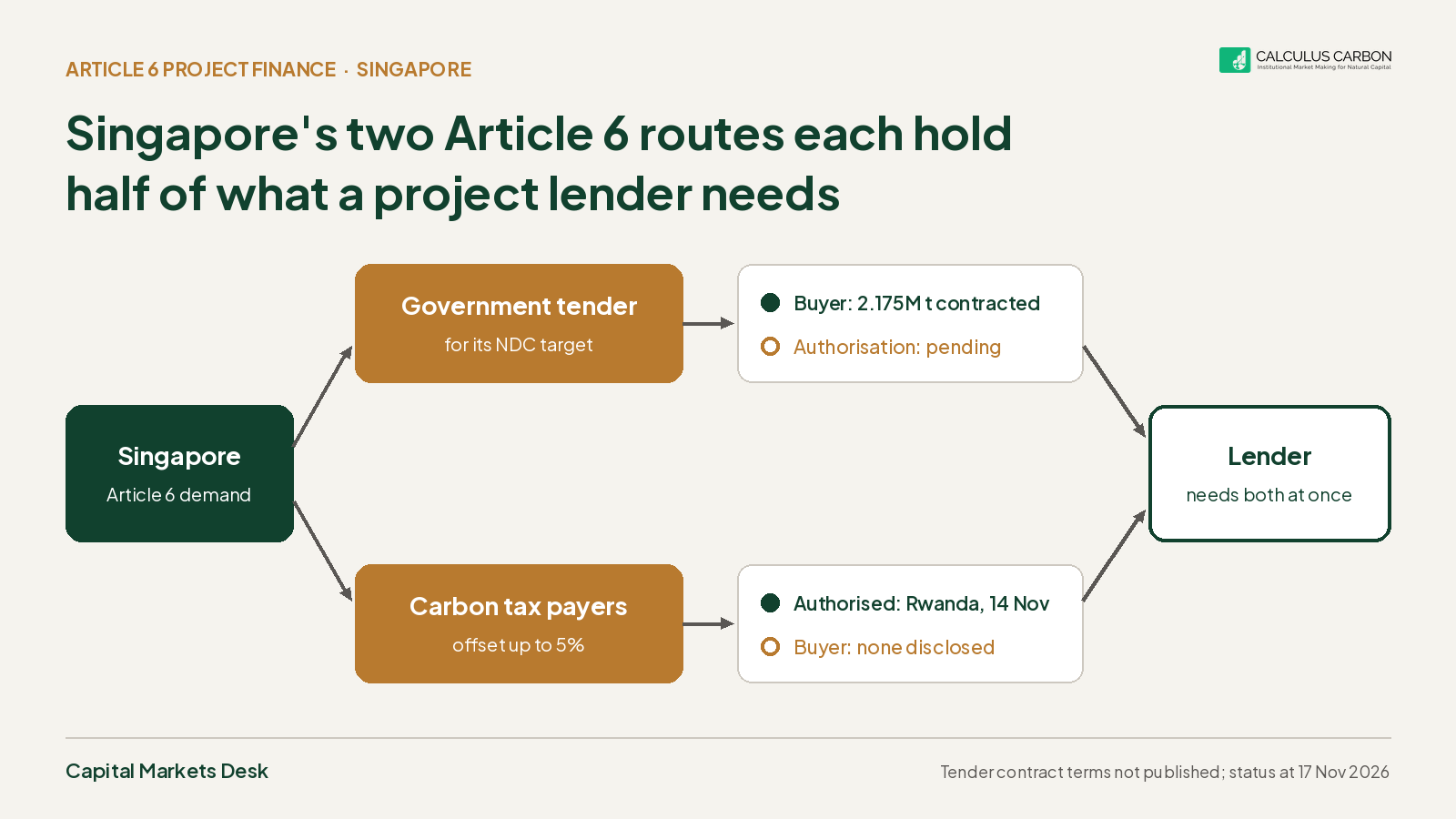
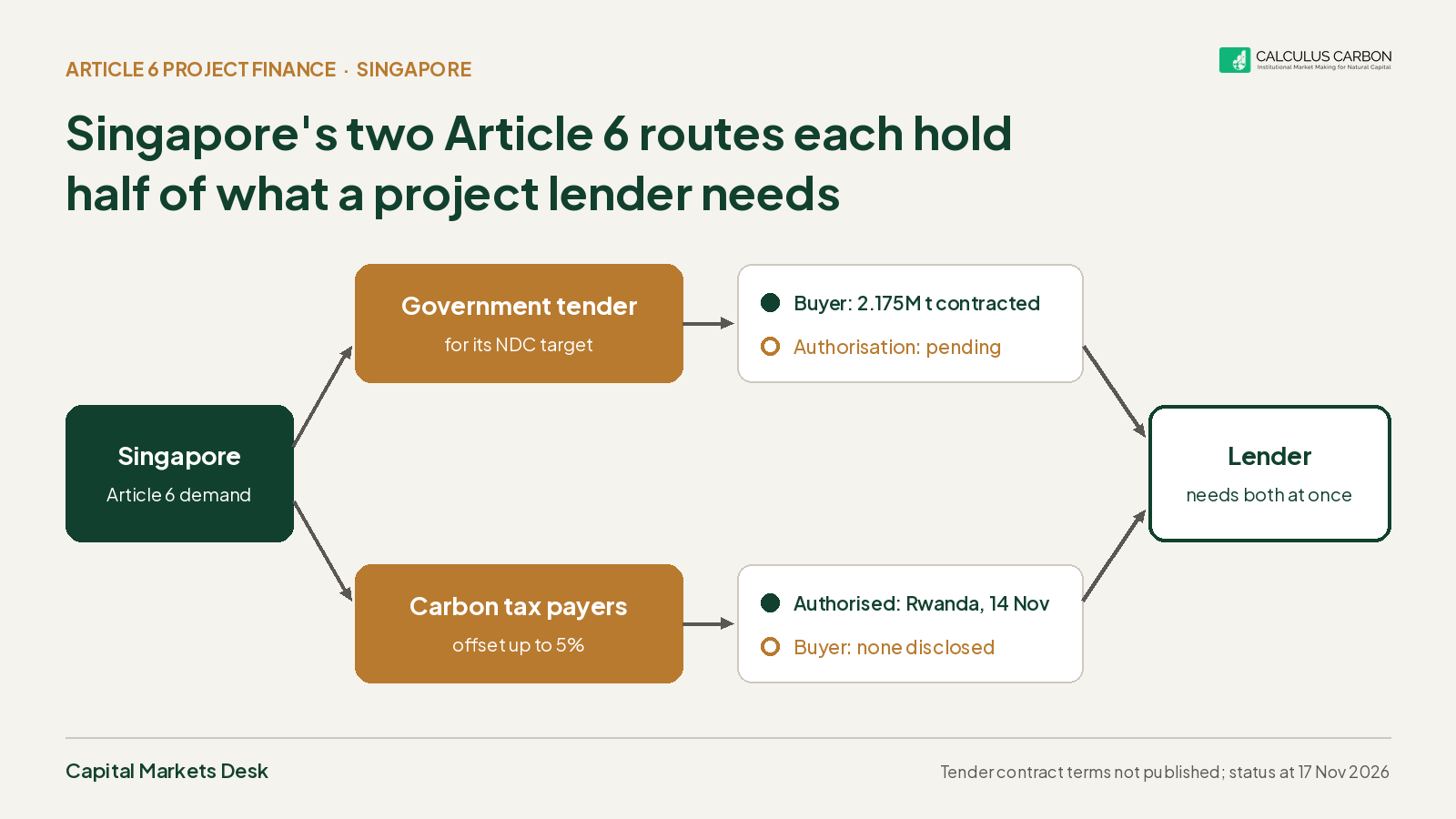
Singapore contracted 2.175 million tonnes from four nature projects in September 2025, none yet authorised, and on 14 November 2026 authorised a Rwandan water filter project with no disclosed buyer. The Zambia and Ghana cookstove loans show lenders waiting for both pieces in one project.
Article 6 Project Finance · Singapore, Rwanda, Ghana, Peru and Paraguay
Singapore’s Two Article 6 Routes: A Buyer Without Authorisation, and Authorisation Without a Buyer
Singapore has contracted 2.175 million tonnes of credits from four nature projects that are not yet authorised, and has just authorised a Rwandan project that has no disclosed buyer. Lenders to Article 6 projects so far have waited for both pieces to sit in the same project.
The Read
An emerging practice in project finance within Article 6 carbon markets is that lenders advance money only once a project holds two things together: a purchase contract with a buyer that needs the credits for compliance, and authorisation from both the selling and the buying government. Singapore now has projects holding one or the other, but not both. It contracted 2.175 million tonnes from four nature projects in September 2025, none of which yet holds Singapore's authorisation.5 On 14 November 2026 it issued its first authorisation, to a water filter project in Rwanda that has no disclosed buyer.1,13 The two loans made so far to Article 6 projects, in Zambia and Ghana, were made only once both pieces were in place.10,12 This note sets out what each Singapore route provides, what it still lacks, and what a lender would need to see before sizing debt against either.
Is Article 6 Authorisation the Same as Having a Buyer?
No. The two answer different questions for a lender. Article 6 of the Paris Agreement lets one country count emission reductions made in another towards its own national climate target, known as its nationally determined contribution or NDC. The traded units are internationally transferred mitigation outcomes, or ITMOs. For the transfer to count, the selling country must make a corresponding adjustment, meaning it removes those tonnes from its own climate accounts so they are not counted twice.
Singapore runs this through bilateral implementation agreements, of which it has signed nine, with Bhutan, Chile, Ghana, Papua New Guinea, Peru, Paraguay, Rwanda, Thailand and Vietnam.5 Under the Rwanda agreement, a project moves through three stages.3 At Stage A it submits a concept note. At Stage B it submits its design document and an independent validation report, and receives Letters of Authorisation from both governments. At Stage C, after its reductions have been verified and credits issued, it applies for the corresponding adjustment. Singapore also commits to cancel 2 percent of the adjusted credits at first issuance and to direct 5 percent of their value to adaptation in Rwanda.3
Authorisation therefore tells a lender that the credits are eligible to become compliance units, subject to delivery and to the adjustment at Stage C. It says nothing about who pays for them, at what price or for how long. A purchase contract answers those questions, and it is the contract a lender sizes debt against.
Does the Carbon Tax Route Give a Lender Revenue It Can Count?
Not yet. The first route serves companies that pay Singapore's carbon tax. The tax is S$45 per tonne in 2026 and 2027, with a stated aim of S$50 to S$80 per tonne by 2030, and since 2024 taxable facilities may use eligible international credits to offset up to 5 percent of their taxable emissions.4 Credits from projects authorised under an implementation agreement can be used for this purpose once they meet Singapore's eligibility criteria.3
The Safe Water Supply Project, developed by Climate Bridge International, is the first to receive Singapore's authorisation.1 It plans to distribute 300,000 ceramic water filters to households and early childhood centres across Rwanda, mainly in the Western Province, so that families no longer boil water over firewood or charcoal. An initial 10,000 filters went out from June 2026, and the remainder are due to be deployed in 2027.1 The project expects to mitigate about 780,000 tonnes between 2026 and 2030, and it is listed with Gold Standard, an independent carbon crediting programme.1,2 More than 20 further projects are being assessed under the same agreement.1
The register shows the expected volumes year by year: 3,671 tonnes in 2026, 76,127 in 2027, 227,047 in 2028 and 240,403 in each of 2029 and 2030.2 Nearly 90 percent of the volume therefore arrives in the last three years, after most filters have been distributed. Neither the authorisation notice nor the register names a buyer.1,2 Until a taxpayer or trader signs a contract, there is no revenue to size a loan against. The tax also sets a practical ceiling on what a taxpayer is likely to pay, because a credit is worth buying only while it costs less than the tax it offsets, and the 5 percent limit caps how many credits each facility can use.4
Can a Tender Contract Be Financed Before the Projects Are Authorised?
The second route is government procurement for Singapore's own NDC. On 16 September 2025, after a request for proposals launched in September 2024, the National Climate Change Secretariat and the Ministry of Trade and Industry announced contracts for 2,175,000 tonnes worth about S$76M, for use from 2026 to 2030.5 The four projects are the Kowen Antami and Together for Forests forest protection projects in Peru, the Boomitra grassland restoration project in Paraguay and the Kwahu landscape restoration project in Ghana.5 The sellers are GenZero, the Temasek-backed investor, the trader Mercuria, which supplies the two Peruvian projects, and Boomitra, which expects to deliver on a schedule from 2026 to 2031.6 The average works out at roughly S$35 per tonne; OPIS calculated USD 27.34.5,7
These projects have the buyer a lender looks for: a sovereign that needs the tonnes for its own target. The award, however, states that the projects “must use methodologies bilaterally agreed to by Singapore and the respective host country, and secure authorisation under the relevant government-to-government Implementation Agreement”.5 Three of the projects use Verra methodologies that both governments still need to place on their approved lists, and the fourth also needs that approval from its host country.5 More than a year after the award, Singapore's first authorisation went to Rwanda rather than to any of these projects, and Singapore's register for Ghana lists no projects.1,8 Applications under the Ghana agreement opened on 30 September 2024 and under the Peru agreement on 24 October 2025, so the contracted projects are moving through separate national processes on separate timetables.14,15
For a lender this is a timing risk rather than a credit risk. The buyer is strong, but the credits cannot be delivered into the contract until the projects are authorised, and each year of delay shortens the window in which they can deliver for use by 2030. The contract terms, including what happens if authorisation is late or refused, have not been published, so a lender cannot yet tell how much of the contracted value is protected against that delay.
Is the Zambia Loan the Template for Both Routes?
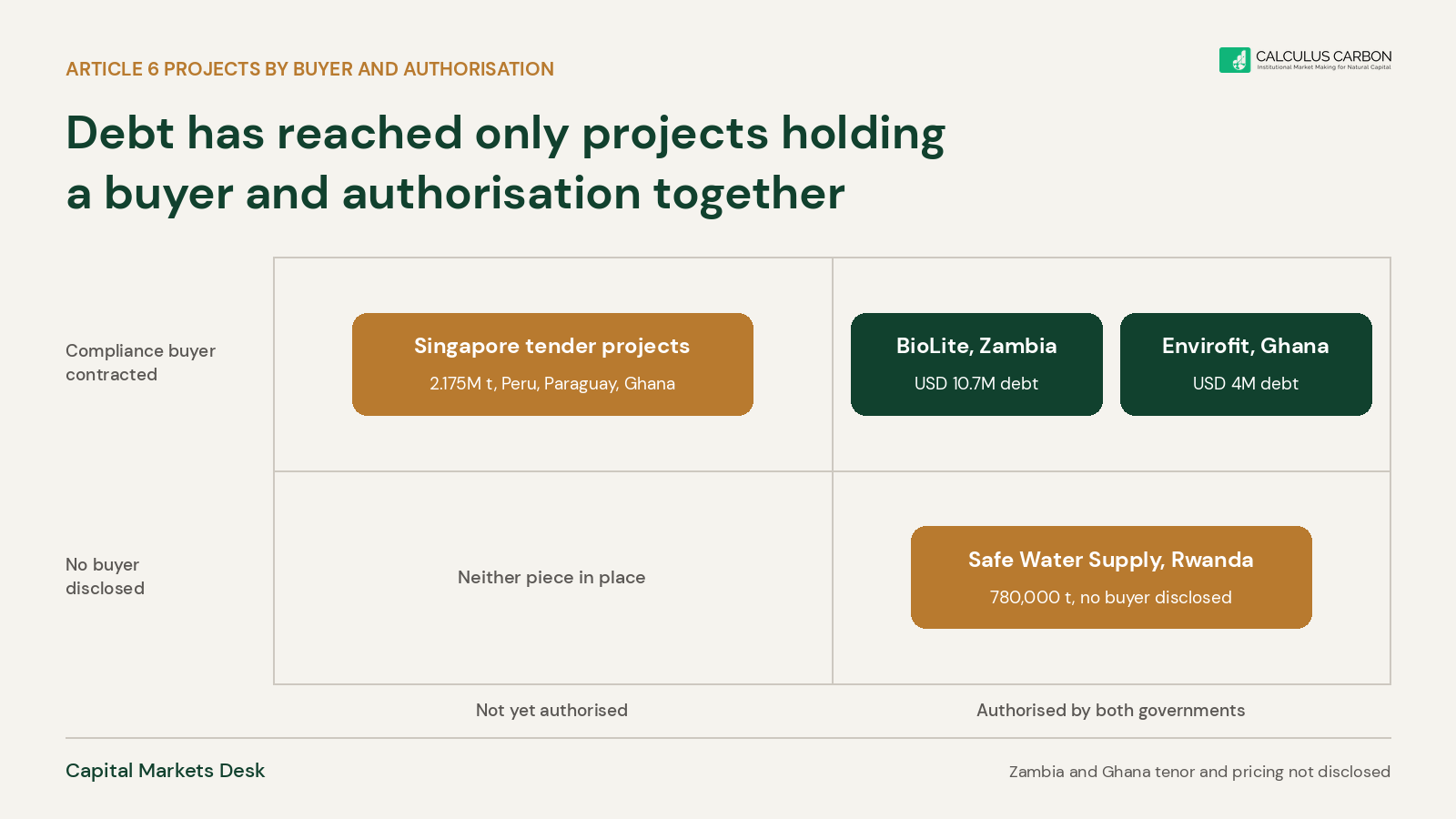
It is the clearest case of both pieces in one project. In July 2026, Africa Go Green, a debt fund managed by Cygnum Capital, provided a USD 10.7M senior debt facility to BioLite to fund at least 163,500 improved cookstoves in Zambia.10 The credits are sold to Switzerland's KliK Foundation, the body that buys mitigation outcomes abroad for Switzerland's climate target, under a mitigation outcomes purchase agreement, and the activity was authorised on 25 June 2026 under the Zambia and Switzerland agreement.10,11 Delivery insurance from CFC and Kita transfers part of the risk that fewer credits are delivered than planned.11 Calculus Carbon's earlier note on the transaction describes the purchase agreement as, in effect, the collateral for the loan.11 Africa Go Green caps its tenors at ten years, and the exact tenor and pricing of the BioLite facility have not been disclosed.11
Ghana offers an earlier case. Envirofit's cookstove activity in rural Ghana was financed with an initial USD 4M project finance facility from the Spark+ Africa Fund to a special purpose company, with a further USD 2.85M facility approved later for more stoves, and KliK buying the credits at a fixed price.12 The activity was authorised by both Ghana and Switzerland, and its first 11,733 ITMOs, issued in July 2025, were transferred to Switzerland.12 In both cases the lender had a compliance buyer with a long-term contract and a project already authorised by both governments before it lent. Two deals do not make a market, but they do show the order in which lenders have needed the pieces to arrive.
Should Developers Expect Singapore's Two Routes to Meet?
There are signs that they could. In October 2025 the Ministry of Trade and Industry launched a second request for proposals, open to both nature and technology credits from countries that have signed implementation agreements with Singapore, which includes Rwanda.9,5 An authorised project could, in principle, offer its credits into a later procurement round, or sign a multi-year contract with a taxpayer that wants a reliable supply below the tax rate. Either step would give one project both pieces.
A lender would still check three further points. The contract tenor should match the debt, which matters for the Rwanda project because most of its volume arrives from 2028. The contract should say who bears the loss if the corresponding adjustment at Stage C is delayed or refused, since authorisation at Stage B does not guarantee it. And delivery risk should be covered, as insurance did in Zambia. Until these are visible, Singapore's demand is a strong signal for developers but not yet a basis for debt.
The Read for Institutional Capital
Singapore is building real compliance demand for Article 6 credits, through a carbon tax that accepts them and a government that buys them for its own target. Each route today provides only half of what a lender needs: the tender projects have a buyer but await authorisation, and the first authorised project awaits a buyer. The Zambia and Ghana loans show that debt arrives once both sit in the same project, with insurance on top. Allocators should treat a Singapore contract or a Singapore authorisation on its own as a pipeline signal, and reserve credit appetite for projects that hold both.
Lenders to Article 6 projects have so far waited for a compliance buyer and both governments' consent to meet in one project; Singapore has created both conditions, but not yet in the same place.
This note is for information only and is not investment advice.
Sources
- [1] National Environment Agency, “Singapore Issues First Carbon Credit Project Authorisation”, 14 November 2026. nea.gov.sg
- [2] Singapore Carbon Markets Cooperation, “Project Register for Rwanda”. carbonmarkets-cooperation.gov.sg
- [3] Ministry of Sustainability and the Environment, “Singapore and Rwanda Invite Applications for Carbon Credit Projects under Bilateral Implementation Agreement”, 30 January 2026. mse.gov.sg
- [4] National Climate Change Secretariat, “Carbon Tax”. nccs.gov.sg
- [5] National Climate Change Secretariat, “Singapore Will Contract High Quality Nature Based Carbon Credits From Four Projects”, 16 September 2025. nccs.gov.sg
- [6] Singapore Economic Development Board, “Singapore to buy S$76.4 million worth of nature-based carbon credits from projects in Ghana, Peru, and Paraguay”. edb.gov.sg
- [7] OPIS, “Singapore Contracts 2.2 Million mt of Paris-Aligned Nature-Based Carbon Projects”. opis.com
- [8] Singapore Carbon Markets Cooperation, “Project Register for Ghana”. carbonmarkets-cooperation.gov.sg
- [9] Ministry of Trade and Industry, “Singapore launches second request for proposals for high quality carbon credits”, 31 October 2025. meti.gov.sg
- [10] Cygnum Capital, “Africa Go Green backs BioLite's clean cooking rollout in Zambia under Article 6.2 of the Paris Agreement”, 20 July 2026. cygnumcapital.com
- [11] Calculus Carbon, “Article 6.2 Just Got a Senior Debt Facility. The Offtake Is the Collateral.”, 8 September 2026. calculuscarbon.com
- [12] Gas Outlook, “Ghana cookstove project becomes Africa's first carbon offset deal”, 5 September 2025. gasoutlook.com
- [13] S&P Global Commodity Insights, “Singapore approves first Article 6.2 carbon project, focused on Rwanda clean water”, 16 November 2026. spglobal.com
- [14] National Climate Change Secretariat, “Singapore and Ghana Launch First Call For Project Applications Under Implementation Agreement on Carbon Credits Cooperation”, September 2024. nccs.gov.sg
- [15] National Environment Agency, “Singapore and Peru Invite Applications for Carbon Credit Projects under their Implementation Agreement”, October 2025. nea.gov.sg