Venture Debt Before Project Finance: What Terraton's HSBC Loan Is Paying For
Terraton borrowed USD 1.5M from HSBC Ventures after its first credits were issued in Kenya. Read with JPMorgan's USD 20M facility for Charm Industrial, the loan points to venture debt paying for the delivery record, buyer commitments and ticket size a project lender checks.
Carbon Removal Project Finance · Terraton and HSBC Ventures
Venture Debt Before Project Finance: What Terraton’s HSBC Loan Is Paying For
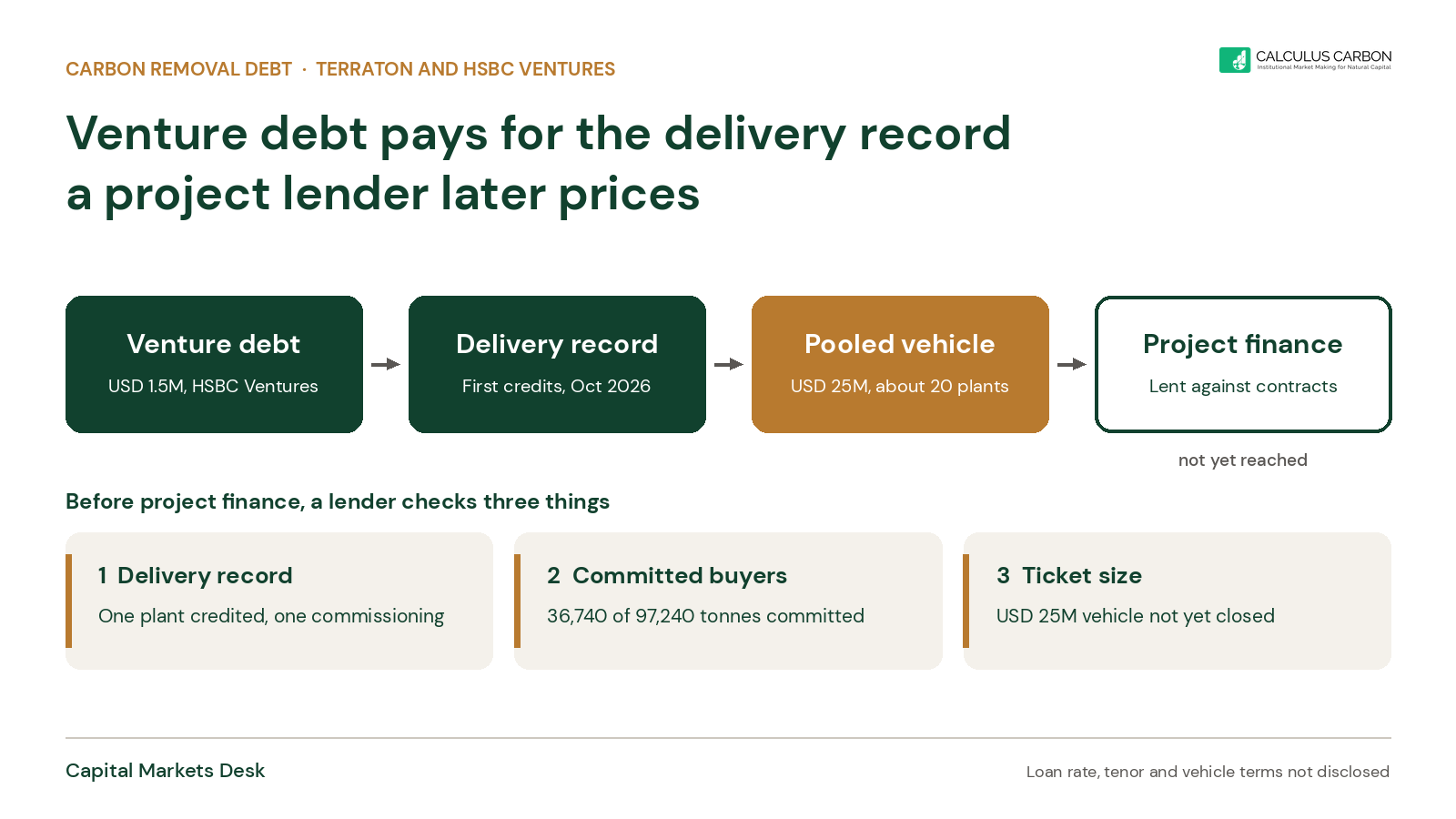
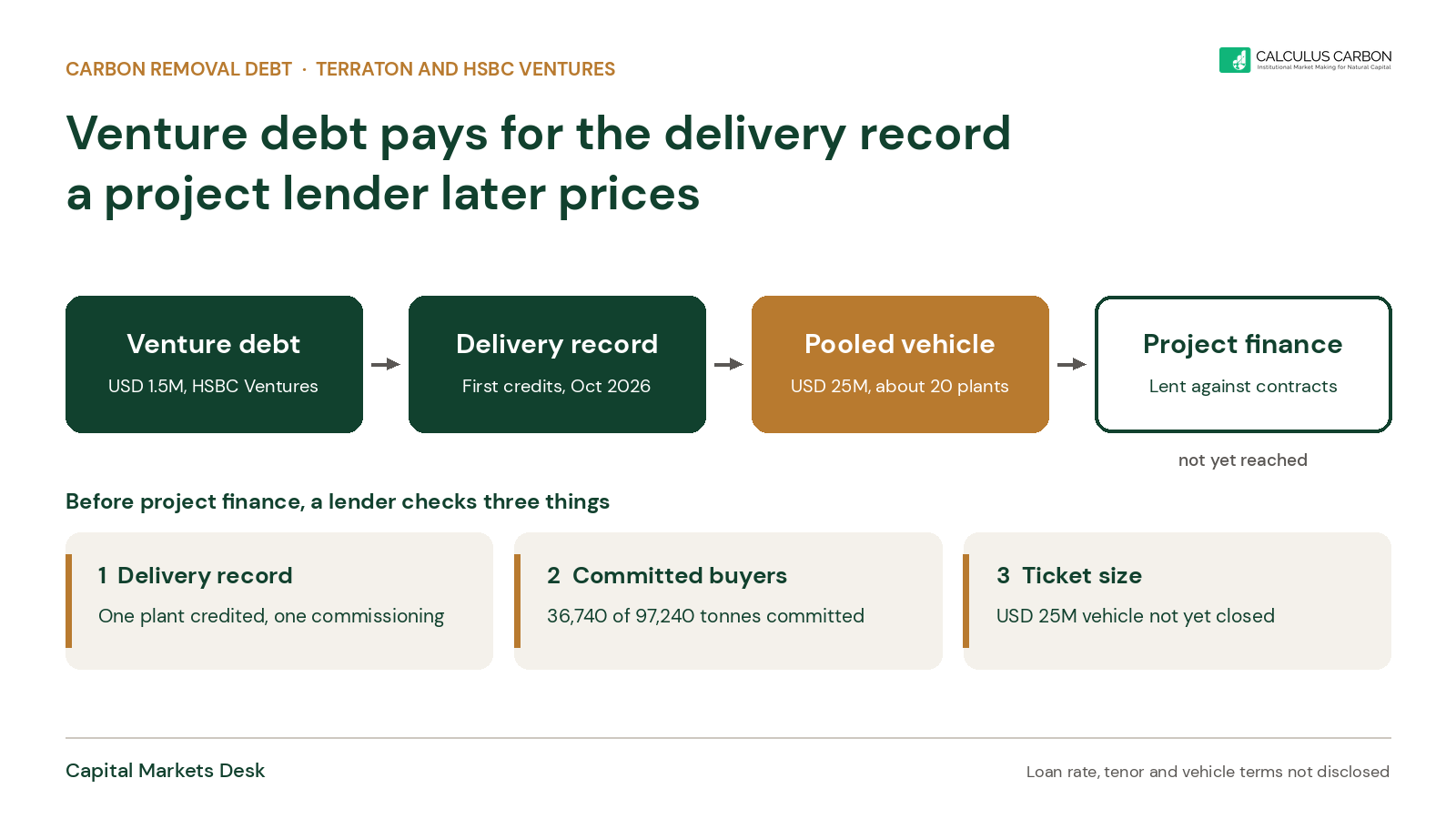
Terraton's USD 1.5M of debt from HSBC Ventures is not project finance, and it is not meant to be. It pays for more plants of one design, and so for the delivery record, contracted buyers and ticket size that a project lender checks before it lends.
The Read
An emerging practice in project finance within carbon removal is to use venture debt, a loan made to a young company on the strength of the company itself, to pay for the delivery record that a project lender needs to see before it lends against contracts. Terraton, a San Francisco biochar developer, is the latest case: on 20 October 2026 it announced USD 1.5M of debt from HSBC Ventures to fund more plants over the next two years, alongside the first credits from its plant in Kenya.1 In June, JPMorgan lent Charm Industrial USD 20M of venture debt and bought 61,500 tonnes of removals from it in the same signing.3 The Terraton loan is small, and on its own it finances nothing a project lender would recognise. Its value lies in what it pays for: more plants of the same design, each adding to the evidence that a lender later prices. This note sets out the three things a project lender checks, which are the delivery record, committed buyers and ticket size, and where Terraton stands on each.
Is Venture Debt a Form of Project Finance?
Not in the sense a project lender uses the term. Project finance is a loan to a single project company that is repaid from that project's own contracted income, so the lender looks first at the contracts and the asset rather than at the owner. Venture debt is a loan to the operating company, typically sized against the equity it has already raised and the strength of its balance sheet. A World Economic Forum report on carbon removal finance, published in May 2026, describes HSBC's venture debt in exactly these terms: non-dilutive capital, meaning it does not reduce the founders' and investors' ownership, provided to start-ups at Series A or B stage “based on balance sheet strength rather than contracted revenues”.6 HSBC Innovation Banking lists venture debt beside cash flow lending and structured finance as separate products.11
Terraton raised USD 11.5M of seed equity, co-led by Lowercarbon Capital and Gigascale Capital, before taking the HSBC Ventures loan.1 The release does not disclose the interest rate, tenor or security for the USD 1.5M, so the precise protection HSBC holds is not public. The Charm facility is larger but of the same kind: ESG Dive describes it as a USD 20M venture debt facility to expand Charm's Colorado operation, including its pyrolysis and injection capacity.3 The same WEF report frames the two instruments as stages of one sequence, with venture debt and later project finance forming “a staged capital pipeline” from early funding to infrastructure scale.6
Does One Plant's Credits Give a Lender a Delivery Record?
It gives a lender the start of one. A delivery record is the history of a developer building plants on time and producing the volume of credits it promised. Lenders care about it because, as the WEF report puts it, banks cannot reliably assess delivery risk without historical performance data, and “if risk cannot be priced, lending does not occur”.6 Terraton's first plant sits at EcoFix, a nut processor in Nanyuki, Kenya, which turns agricultural waste into biochar, a charcoal that stores carbon for long periods when added to soil. The final investment decision was taken in August 2025, biochar production began in May 2026, and Isometric, a carbon removal registry that verifies and issues credits, issued the first credits in October 2026.1 That is about 14 months from decision to credits, with measurement data collected digitally through Offstream, a digital measurement, reporting and verification provider.1 One plant with one set of issued credits is evidence that the design works, but not yet evidence of how it performs over several years, across feedstock seasons or under different operators.
The more useful feature for a lender is repetition. Terraton states that every facility uses the same design, equipment and reporting, and a second site with Tupande, part of One Acre Fund, in Sagana, Kenya, is being commissioned.1 It reports 28 memoranda of understanding and a pipeline of more than 30 sites across Africa, South America, South Asia and Southeast Asia, and is targeting a ten-month build for each plant.1 If the HSBC money funds two or three further plants that perform like the first, a lender can compare each new plant against a known template rather than diligence a new design each time. Charm offers the comparison: JPMorgan's head of climate tech in commercial banking named long-term offtakes, “a proven ability to deliver against those contracts, and a scalable operational model” as the reasons for lending, and Charm's chief financial officer called the deal proof of financeability.3,4 Calculus Carbon's earlier note on that transaction sets out how the same bank sat on both sides as lender and buyer.5
Is the 97,240 Tonne Headline the Same as Contracted Tonnes?
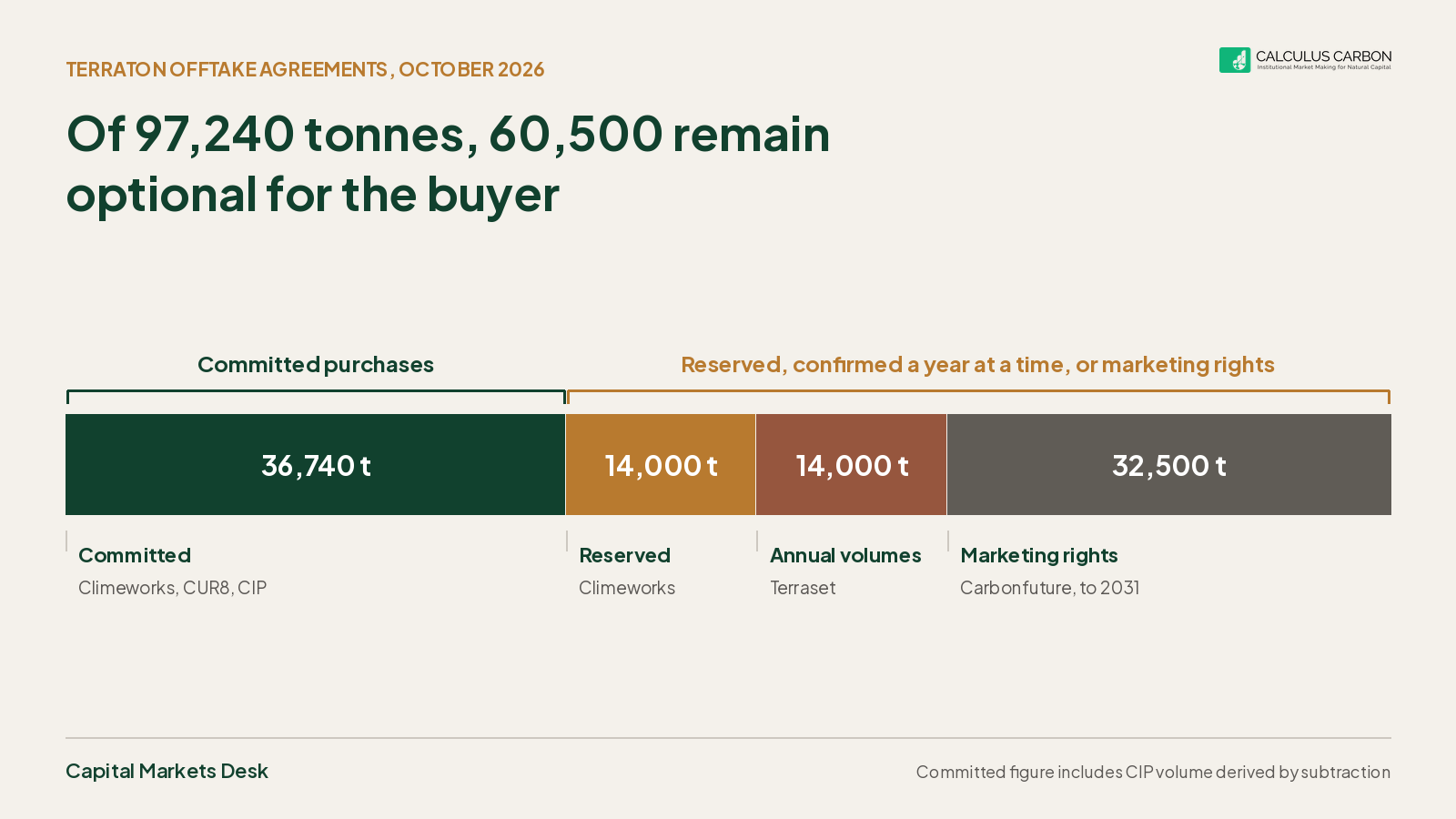
No, and the distinction matters more to a lender than the headline. Terraton's release describes agreements for “up to 97,240 tonnes”, made up of committed purchases, reserved volumes and marketing rights.1 Climeworks Solutions committed to 2,000 tonnes from EcoFix and reserved a further 14,000. Terraset signed a seven-year offtake for up to 14,000 tonnes with annual volumes confirmed in advance, building on its earlier pre-purchase. Carbonfuture holds rights to market up to 32,500 tonnes through 2031. CUR8 agreed 240 tonnes for a global consumer brand, and Climate Impact Partners made committed purchases from EcoFix, Tupande and future sites.1,2
Adding up the optional parts gives 60,500 tonnes, or about 62 percent of the total, that are reserved, confirmed a year at a time, or held as marketing rights. The remaining 36,740 tonnes include the stated committed volumes and, by subtraction, Climate Impact Partners' share, which the release does not break out. Prices are not disclosed for any of the agreements.1 For the buyers, most of which are intermediaries selling on to corporate clients, keeping volumes optional is sensible: they can test demand before committing to long-term offtakes. A lender reads the same terms differently. The WEF report finds that bankability depends on “fixed-price, creditworthy, multi-year offtake agreements aligned with debt repayment cycles”, and a reservation or marketing right does not oblige anyone to pay.6
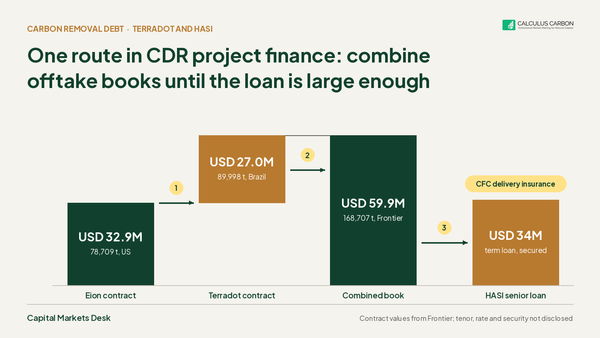
The recent carbon removal loans confirm the pattern. Vaulted Deep's USD 35M from Mediobanca rested on waste service agreements and contracted removals with Frontier buyers.9 InPlanet's facility with Idemitsu is backed by contracted removals for Microsoft.10 Terradot's USD 34M from HASI is secured on fixed-price Frontier offtakes and delivery insurance.8 In each case, the tonnes behind the loan were contracted, not reserved. Terraton's agreements may convert in time, and the structure gives buyers a reason to do so once delivery is proven, but until they convert a lender can count only the committed portion as income it can rely on.
Can a Pooled Vehicle Reach the Ticket Size Lenders Need?
Ticket size is the third test. Each Terraton plant is small, and institutional lenders have fixed diligence costs that make small loans uneconomic. The WEF report notes that deals at typical project sizes of USD 5M to USD 50M are often slow and costly to arrange, that direct engagement with a single bank can take 12 to 18 months, and that growth-stage companies typically need USD 10M to USD 50M to move to project finance.6 A single biochar plant sits well below that range. Lending separately against each plant would mean repeating legal work, technical review and monitoring for every small loan, which is the cost problem a portfolio structure is designed to solve.
Terraton's answer is a USD 25M pooled vehicle, now in development, to finance about 20 facilities.1 The company argues that because each plant uses the same design, equipment and reporting, the fund can underwrite the facilities as one portfolio across operators and countries.1 This matches a finding in the WEF report: pooled vehicles reduce transaction costs, and portfolios that hold a single technology let investors assess risk once and apply it across comparable assets.6 Terradot reached size by a different route, buying a competitor and putting two Frontier contract books under one owner before its HASI loan, as Calculus Carbon's note last week described.7,8 Terraton is attempting the same result through a fund rather than a merger.
The vehicle has not closed, and its terms, investors and capital structure have not been published.1 It also does not remove the other two tests. A pool of 20 plants whose output is mostly reserved rather than contracted would be a larger loan against the same uncertain income.
Should Lenders See Venture Debt as the First Step Towards Project Finance?
On the evidence of 2026, it is reasonable to treat it that way, provided the step is measured by what the loan buys rather than by its size. Two banks, JPMorgan and HSBC, have now lent venture debt to carbon removal developers in the same year, and the WEF report describes this as one stage in a staged sequence of capital.3,6 That is enough to call it an emerging practice, though the number of cases remains small and neither loan's pricing has been disclosed.
The practice has merit when three conditions hold. The loan should fund replication of a design that has already produced verified credits, so each new plant adds to a comparable record. The buyers should have a path from reservations to fixed, multi-year commitments as delivery is proven, which Terraset's annual confirmations and Climeworks Solutions' reserve already imply. And the developer should have a credible way to reach a lendable ticket, whether through a pooled vehicle, a common-terms facility that admits further lenders, or consolidation. If any of these is missing, venture debt simply adds leverage, meaning more borrowing, to an early-stage company. The risk is also concentrated: the lender is exposed to one operating company, and a delay at a single plant affects the whole loan rather than one project within a pool.
The Read for Institutional Capital
Terraton's USD 1.5M is not a project finance transaction, and allocators should not read it as one. Its relevance is that it pays for a sequence of identical plants whose delivery can be measured, and so builds the record a project lender later prices. The two remaining conditions are buyer commitment, with 60,500 of 97,240 tonnes still optional, and ticket size, which depends on a USD 25M vehicle that has not yet closed. Allocators assessing pooled biochar vehicles should look first for converted offtakes and plant-by-plant delivery data, and only then at the headline volume.
Venture debt in carbon removal is earning a place before project finance by funding repeatable plants and the evidence they produce; it becomes bankable only once that record is matched by contracted tonnes and a ticket large enough to lend against.
This note is for information only and is not investment advice.
Sources
- [1] Terraton press release via FinanceWire, “Terraton Issues First Carbon Removal Credits from Agricultural Waste, Signs Agreements with Climeworks Solutions, Climate Impact Partners, Carbonfuture, CUR8 and Terraset”, 20 October 2026. webdisclosure.com
- [2] Terraton press release via Yahoo Finance, “Terraton Issues First Carbon Removal Credits”, 20 October 2026. finance.yahoo.com
- [3] ESG Dive, “JPMorgan signs carbon offtake and financing deal with Charm Industrial”, June 2026. esgdive.com
- [4] Carbon Herald, “JPMorganChase Deepens Charm Industrial Partnership With A New CDR Deal And Debt Financing”, June 2026. carbonherald.com
- [5] Calculus Carbon, “Same Bank on Both Sides: The Charm-JPMorgan Prototype for Carbon Project Finance”, 10 August 2026. calculuscarbon.com
- [6] World Economic Forum, “Banking Carbon Removal: From Early Deals to Scalable Finance”, May 2026. reports.weforum.org
- [7] Calculus Carbon, “Two Offtake Books, One Loan: How Terradot Reached an Institutional Debt Ticket”, 3 November 2026. calculuscarbon.com
- [8] Business Wire, “Terradot and HASI Close $34M Investment for Carbon Removal Projects”, 27 October 2026. businesswire.com
- [9] CFP Energy, “Vaulted Deep Secures $35 Million in Debt Financing with CFP Energy to Expand Nationwide”, 21 September 2026. cfp.energy
- [10] InPlanet, “InPlanet and Idemitsu Americas Holdings Close Non-Recourse Debt Facility”, 17 September 2026. inplanet.earth
- [11] HSBC Innovation Banking, “Climate Tech” sector page. hsbcinnovationbanking.com