One Route in NbS Project Finance: A Tranched Vehicle for Smallholder Agroforestry, Repaid From Carbon Revenue
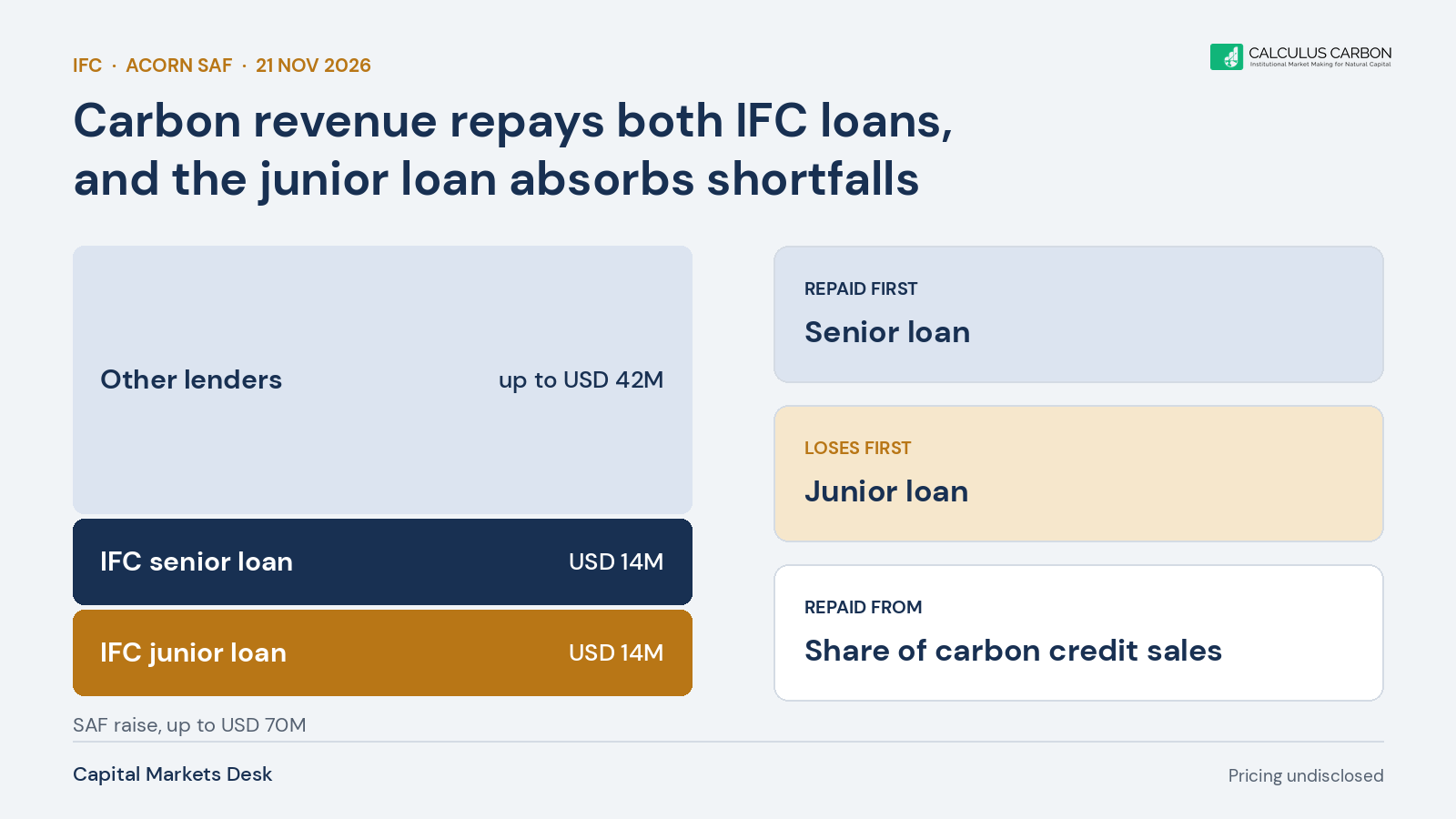
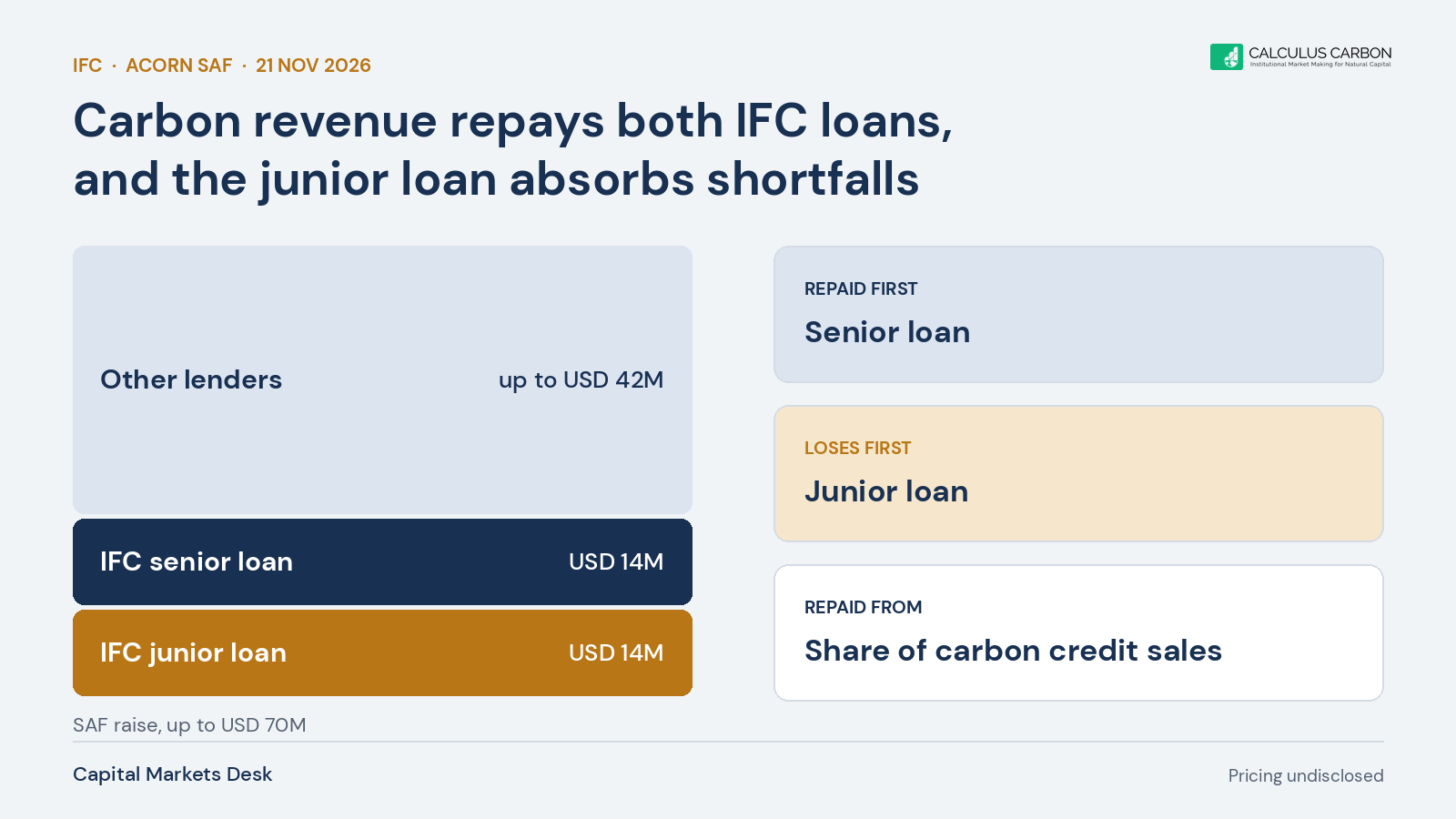
IFC has disclosed a proposed USD 28M investment, split equally between senior and junior loans, in Smallholder Agroforestry Finance, the Acorn vehicle that pre-finances about 15 agroforestry projects and is repaid from carbon credit revenue.
Project Finance · Agroforestry · 23 November 2026
One Route in NbS Project Finance: A Tranched Vehicle for Smallholder Agroforestry, Repaid From Carbon Revenue
An emerging practice in project finance within nature-based solutions is to pre-finance many smallholder agroforestry projects through one tranched lending vehicle, repaid only from a share of future carbon credit revenue and on a schedule that follows tree growth. The proposed IFC loans to Acorn's Smallholder Agroforestry Finance vehicle, disclosed on 21 November 2026, are the latest example.
The Read
An emerging practice in project finance within nature-based solutions (NbS), meaning projects that restore or protect ecosystems, is to pre-finance many smallholder agroforestry projects through one tranched lending vehicle, repaid only from a share of future carbon credit revenue and on a schedule that follows tree growth. On 21 November 2026, the International Finance Corporation (IFC), the World Bank Group's private sector arm, disclosed a proposed investment of up to USD 28M in Smallholder Agroforestry Finance B.V. (SAF), split into a senior loan of up to USD 14M and a junior loan of up to USD 14M.1 SAF is a Dutch special purpose vehicle (SPV), a company set up for one financing purpose, that will be wholly owned and managed by Acorn, the agroforestry carbon business that began inside Rabobank and was spun off as a standalone entity in March 2026.1 SAF plans to raise up to USD 70M across two closings and to provide upfront capital to around 15 agroforestry projects through local partners, mainly in Africa.1 The investment is pending approval, with an IFC board date projected for 22 December 2026.1
Is This a Fund, a Loan or Project Finance?
It is a lending vehicle that sits between development finance institutions and a portfolio of small projects, and each layer carries a different risk. At the top, IFC lends to SAF, so its direct exposure is to the vehicle rather than to any single farm.1 SAF then lends to local partners, which the disclosure describes as the parties implementing the sub-projects, and IFC classifies the deal as a financial intermediary investment with on-lending for agricultural finance.1 On-lending means that SAF borrows the money and then makes its own loans with it.
The local partners are NGOs, cooperatives, farmer organisations and agricultural value chain companies, according to a separate disclosure by FMO, the Dutch development bank.2 They use the money for farmer input packages, such as seedlings and training, and for selected operating costs.2 The farmers keep ownership of the trees; an Acorn presentation on SAF states that the structure deliberately excludes private equity for that reason.4 Across the portfolio, IFC expects about 847,000 farmers, 162M trees on 750,000 hectares, and 7.0M tonnes of certified carbon credits over a 12-year term.1
Does the Senior and Junior Split Matter?
It does, because the junior loan is what allows the senior loan to be lent on these terms. A junior loan is repaid after the senior loan and absorbs losses first, so it protects the senior lender if part of the portfolio underperforms. In this proposal, IFC would hold both layers in equal amounts, whereas Acorn's earlier design showed donor money in the junior layer.1,4
Acorn's own description of SAF shows the intended design. A World Economic Forum case study from May 2025 says the vehicle blends catalytic and commercial capital through tranching, with the tranches bearing the risk that farmers do not perform.3 The Acorn presentation labels the senior tranche as capital preservation and shows donors in the junior tranche, alongside a separate technical assistance facility.4 IFC marks the deal as blended finance but lists the blended element as still to be determined.1 FMO separately proposes a USD 17.45M loan to SAF together with other development finance institutions, although its disclosure does not say in which tranche.2
Can Carbon Revenue Repay the Principal?
It can, provided the trees grow and the credits sell, because carbon revenue is the only repayment source. Acorn sells the carbon removal units, or CRUs, its term for the credits, to corporate buyers, and the credits are certified by Plan Vivo, an independent standard for community land projects.3 Of each sale, Acorn keeps 10% and the local partner receives 10%, while the remaining 80% is the farmer's share; the loan is repaid from that share before the farmer receives the remainder.3 Acorn pays the repayment directly to SAF's financiers.3,4
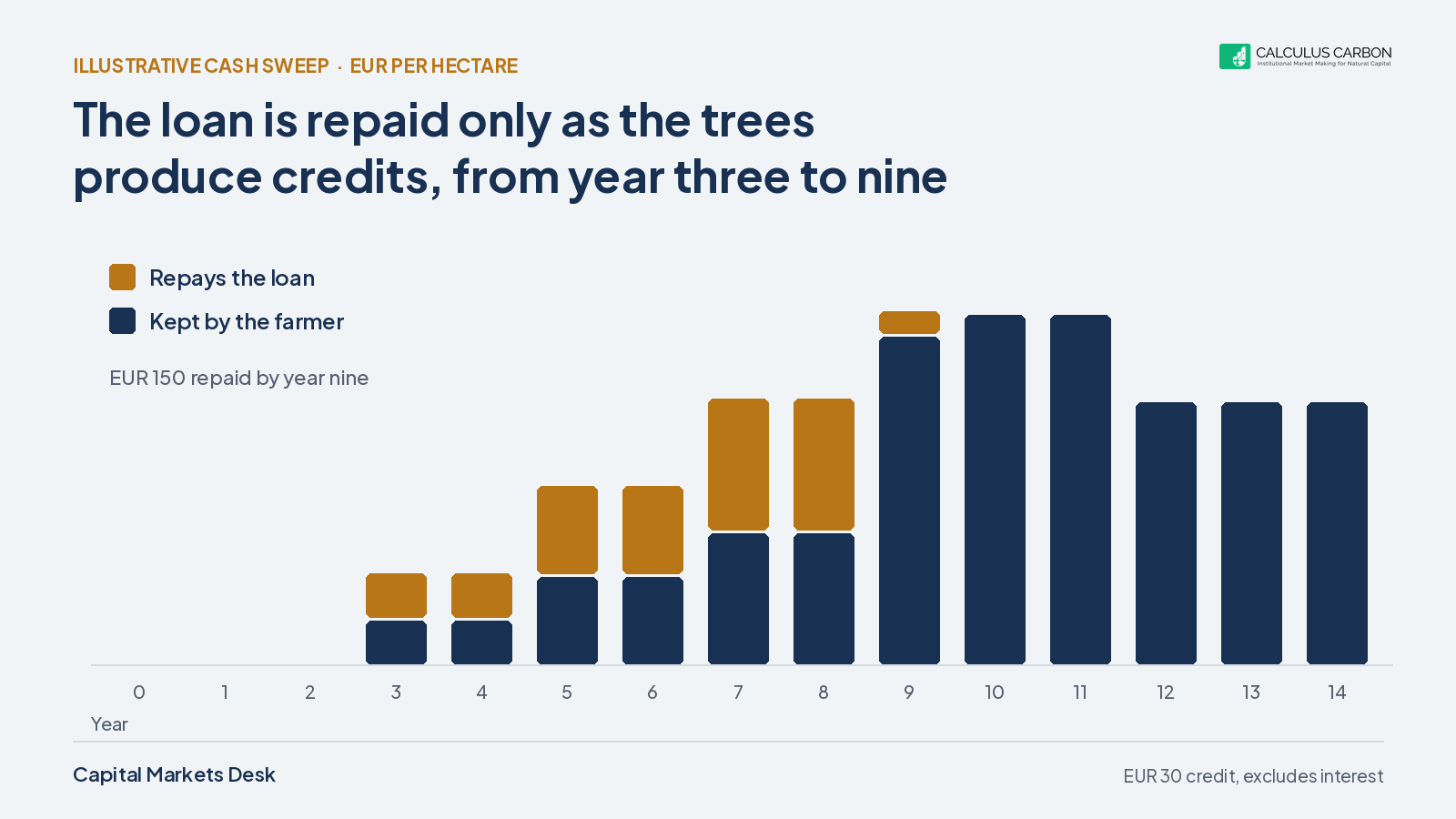
The presentation describes the repayment as a cash sweep, meaning a fixed portion of incoming revenue that goes to the lender, which rises as the trees put on biomass.4 Because credits are issued only after carbon is measured, there are no repayments or interest payments in years with no credits.4 In its illustrative example, EUR 150 of pre-finance per hectare is repaid between year three and year nine at a carbon price of EUR 30, excluding interest, after which the farmer keeps the full farmer share.4 IFC's 12-year loans are structured the same way, with back-ended principal repayment, meaning most principal falls due late in the term, aligned with the cash flow cycle of the agroforestry assets.1
The principal and the return should be read separately. Principal comes back from the carbon sweep, collected by Acorn and passed through SAF to its lenders. The return is the interest on the loans, and IFC has not disclosed the pricing of either tranche; the earlier Acorn presentation quoted rates of 8% to 10% for SAF, against 15% to 25% for conventional microfinance.1,4 Crop income from the new trees stays with the farmers and is not pledged to the lenders.4
Is the Practice Recurring or a One-Off?
It is recurring, which is why we call it an emerging practice. Before settling on that wording, we looked for comparable vehicles that pool many small carbon projects into one borrower and use a loss-absorbing layer to make senior lending possible. The Acorn programme itself is the clearest precedent: a June 2025 World Economic Forum report said it had raised about USD 100M through catalytic capital from aid agencies, with more senior tranches from Rabobank, Oikocredit and the US International Development Finance Corporation.5 The disclosures do not explain how that earlier raise relates to the new USD 70M programme.
The same design appears in carbon dioxide removal (CDR), the technologies that take carbon out of the air. A May 2026 World Economic Forum report describes CUR8 aggregating smaller removal projects into SPVs, using fixed offtakes, insurance and limited first-loss capital so that banks can lend at a cost of capital of about 7% to 12%.6 IFC itself now tracks, as a results indicator for this deal, the number of carbon credit developers raising finance through a single-developer vehicle, which suggests it expects the format to repeat.1 The new element in the SAF proposal is a development finance institution holding both the senior and junior layers, with a 12-year tenor that IFC describes as not readily available in the market.1
Should Other Lenders Accept Carbon-Only Repayment?
Only on clear conditions, and the conditions are specific to this structure. The first is volume: the 7.0M credits depend on tree survival and measured biomass across hundreds of thousands of small plots, so the junior layer has to be sized for underperformance.1 The second is price, because the sweep is a share of revenue and a lower credit price lengthens repayment; IFC does not disclose any offtake or price floor. The third is governance, since IFC requires Acorn to screen out higher-risk sub-projects and to strengthen land tenure checks, grievance procedures and its environmental and social system by July 2027.1
The limits are equally clear. All the credits come through one platform and one standard, so lenders take concentrated exposure to Acorn's ability to sell. Repayment is also exposed to demand in the voluntary carbon market, where companies buy credits by choice rather than under regulation. For SAF specifically, the open items are the pricing of each tranche, the identity and terms of the other lenders, and any contracted buyers for the credits.1,2
The Read for Institutional Capital
The route of pre-financing smallholder agroforestry through a tranched vehicle that is repaid from a share of carbon revenue, on a schedule that follows tree growth, is an emerging practice in project finance within NbS. The IFC proposal builds on Acorn's earlier SAF raise and resembles the CUR8 aggregation approach in CDR, and it adds a 12-year, back-ended loan with IFC holding both the senior and junior layers.1,5,6 For a commercial lender considering the remaining capital in the USD 70M raise, the questions are how thick the junior layer is, what credit price the repayment case assumes, and who has agreed to buy the credits.1
A loan to thousands of small farms becomes lendable when the carbon those farms produce sets both the amount and the timing of repayment, and a junior layer absorbs the plots that fall short.
This note is for information only and is not investment advice.
Sources
- [1] IFC, Acorn SAF (Project 50870), Summary of Investment Information, disclosed 21 November 2026. disclosures.ifc.org
- [2] FMO, Project detail: Smallholder Agroforestry Finance B.V., published 13 October 2026. fmo.nl
- [3] World Economic Forum, Financing the Transition Community, case study: Acorn x Rabobank, 14 May 2025. initiatives.weforum.org
- [4] Acorn, Smallholder Agroforestry Finance presentation, annex to an AFoCO meeting, undated. media.afocosec.org
- [5] World Economic Forum, Putting Food on the Balance Sheet: Financing Strategies to Scale Investment in Food Systems, June 2025. reports.weforum.org
- [6] World Economic Forum, Banking Carbon Removal: From Early Deals to Scalable Finance, May 2026. reports.weforum.org