Delivery Risk Terms in a Carbon Offtake Are Project Finance Terms
Project Finance · Nature-Based Solutions · 12 August 2026
Delivery Risk Terms in a Carbon Offtake Are Project Finance Terms
Nature-based-solutions offtake clauses on buyer termination, security instruments and insurance decide whether a long-term contract can raise debt at all.
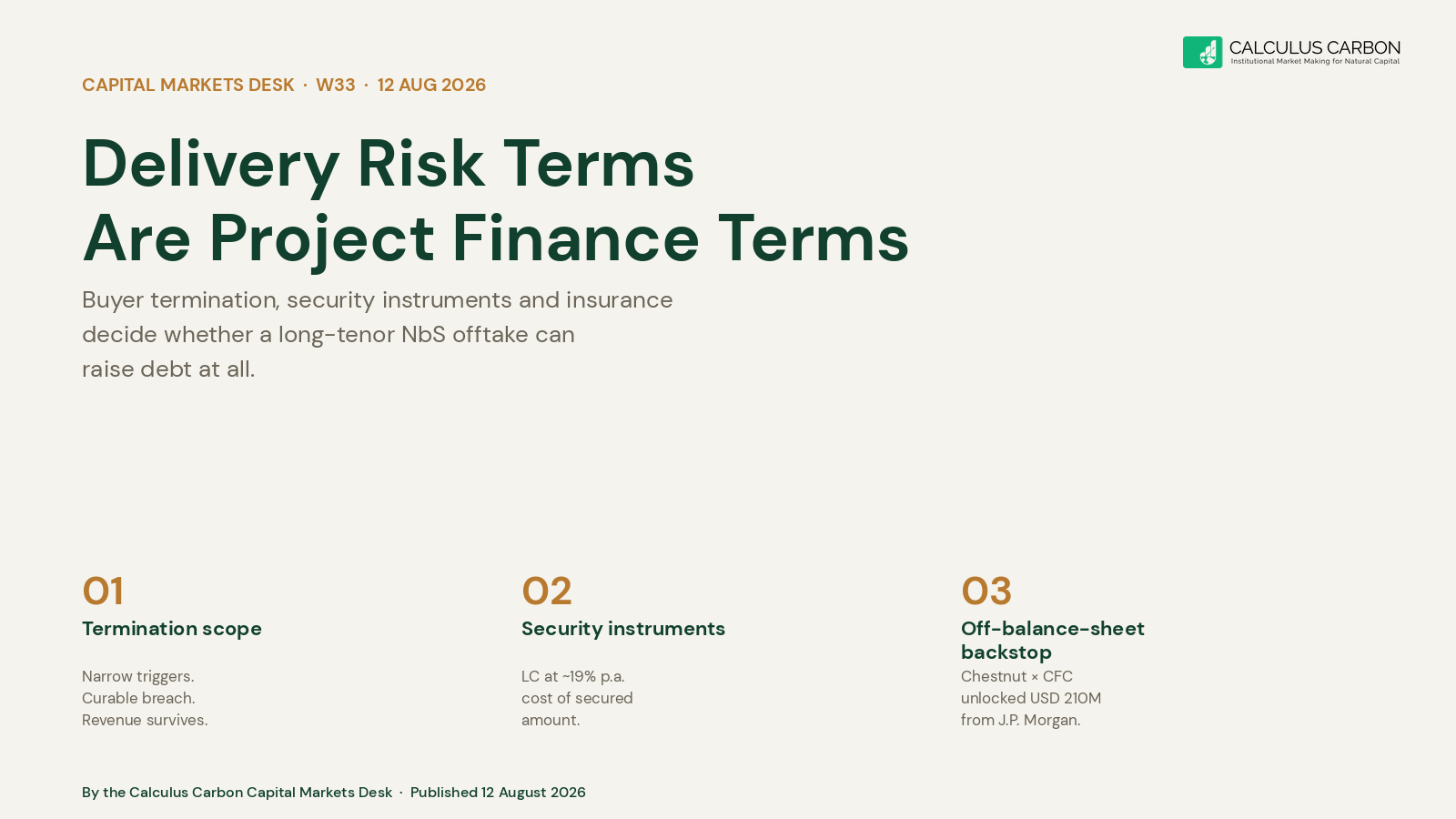
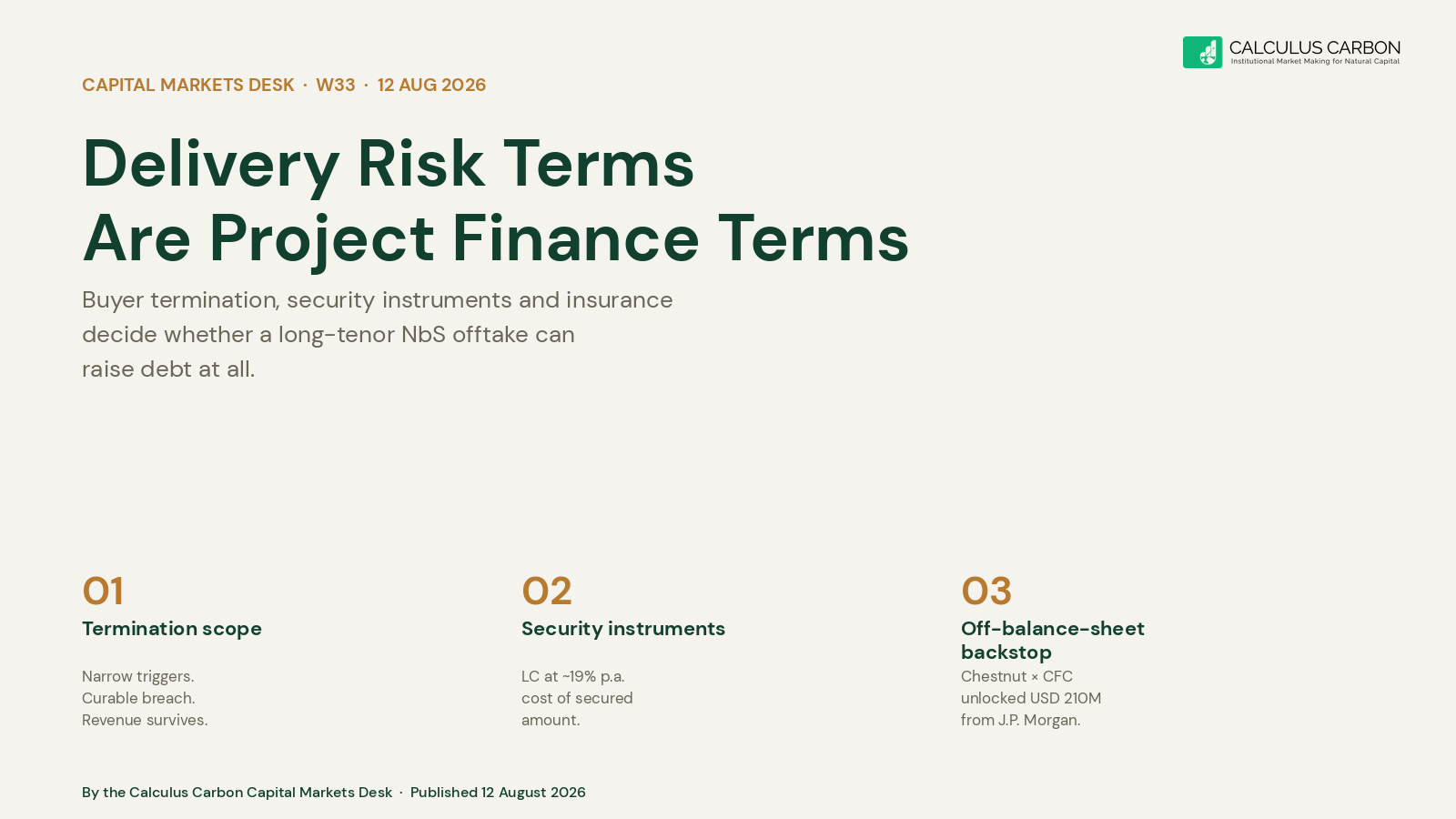
Long-tenor nature-based-solutions offtake contracts are increasingly the load-bearing instrument in project finance for restoration and land-use projects. A 10 to 25 year corporate purchase commitment for verified removal or reduction units is the closest thing the sector has to a Power Purchase Agreement, and it is the document a lender reads before extending non-recourse debt against the project. The CrossBoundary and Symbiosis Coalition Carbon Offtake Guide, published in 2026, is the first structured attempt to codify what those contracts should contain, and it lands in a market where the clauses on delivery risk are quietly deciding whether a contract can raise debt at all.1 Three provisions in particular carry the load: the scope of buyer termination rights, the cost of security instruments the developer posts, and whether the residual planting-to-issuance backstop sits on the developer's balance sheet or off it.
Why Do Buyer Termination Rights Sit at the Top of the Lender's File?
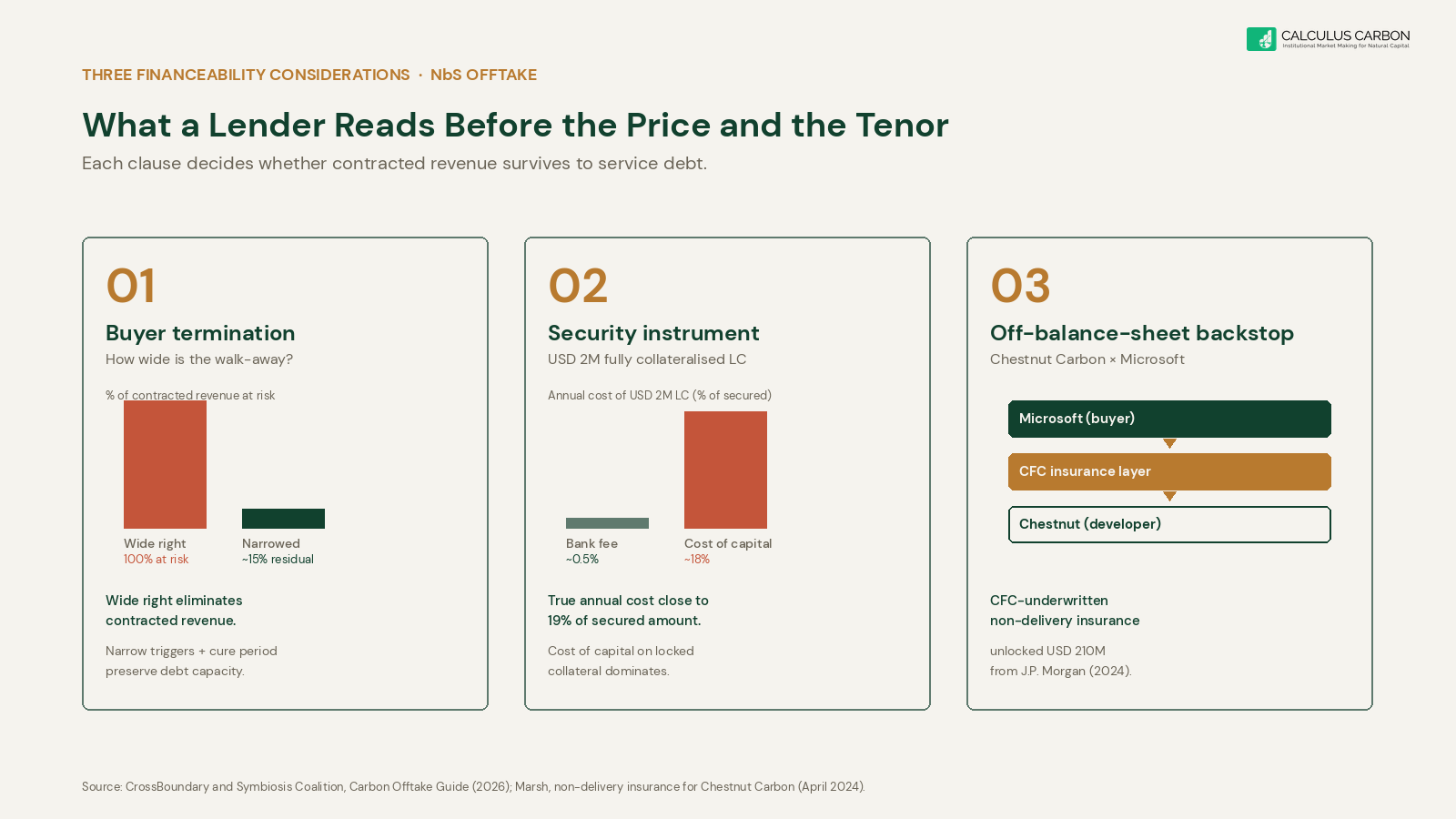
The lender underwrites a long-tenor offtake as a contracted revenue stream. Everything in the debt sizing spreadsheet, tenor, coupon, drawdown schedule, debt service coverage ratio, sits on the assumption that the buyer will honour the contract for its full life. A broad, unqualified termination right in the buyer's favour collapses that assumption. If the buyer can walk away for any material adverse development, or for a soft interpretation of a delivery shortfall, the revenue is not contracted in a project-finance sense. It is optional. The Carbon Offtake Guide notes that termination clauses drafted with buyer procurement discretion in mind, rather than lender bankability in mind, can eliminate the very contracted revenue the offtake was meant to raise capital against.1
The financeable version narrows the termination scope in three ways. First, termination triggers are enumerated and objectively measurable, not left to the buyer's reasonable judgement. Second, breaches that can be remedied are treated as curable, with a defined cure period during which the buyer cannot walk. Third, remedies for delivery shortfalls are calibrated as damages or price adjustments rather than blanket termination, so a delayed delivery does not extinguish the contract. Buyers, especially the anchor Symbiosis Coalition members, Meta, Microsoft, McKinsey and Salesforce,4 are increasingly willing to accept this discipline where the alternative is that their preferred developer cannot close the debt round that finances the very units they are contracting for.
What Is the True Annual Cost of a Fully Collateralised Letter of Credit?
The second frontier of the delivery risk conversation is the security instrument the developer posts to back its own performance. A Letter of Credit, an escrow deposit, or a performance bond gives the buyer a claim on hard cash in the event of a delivery shortfall. In principle this is what buyers want. In practice, for a project developer operating on a thin balance sheet, the instrument is expensive in a way that does not always surface in the negotiation.
The CrossBoundary and Symbiosis guide runs the arithmetic on an illustrative USD 2M fully collateralised Letter of Credit. The bank fee to write the instrument is a few tens of basis points a year. The dominant cost is not the bank fee, it is the cost of capital on the collateral the developer immobilises to back the LC. Cash locked as LC collateral cannot be spent on planting, on nursery expansion, on payroll, or on debt service. It has to earn its blended cost of capital elsewhere in the project, or the project runs short. Adding the bank fee to the developer's cost of capital, the guide puts the true annual cost of a fully collateralised USD 2M LC at close to 19 per cent of the secured amount.1 On a USD 10M LC that is USD 1.9M a year of foregone value. Over a ten-year offtake tenor, on undiscounted terms, that is nineteen times the secured amount in cumulative economic cost.
The load-bearing observation for the negotiation is that a security instrument is only economically sensible where the residual delivery risk it covers, after every other risk mitigant has been applied, is materially larger than the cost of the instrument itself. In practice this argues for a layered structure. Conservative contracted volumes, sized well below the developer's expected issuance, reduce the probability of shortfall at source. Milestone-linked delivery schedules, tied to verifiable planting or measurement, reduce the volume of exposure at any given point in the contract. Calibrated shortfall damages, set at a level that compensates the buyer without extinguishing developer economics, further narrow the residual risk. Only then does the security instrument step in, sized to the smaller residual number, and its cost is proportionate.
When Does the Backstop Belong Off the Developer's Balance Sheet?
In situations where a hard backstop is genuinely required, either because the buyer's procurement policy demands it or because the project has a specific window of unresolvable delivery risk, the guide argues that the backstop should move off the developer's balance sheet altogether. Insurance and third-party guarantees are the two vehicles.1
The clearest live precedent is the Chestnut Carbon and Microsoft transaction announced in early 2025.3 Chestnut Carbon signed a 25 year offtake with Microsoft for verified removals from an afforestation programme in the United States South. The offtake covered a delivery window that ran from planting through to the first issuance of credits, a window of several years during which trees are in the ground but no credits have yet been generated. The residual risk in that window, that trees fail to establish, that measurement rules shift, or that verification is delayed, does not fit cleanly onto a young developer's balance sheet.
The structure that closed the transaction paired the Microsoft offtake with a non-delivery insurance policy underwritten by CFC, a specialist insurer, and brokered by Marsh.2 The policy is not indemnifying the buyer against a walk-away by Chestnut Carbon. It is indemnifying against verified non-delivery of the contracted removal tonnage during the planting-to-issuance gap. That specific structural piece, insurance sitting between the developer and the buyer for the delivery risk that neither party wants on its own balance sheet, played a documented role in J.P. Morgan closing a USD 210M non-recourse debt facility against the offtake.5 The lender's bankability question was no longer, what happens if Chestnut fails to deliver in year four. It was, who is on the hook if delivery is short, and is that party investment-grade credit. With CFC on the risk, the question resolved.
The pattern generalises. A guarantee from an export credit agency, a first-loss cushion from a Development Finance Institution, or a private non-delivery insurance product each does the same structural work. Each moves a piece of residual delivery risk from the developer's balance sheet to a specialist balance sheet that is priced and capitalised to hold it. Each unlocks a proportion of debt capacity that would otherwise sit un-financeable.
How Do Buyer and Lender Protections Get Reconciled in One Contract?
The reconciliation is not a negotiating trick. It is a structural sequence. The buyer's procurement team has a legitimate need to know that if delivery falls short, there is a remedy proportionate to the shortfall. The lender's credit team has a legitimate need to know that contracted revenue survives all but the most extreme delivery failures, because a debt facility sized to that revenue has to be serviced.
Astute deal structuring builds up the same protections in a stack that reads well to both readers. Conservative contracted volumes, planted milestones, calibrated damages, curable breach terms and narrowed termination scope sit in the offtake contract itself. In situations where residual risk remains after those layers, security instruments are sized to that residual number, not to the headline contract volume. In situations where a hard backstop is required, insurance or guarantee moves it off the developer balance sheet. Each of these tools has a place. The failure mode for contracts as project-finance instruments is not the presence of buyer protection. It is the sequencing, or the assumption that a fully collateralised security instrument is a cheap substitute for a well-drafted contract.
The Read for Institutional Capital
Capital allocators evaluating a long-tenor nature-based-solutions offtake for its debt-raising capacity should read three specific clauses before the price and the tenor. First, the termination scope, because a wide right to terminate erases the contracted revenue the debt is being sized against. Second, the security instrument requirement, because the developer's cost of capital sitting inside a Letter of Credit at close to 19 per cent a year is a hidden expense that will show up in either the developer equity return or in reduced debt capacity. Third, the residual-risk backstop, because moving that risk to an insurer or a guarantor, as Chestnut Carbon did with CFC to close the J.P. Morgan facility, converts a bankability question into a counterparty credit question. The contract that gets these three right is a project-finance instrument. The contract that treats delivery risk as a procurement issue alone tends to sit on a developer's shelf, waiting for a lender who never turns up.
Delivery risk clauses in a long-tenor offtake are project finance terms. Read them before the price and the tenor.
This piece extends the LinkedIn post scheduled 12 August 2026. Analysis by the Calculus Carbon Capital Markets Desk.
Sources
- [1] CrossBoundary and Symbiosis Coalition, Carbon Offtake Guide (2026). crossboundary.com
- [2] Marsh, non-delivery insurance and bank financing for Chestnut Carbon (16 April 2024). marsh.com
- [3] Chestnut Carbon and Microsoft, 25-year removal agreement (30 January 2025). chestnutcarbon.com
- [4] Symbiosis Coalition, founding members and buyers. symbiosiscoalition.org
- [5] J.P. Morgan, USD 210M non-recourse debt facility for Chestnut Carbon (16 April 2024). jpmorgan.com