The Small Cheque Before The Loan: How Carbon Removal Pre-Purchases Build The Path To Project Finance
Small upfront pre-purchases fund the first verified tonnes of carbon removal. That delivery record is what later offtake buyers and lenders price.
Project Finance · Carbon Removal · Offtake Ladder · 6 October 2026
The Small Cheque Before The Loan: How Carbon Removal Pre-Purchases Build The Path To Project Finance
Salesforce has signed another round of small carbon removal pre-purchases. Against multi-million-tonne offtakes, the volumes look trivial. In practice, they are the first rung of a ladder that ends with a lender, and Vaulted Deep shows every step.
The Read
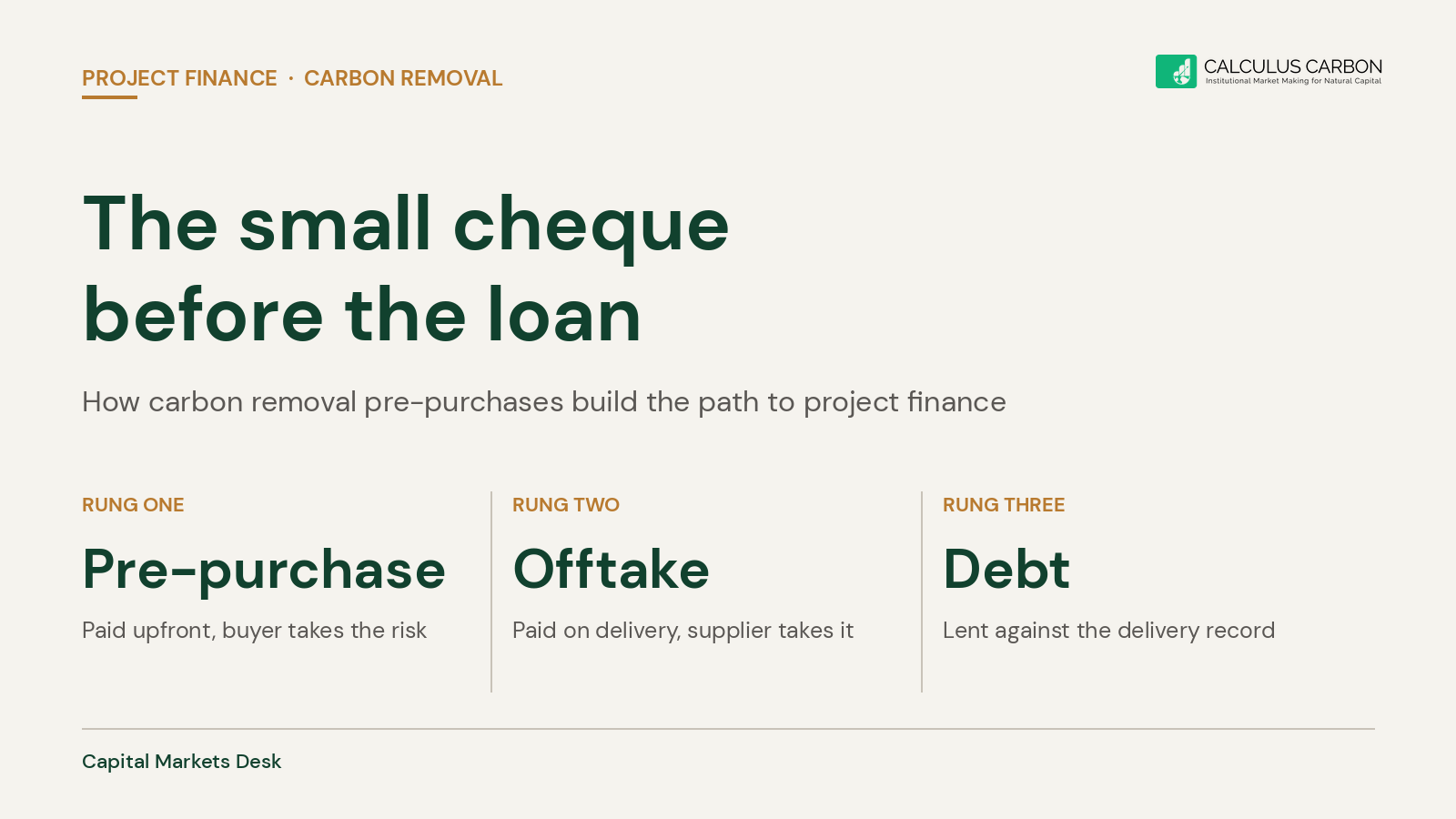
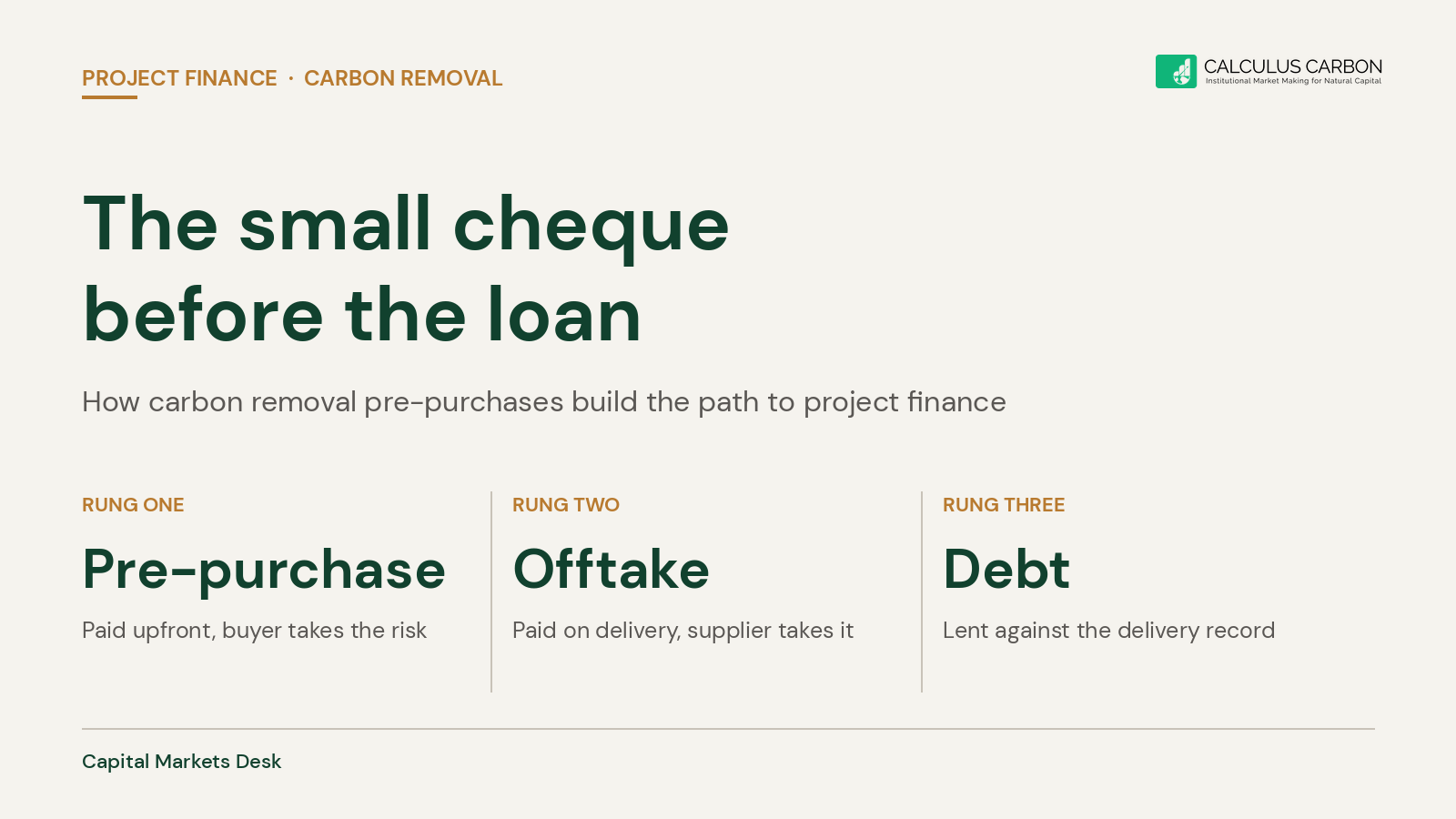
Salesforce has signed a new round of carbon removal pre-purchases, arranged by Milkywire, with eight early-stage suppliers covering more than 3,600 tonnes.1 Beside the multi-million-tonne contracts that usually make headlines, that is a small number. The reading of the Capital Markets Desk is that small pre-purchases are not a footnote to carbon removal finance. They are the first rung of a three-step ladder. A pre-purchase pays upfront for the first tonnes, an offtake pays on delivery for many more, and a lender then advances money against those contracted payments. Each rung exists because the one below it produced evidence the next party could price.
What Is A Pre-Purchase, And How Is It Different From An Offtake?
Carbon removal means taking carbon dioxide out of the air and storing it for a very long time, for example by injecting organic waste deep underground or by locking carbon into rock. Buyers pay for each verified tonne removed, and the two most common contracts for doing so look similar but allocate risk in opposite ways.
Frontier, the buyer group backed by Stripe, Alphabet, Shopify, Meta and McKinsey, describes the difference plainly. Its pre-purchases are low-volume agreements, typically around USD 500K, paid upfront before any tonnes are delivered, for early-stage suppliers piloting new technology.3,4 Its offtakes are larger multi-year agreements of roughly USD 10M to USD 50M, under which buyers commit to purchase future tonnes at an agreed price if and when they are delivered.4
The payment timing is the whole point. Under a pre-purchase the buyer carries the delivery risk, because the money has gone out before a tonne exists. Under an offtake the supplier carries it, because no tonne delivered means no cash received. Frontier's own eligibility rules reflect that shift. Pre-purchase applicants need lab-scale data and a credible plan to deliver first tonnes within one to two years, while offtake applicants should ideally have already delivered tonnes on a registry and be able to deliver at least 10,000 tonnes within five years.3
Why Would A Buyer Pay Upfront For A Few Thousand Tonnes?
Salesforce's stated reason is construction, not volume. Its climate director said each of the eight contracts will help a pilot or demonstration unit get built.1 The round follows a January 2026 portfolio, also arranged by Milkywire, of more than 12,500 tonnes from 19 suppliers across 15 countries, a programme worth USD 5M within Salesforce's pledge to contract USD 100M of durable carbon removal by 2030.1,2
For the supplier, an upfront payment does three jobs at once. It funds the first plant before any revenue exists. It puts a credible buyer's diligence on record, which later counterparties can lean on. And it creates the first verified deliveries, which are the only evidence that a forecast of future tonnes is more than a model. Non-profit accelerators work on the same logic at an even smaller scale. The Carbon Removal Foundation's remove programme offers selected start-ups a EUR 15,000 purchase agreement so they can show commercial traction, and takes no equity in return.12
How Did Vaulted Deep Climb From Pre-Purchase To Debt?
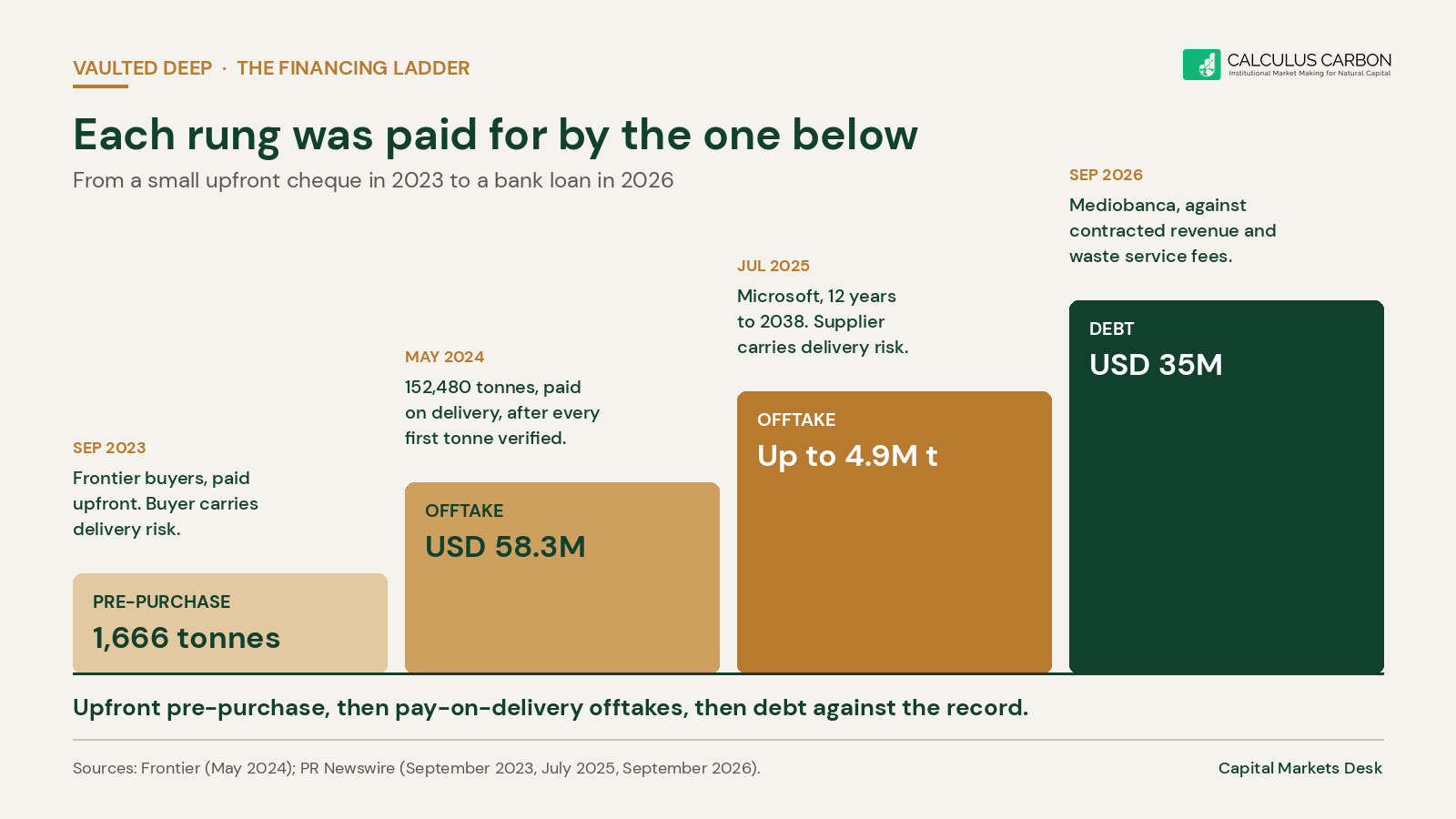
Vaulted Deep is the clearest worked example. The Houston company injects organic waste such as biosolids, manure and paper-mill sludge into deep wells, and it spun out of the industrial waste business Advantek in September 2023 with a USD 8M seed round led by Lowercarbon Capital.6,7 In the same month, Frontier buyers became its first customers through a pre-purchase of 1,666 tonnes.7
By May 2024 Vaulted had delivered and verified every one of those tonnes, and Frontier buyers came back with an offtake worth USD 58.3M for 152,480 tonnes between 2024 and 2027, enough to commission three new wells.7 In July 2025 Microsoft followed with an offtake for up to 4.9 million tonnes over 12 years, running to 2038.8
The final rung arrived in September 2026. Mediobanca provided a USD 35M debt facility, arranged by CFP Energy and supported by Vaulted's waste service agreements and contracted carbon removal revenue, including its offtakes with Frontier buyers.9 The company describes it as the largest publicly disclosed US commercial debt deal in durable carbon removal secured by long-term purchase contracts. By then Vaulted had delivered more than 20,000 tonnes to Frontier buyers in the first half of 2026 alone, more than in the whole of 2025.9
Taken as a sequence, each step financed the evidence for the next. Seed equity and a small upfront pre-purchase funded the first deliveries. Verified deliveries won a pay-on-delivery offtake. A growing offtake book and a delivery record gave a bank something it could lend against.
Is Vaulted An Exception Or A Pattern?
The pattern appears across Frontier's book. By September 2024, four of the seven companies holding Frontier offtakes had first been in its pre-purchase portfolio, and at that point every tonne Frontier had received, 1,716 in total, had come through the pre-purchase track.5 Nulife GreenTech followed the same route more recently. Frontier buyers were its first customers through a 2024 pre-purchase, under which it has delivered 407 tonnes, and in December 2025 they signed a USD 44.2M offtake for 122,000 tonnes between 2026 and 2030.10
The same ladder is now visible outside Frontier. Carbonsate, which stores encroacher bush wood in sealed underground chambers in Namibia, received a 1,320-tonne allocation in Salesforce's January 2026 pre-purchase round.2 In August 2026 it signed a 50,000-tonne offtake with Senken covering 2026 to 2028 vintages, with each tonne independently verified under the Puro.earth standard.11
The common thread is that the second contract was always larger than the first by one or two orders of magnitude, and was signed only after the first had been delivered. Vaulted moved from 1,666 tonnes to 152,480, Nulife from a pre-purchase to 122,000 tonnes, and Carbonsate from 1,320 tonnes to 50,000. In each case, the small cheque bought the evidence and the larger buyer paid for scale.2,7,10,11
What Should A Supplier Ask For At Each Rung?
The ladder only works if each contract is written with the next rung in mind. A pre-purchase that delivers tonnes nobody can verify, or a small offtake that a lender cannot rely on, leaves the supplier stuck on the rung it is standing on.
At the pre-purchase stage, the most valuable terms are not price. They are a measurement and verification method the buyer has reviewed, a registry the tonnes will be issued on, and a delivery window short enough that the record arrives while the next buyer is still listening. Frontier's own rule of first tonnes within roughly one to two years is a useful benchmark.3 A buyer's published diligence is worth almost as much as the cash, because it saves the next counterparty from repeating the work.
At the offtake stage, the terms that matter to a future lender are the ones that make the revenue predictable. These include a fixed or floored price per tonne, a delivery schedule that matches the plant's realistic ramp-up, clear remedies if a delivery falls short, and buyers whose credit a bank will accept. Options for buyers to purchase more tonnes at lower prices, which Frontier buyers took in the Vaulted offtake, also show a lender that demand can grow with capacity.7
At the debt stage, the supplier is effectively asking a bank to discount contracted revenue it has already proved it can earn. The stronger the delivery record, the larger the share of contracted revenue a lender is willing to advance against, and the cheaper that advance becomes.
Where Does A Lender Come Onto The Ladder?
A lender cannot lend against a pre-purchase. The money has already been paid, so there is no future cash flow to secure. A lender also struggles to lend against an offtake alone, because pay-on-delivery revenue is only as reliable as the supplier's ability to deliver.
The delivery record is what closes that gap. Once a supplier has issued and delivered verified tonnes on schedule, a lender can treat contracted offtake revenue as a probable cash flow rather than a hope, and size debt against it. Vaulted's facility was supported by two revenue lines, waste service fees and contracted carbon removal revenue, which is a further protection: the waste business pays even before a tonne is credited.9
In practice the credit questions follow the ladder. A lender asks how many tonnes have been delivered and verified, against how many are contracted. It asks how much of the debt service is covered by contracted volume at agreed prices, and from how many independent buyers. And it asks whether any non-carbon revenue sits alongside the credits to carry the debt through a delivery shortfall.
These questions are the reason the first rung matters to a credit committee years after the cheque was written. A supplier that started with a verified pre-purchase can answer the first question with registry data. A supplier that skipped it is asking a bank to underwrite both the technology and the buyer book at the same time, which is a risk lenders rarely take at a price that works.
The Read For Institutional Capital
Offtakes get the credit for making carbon removal bankable, but the first rung is usually a small upfront cheque from a buyer willing to carry delivery risk. That cheque pays for the first verified tonnes, and those tonnes become the record the next buyer and eventually a lender can price. For allocators, the useful signal in a pre-purchase round is not its tonnage. It is the list of suppliers who now have a funded route to a delivery record, and therefore a credible route to debt within a few years.
A pre-purchase buys the first tonnes, an offtake buys the next thousands, and a lender lends against the record the first two created.
This piece expands a Calculus Carbon company LinkedIn short-form by Saurabh Anand, scheduled for Thursday 8 October 2026.
Sources
- [1] ESG Today, Salesforce Signs Series of Carbon Removal Deals with 8 Early-Stage Suppliers, 30 September 2026. esgtoday.com
- [2] Milkywire, Milkywire completes Salesforce-backed pre-purchases from 19 durable carbon removal suppliers, 9 January 2026. milkywire.com
- [3] Frontier, Apply: prepurchases and offtakes. frontierclimate.com
- [4] Frontier, Offtake request for proposals: Track 1 prepurchases and Track 2 offtakes. frontierclimate.com
- [5] Latitude Media, Is Frontier succeeding in creating demand for carbon removal?, 5 September 2024. latitudemedia.com
- [6] PR Newswire, Advantek spins off new carbon removal company Vaulted Deep with USD 8M seed investment led by Lowercarbon Capital, 7 September 2023. prnewswire.com
- [7] Frontier, Frontier buyers sign offtake agreements with Vaulted Deep, 1 May 2024. frontierclimate.com
- [8] PR Newswire, Vaulted Deep signs deal with Microsoft to remove carbon via waste management infrastructure, 17 July 2025. prnewswire.com
- [9] PR Newswire, Vaulted Deep secures USD 35 million in debt financing to expand nationwide, 21 September 2026. prnewswire.com
- [10] ESG Dive, Frontier signs USD 44.2M offtake deal for biowaste carbon removal with Nulife GreenTech, 19 December 2025. esgdive.com
- [11] Senken, Senken and Carbonsate sign Europe's largest biomass storage deal, 17 August 2026. senken.io
- [12] remove, Carbon Removal Foundation accelerator programme. remove.global