A Fund Target Is Not A Project Loan: Reading Mombak's Amazon Raise As A Capital Stack
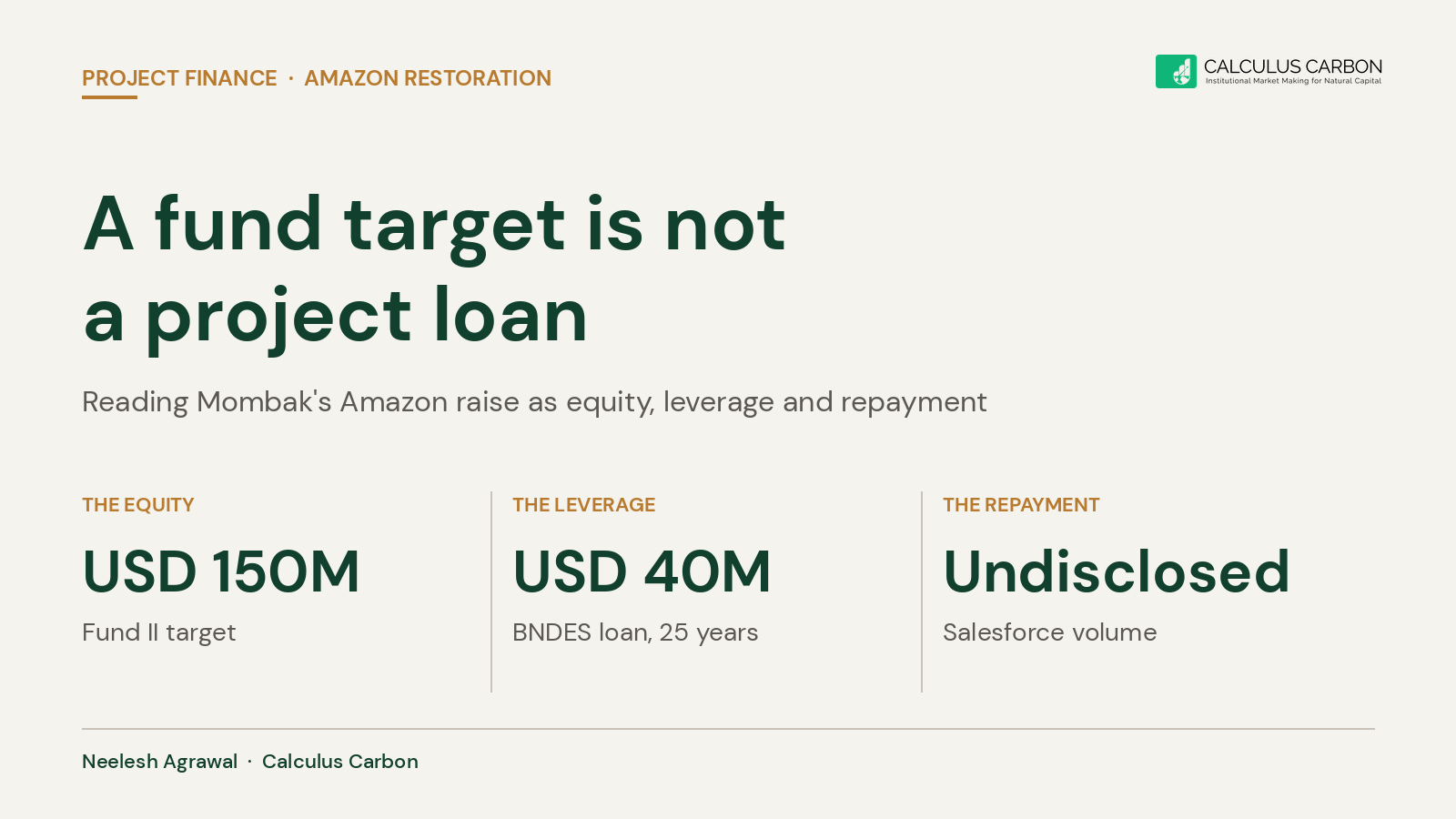
Mombak's USD 150M fund target, Salesforce offtake and 25-year BNDES loan are three layers of one capital stack, not one headline.
Project Finance · Amazon Restoration · Capital Stack · 5 October 2026
A Fund Target Is Not A Project Loan: Reading Mombak’s Amazon Raise As A Capital Stack
Mombak announced a first close for its second Amazon reforestation fund, a new buyer in Salesforce and a 25-year loan from Brazil's development bank in the same week. Taken together, they are not three versions of the same headline. They are the equity, the debt and the repayment source of one restoration project.
The Read
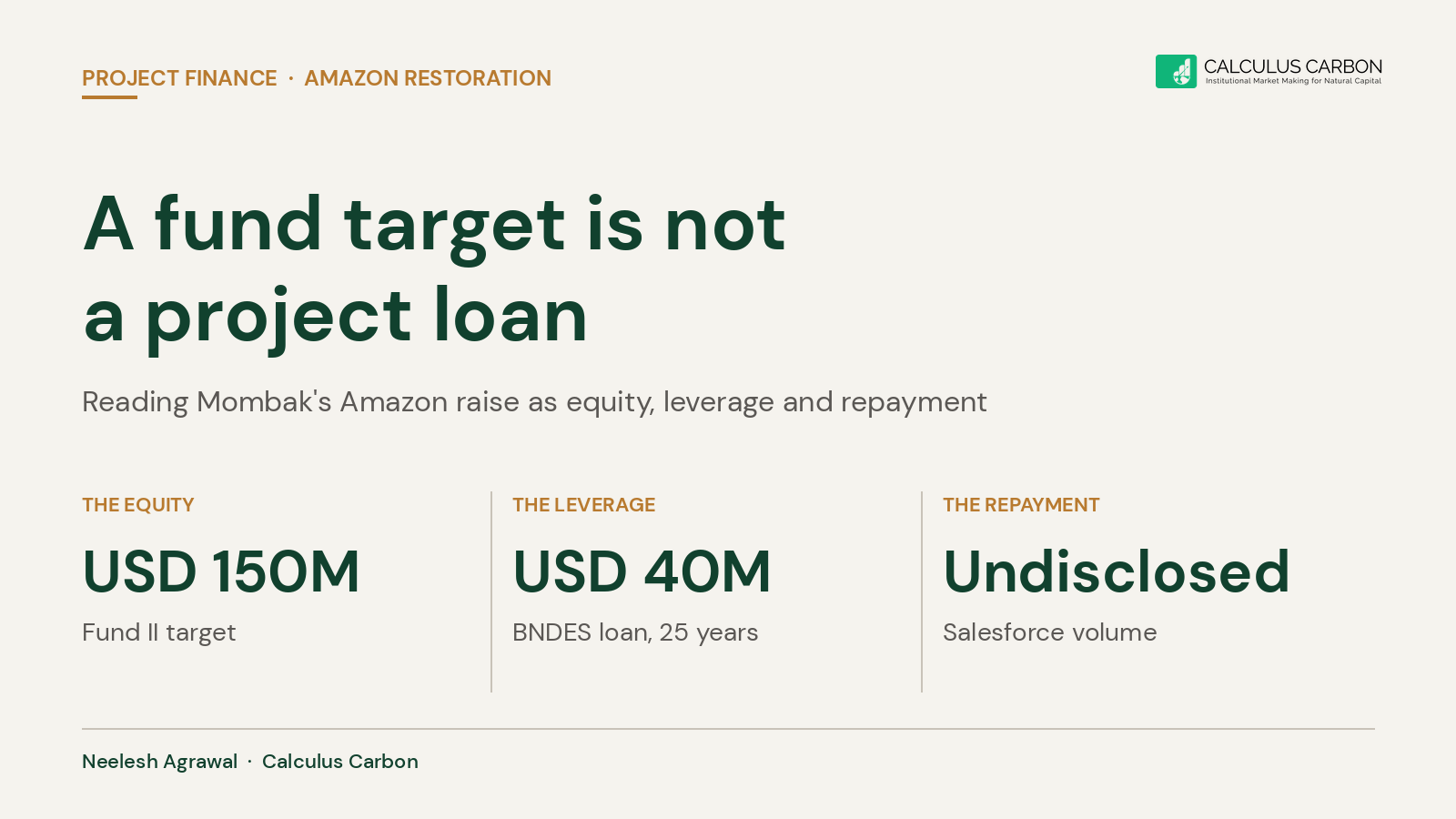
Mombak, the Brazilian reforestation company, announced on 21 September 2026 a first close for its second Amazon fund, which targets USD 150M, alongside a multi-year carbon removal purchase agreement with Salesforce.1,2 In the same week, Brazil's state development bank BNDES approved a 25-year loan of R$200M, about USD 40M, for a single restoration project.2,3 The easy read is that Mombak has raised a lot of money. Our read is that these are three different instruments doing three different jobs. The fund supplies equity, the BNDES loan supplies long-dated leverage, and the buyer contracts supply the cash that repays it. None of them can stand in for the others, and a lender reading the announcement needs all three.
What Exactly Did Mombak Announce?
The fund is Amazon Reforestation Fund II, Mombak's second investment vehicle. It targets USD 150M to buy and restore degraded pasture in the Brazilian Amazon, and the amount raised at first close was not disclosed.1,2 Its predecessor raised USD 120M from investors including AXA Investment Managers, CPP Investments and Bain Capital, and financed restoration on 15 farms with nearly 15 million native trees.1,4
The Salesforce agreement is a multi-year forward purchase of carbon removal credits. Mombak says 2,000 credits have already been delivered, but neither the total volume nor the price has been made public.2,4 Salesforce joins earlier buyers including Microsoft, which in December 2023 agreed to take up to 1.5 million credits, and Google.1,8
The loan is the most precisely described of the three. BNDES approved R$200M from its Climate Fund line for native forests, over a total term of 25 years, for a project that will restore 7,200 hectares of degraded cattle pasture, mainly in Pará.3 BNamericas reports a concessional interest rate of 2.3 per cent a year.4
Is The Fund Target The Same As Money For Projects?
No, and the gap matters. A fund target is an ambition at the vehicle level. It tells a reader how much equity a manager hopes to gather over the fundraising period, not how much has been committed or how much any one project can draw.1,2 With the first close undisclosed, the only fund number in the public record is the target.
Equity in a restoration fund does a specific job. It buys or leases the land, pays for nurseries and planting in the early years, and absorbs the first losses if trees fail or credits arrive late. That makes it the layer that lets the debt exist, rather than an alternative to it.
How Does The BNDES Loan Fit The Project?
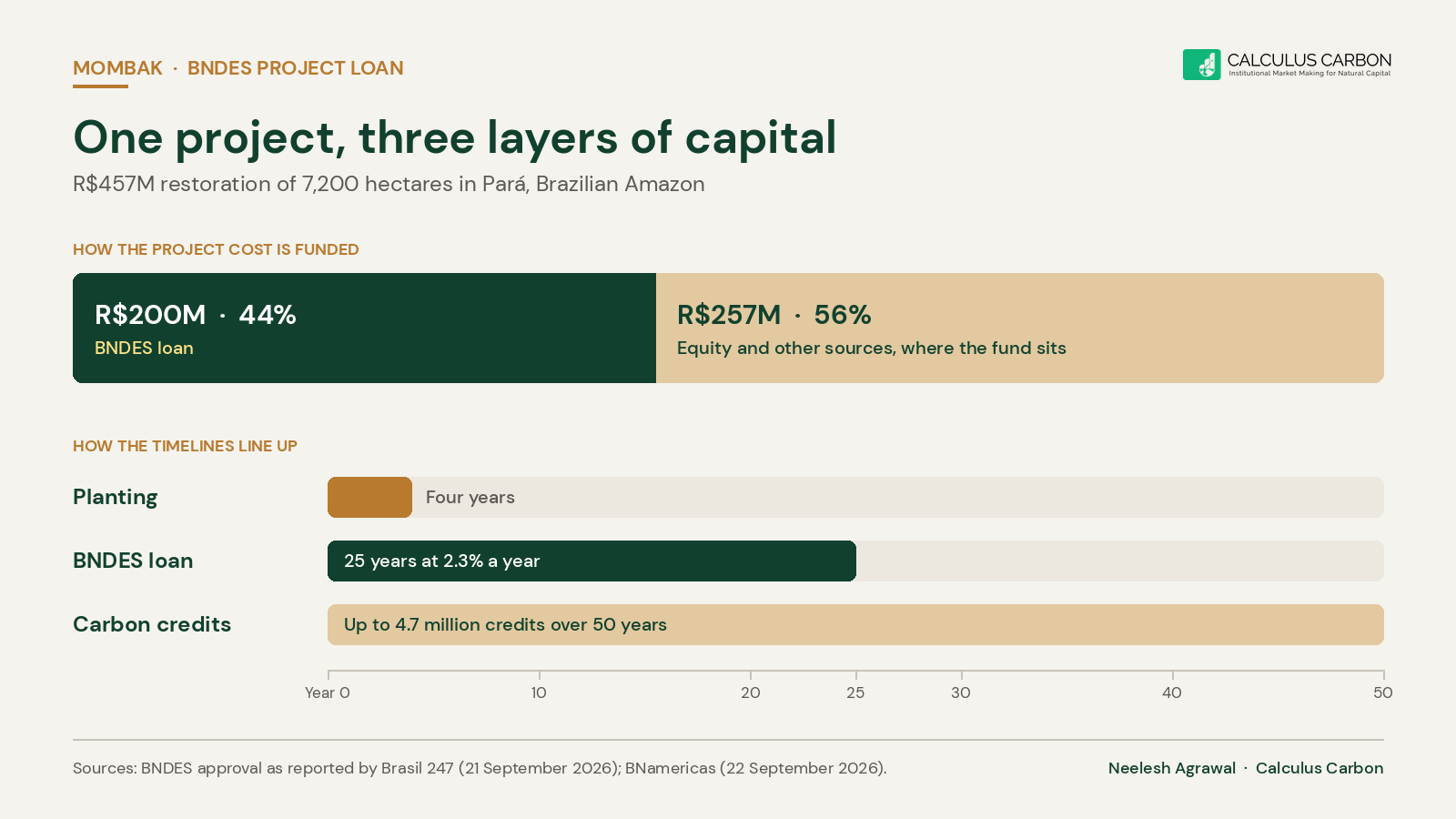
The project's total investment is estimated at R$457M, so the BNDES loan covers roughly 44 per cent of the cost, with Mombak providing the remainder from other sources.3 On our arithmetic that is about R$63,000 of investment per hectare, of which a little under half is debt. That is a recognisable project-finance shape: a senior lender at a moderate share of capital cost, with equity carrying the larger slice.
The tenor is the more instructive number. Planting is expected to run over four years, while the project is expected to generate up to 4.7 million carbon removal credits over 50 years.3 A 25-year loan sits between those two horizons. It is long enough to carry the project through the years when trees are growing and certificates are few, and short enough to be repaid well inside the crediting life of the forest.
This is also not BNDES's first loan to Mombak. An earlier R$160M operation, combining R$80M of Climate Fund money with R$80M from BNDES's Finem line, was contracted in January 2025 for 13,000 hectares, of which 9,400 hectares had been planted by June 2026.3,5 BNDES also reported in April 2025 that an R$100M operation with Mombak, mostly funded by the Climate Fund, was made possible by a bank guarantee from Santander.6 A repeat borrower with a delivery record, and in at least one case a commercial bank standing behind the credit, is how a development bank gets comfortable lending for 25 years against trees.
Where Does The Buyer Contract Come In?
A reforestation loan is repaid from the sale of carbon removal credits, so the buyer book is the repayment source. Mombak issued its first credits in 2026 under Isometric's reforestation protocol, with 21,771 certificates announced on 1 July 2026, and expects a second issuance of about 80,000 tonnes by the end of the year.2,7 Each issued certificate that a contracted buyer accepts turns forecast revenue into cash that can service debt.
This is where the undisclosed numbers bite. Without the Salesforce volume and price, an outside reader cannot match contracted revenue against the BNDES repayment schedule, and the fund's first close tells us nothing about how much equity sits beneath the loan. BNDES and the fund's investors will have seen those figures. The market has not, which is why the three announcements should be read as layers of a structure rather than as a single number.
What Would A Lender Want To See Behind The Headline?
A 25-year loan against a growing forest is only as good as the documents that sit around it. Four protections tend to decide whether this kind of debt is priced as infrastructure or as venture risk, and none of them is visible in a press release.
The first is a repayment profile shaped to the issuance curve. Few certificates arrive in the planting years, so a sensible loan carries a grace period on principal and steps up repayment only as verified tonnes start to issue. The second is a cash waterfall, under which credit sale proceeds pass first to operating costs and debt service, then to a reserve account, and only then to the equity holders. The third is contracted cover, meaning the share of scheduled debt service that is backed by signed buyer volumes at agreed prices, rather than by an assumed market price in a decade's time.
The fourth is a plan for physical loss. Fire, drought and tree mortality are the risks that turn a carbon project into a credit problem, so a lender will look for replanting obligations, insurance where it can be bought, and a buffer of uncontracted credits that can cover a delivery shortfall. In this structure the fund's equity is what makes those protections affordable. It funds the reserves, absorbs early shortfalls and gives the lender someone with real money at risk.
What Should A Lender Take From This Structure?
Any restoration financing can be read in three questions, each answered by a different instrument. The first is who carries the early risk, which is answered by the equity. The second is how much leverage the project can bear and for how long, which is answered by the loan tenor and its share of capital cost. The third is who pays, and when, which is answered by the buyer contracts and the issuance record.
Mombak's case is useful because the public record answers the second question in detail and the other two only in part. A 25-year, 44 per cent, concessional senior loan is now a visible benchmark for Amazon restoration debt. The questions that remain open, the equity committed at first close and the contracted volume behind the loan, are the ones a credit committee would ask first.
The Read For Institutional Capital
Headlines about reforestation finance tend to collapse fund targets, buyer deals and loans into one figure. They should be read separately. The fund target is the equity, the BNDES loan is the leverage, and the buyer contract is the repayment. For allocators and lenders, the strongest signal in the Mombak announcement is a 25-year development bank loan sized at under half the project cost, and the most important missing number is the contracted volume that will repay it.
The fund is the equity, the loan is the leverage, and the buyer is the repayment. They belong in one stack, not three headlines.
This piece pairs with a Neelesh Agrawal LinkedIn short-form scheduled for W41, Tuesday 6 October 2026, 11:30 IST.
Sources
- [1] Reuters, Brazil's Mombak raises new fund, adds Salesforce as carbon credit buyer, 21 September 2026. reuters.com
- [2] Carbon Pulse, Brazilian CDR developer signs Salesforce deal, targets USD 150 mln reforestation fund, 21 September 2026 (updated 27 September 2026). carbon-pulse.com
- [3] Brasil 247, BNDES aprova R$ 200 milhões para Mombak restaurar áreas na Amazônia, 21 September 2026. brasil247.com
- [4] BNamericas, Mombak raises USD 150mn with BNDES support, closes carbon removal deal with Salesforce, 22 September 2026. bnamericas.com
- [5] BNDES Agência de Notícias, BNDES aprova R$ 160 milhões para reflorestamento da Mombak no Arco da Restauração. agenciadenoticias.bndes.gov.br
- [6] BNDES Agência de Notícias, BNDES Fundo Clima desembolsa R$ 100 milhões para restauração florestal com Mombak, April 2025. agenciadenoticias.bndes.gov.br
- [7] Isometric, Isometric's first nature-based carbon removal certificates, 1 July 2026. isometric.com
- [8] ESG Today, Microsoft signs one of the largest ever nature-based deals to remove 1.5 million tons of carbon, 6 December 2023. esgtoday.com