Private Commitments Are Underwriting Evidence: Reading The IDH Cameroon PES Hub As A Project-Finance Structure
Project Finance · Nature Finance · Cameroon · 24 September 2026
Private Commitments Are Underwriting Evidence: Reading The IDH Cameroon PES Hub As A Project-Finance Structure
The IDH Cameroon Investment and Payment for Environmental Services Hub disburses USD 24.6M from CAFI in three performance-linked tranches, gated on signed private-company contracts and independent verification. The tranche structure is a lender-grade diligence template for Global South nature debt.
The Read
The Investment and Payment for Environmental Services Hub in Cameroon, launched by IDH on 15 September 2026 with USD 24.6M in performance-linked funding from the Central African Forest Initiative, is being widely reported as a blended-finance announcement.2,4 The more instructive read is structural. The Executive Board decision that approved the project on 21 January 2026 sequences the USD 24.6M into three tranches, each gated on named performance conditions, with a hard requirement that USD 6.7M of signed private-company contracts and letters of intent sit on the file before the final tranche is released.3 That is not a grant hoping for follow-on capital. It is a project-finance covenant structure written into a concessional facility, and it is a useful diligence template for anyone underwriting nature-based debt in the Global South.
What Was Actually Approved On 21 January 2026
CAFI Executive Board Decision EB.2026.02, adopted on 21 January 2026 and disclosed in the Board’s approval memorandum, sizes the project at USD 24.573M over a 58-month implementation window.3 USD 24.149M is administered by IDH as the implementing organisation. The remaining USD 425,000 is managed directly by the CAFI fund and ring-fenced for ex-post payments to the beneficiaries of environmental services once outcomes are independently verified. The disbursement schedule sits underneath that split, and it is where the project-finance logic becomes visible.
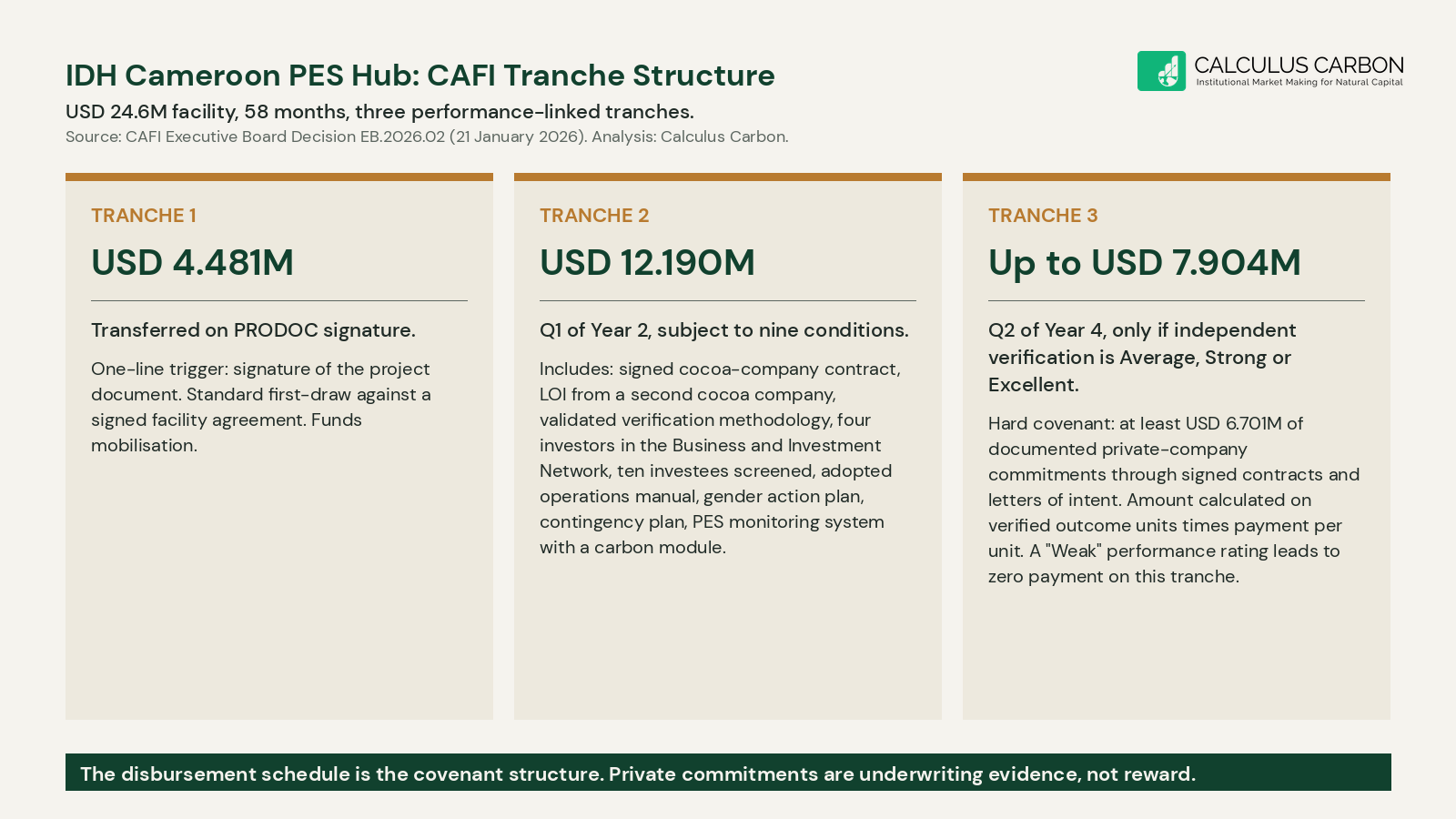
Tranche one, USD 4.481M, is transferred to IDH on signature of the project document. This is the classic first-draw against a signed facility agreement. It funds mobilisation. It is not a grant; it is the initial working capital of a facility that has to earn its next draw.
Tranche two, USD 12.190M, is scheduled for the first quarter of the second year of implementation and is conditional on nine named deliverables.3 The list reads like a project-finance conditions-precedent schedule. IDH must complete an open bidding process for the Technical Assistance and Seed Capital Facility, sign contracts with the selected managers, and adopt an operations manual establishing monitoring, reporting, risk-management and safeguards procedures. It must customise the CAFI PES Monitoring System with a carbon-tracking module. Critically, it must sign a contract with at least one cocoa company committing financial support to the CAFI PES programme through insetting, and a letter of intent with at least one additional cocoa company. It must bring at least four investors into the Business and Investment Network. It must screen at least ten potential investees for the Seed Capital Facility. It must file a validated independent verification methodology and a performance-based payment formula. It must file a contingency plan for reduced private-sector co-financing and cocoa-price volatility. And it must file a detailed gender action plan with indicators built into the results framework.
Tranche three, up to USD 7.904M, is scheduled for the second quarter of the fourth year.3 The amount is capped, not fixed. It is calculated against the number of verified outcome units meeting CAFI quality standards, multiplied by a payment amount per outcome unit that is itself defined in the independent verification methodology developed during the first year. Outcome units include hectares of deforestation-free agriculture, agroforestry, reforestation, regeneration and forest conservation. If independent verification concludes that project performance was “weak”, no disbursement is made to IDH from this tranche. The specific volumetric gate on the third tranche is that the overall amount of funding committed by private companies, through signed contracts and letters of intent, must equal or exceed USD 6.701M by the assessment date.
Why This Is A Project-Finance Structure, Not A Grant
Three features of this schedule are worth naming for institutional readers who normally see this asset class through a public-finance lens.
The first is performance-linked disbursement with a full stop. A “weak” independent performance rating in Year 3 leads to zero third-tranche payment.3 That is a genuine loss of face-value capital, not a warning-with-flexibility. It is the same discipline a senior lender writes into a construction loan when material completion covenants are missed at a milestone date.
The second is that the concessional counterparty is explicitly using private-company commitments as evidence of demand and operating discipline. The USD 6.7M hurdle is not a nice-to-have. It is a covenant. The negotiating logic is that public money is unwilling to underwrite the outcome-payment mechanism until named private companies have put their names on paper against it. That is the same logic a project-finance bank applies when it asks for a signed offtake before it will fund construction. Private commitments in this structure are not the reward. They are the underwriting evidence that the outcome-payment mechanism will have paying counterparties on the other side of it when it comes into force.
The third is that the covenant list at tranche two is stacked to test operating capability, not intent. Signing a contract with a cocoa company is one item on a nine-item conditions-precedent schedule. The other eight items compel IDH to build the operating infrastructure that a lender would look for before releasing the bulk of the facility. An independent verification methodology has to be validated by a body CAFI selects. An operations manual has to be adopted. An MRV system has to be customised with a carbon module. A gender action plan has to be integrated into the results framework and the verification methodology. These are the operating rails a nature-project sponsor needs in place before it can generate the outcome units that make ex-post payment possible.
The Insetting Question And Why It Matters
The Executive Board decision is specific about the mechanism through which cocoa companies are expected to co-finance the PES programme: insetting.3 Insetting is the practice by which a corporate buyer inside an agricultural supply chain funds environmental interventions in the geography from which it sources, and counts the resulting emissions performance against its own value-chain footprint rather than trading the credits externally.
The decision applies three risk controls specific to insetting. Each cocoa company’s net-zero claim against the CAFI PES programme must be fully aligned with the SBTi Corporate Net-Zero Standard.3 The implementing organisation must continuously review new SBTi standards and integrate updates into project design. And where feasible, contracts with financially supporting companies must include provisions requiring the companies to refrain from selling or trading the resulting emission reductions and removals. At a minimum, agreements must contain written clauses discouraging such sale or trading.
This is the point where the structure moves from generic blended finance into carbon-market territory that a project-finance lender needs to underwrite carefully. Insetting arrangements are attractive to corporates precisely because they keep the emissions benefit inside the value-chain claim and avoid the reputational risk of external carbon-credit trading. But they also mean the outcome units flowing through the CAFI PES programme are, by design, not being sold into the voluntary carbon market. The USD 6.7M private-company commitment is therefore a claim on the buyer’s own procurement budget, not a receivable against future credit sales. That is a different underwriting question, and it is the right one to ask when pricing the credit risk of any facility that sits alongside a structure like this.
The Wider Applicability
The Cameroon Hub is not, by itself, a large facility by international project-finance standards. The lender-relevant point is not the size. It is the template.
CAFI is a concessional funder using a lender’s toolkit: sequenced tranches, performance-linked disbursement, explicit conditions precedent, a hard private-commitment covenant, and independent third-party verification of results as a payment trigger. The IDH facility is one instance of that template. The 2030 target of USD 29M in additional private, climate and PES-linked finance sits on the other side of this discipline.1,2 It is priced against the assumption that the operating rails built by tranche two, and the private commitments crystallised by tranche three, will make the project bankable for commercial capital by the end of the 58-month period. If that assumption holds, the Cameroon Hub becomes a fundable proposition. If it does not, commercial capital will price accordingly, or stay out.
For a debt provider looking at other CAFI-region programmes, or at nature-based facilities in Ghana, Zimbabwe, Guyana or the wider Congo Basin, the correct exercise is to read for the same features. Is there a hard private-commitment gate on the concessional facility? Is disbursement genuinely performance-linked with a floor at zero for weak performance? Are the conditions precedent operating-capability tests, or box-ticking? Is the outcome-payment mechanism tied to insetting or to external credit trading, and is that consistent with the buyer’s procurement stance? These are the questions that separate a bankable structure from one that will need a rescue.
The Read For Institutional Capital
Concessional capital in nature finance is starting to behave like project-finance debt. Sequenced tranches, private-commitment covenants and floor-at-zero performance disbursements are becoming standard features rather than exceptions. The strategic implication for institutional capital is that the concessional layer is doing the underwriting work that commercial lenders would otherwise have to do themselves before they can price the risk. A commercial facility sitting alongside a CAFI-style structure inherits that discipline. A facility that does not sit alongside one has to build the discipline from first principles.
The IDH Cameroon Hub is worth reading as a worked example of how the discipline lands in practice. The USD 4.481M first-draw, the nine-condition second draw of USD 12.190M, and the USD 7.904M third draw gated on both independent verification and the USD 6.701M private-commitment covenant are not administrative furniture. They are the shape of a lender-grade concessional structure in nature finance. Private commitments in that structure are underwriting evidence.
The Letter of Intent is not paperwork. It is the covenant that turns a nature project into a facility a lender can price.
This piece pairs with a Neelesh Agrawal LinkedIn short-form scheduled for W39, Thursday 24 September 2026, 18:00 IST.
Sources
- [1] Central African Forest Initiative (CAFI), Investment and Payment for Environmental Services Hub Cameroon (project page), accessed 21 September 2026. cafi.org
- [2] IDH — The Sustainable Trade Initiative, Cameroon Investment and PES Hub, published 15 September 2026. idh.org
- [3] CAFI Executive Board, Decision EB.2026.02, Private Sector approval of the project “Investment and Payment for Environmental Services Hub Cameroon” implemented by IDH, adopted 21 January 2026. cafi.org
- [4] Business in Cameroon, Cameroon Agricultural Firms Get CFA14 Billion Financing Support Under CAFI-IDH Program, 16 September 2026. businessincameroon.com