The Parent Balance Sheet Is The Collateral: How Commodity Incumbents Finance Their Carbon Removal Divisions
Exomad Green and Sirius Regenerative turn timber and palm residues into biochar. Lenders price the parent's credit history, not a carbon start-up's promise.
Project Finance · Carbon Removal · Latin America · 2 October 2026
The Parent Balance Sheet Is The Collateral: How Commodity Incumbents Finance Their Carbon Removal Divisions
A Bolivian timber exporter and a Colombian palm oil producer now run carbon removal divisions built on their own waste streams. The lender's first question is not about the carbon. It is about the parent that already pays its debts.
The Read
Two Latin American commodity houses have built carbon removal businesses out of their own waste. Exomad, Bolivia's largest wood exporter, runs Exomad Green, which turns sawmill residue that was once burned in open pits into biochar, a charcoal that locks carbon into soil for a century or more.1,2 Guaicaramo, Colombia's largest palm oil producer, runs Sirius Regenerative, which does the same with palm kernel shells left over from oil extraction.7,9 The Capital Markets Desk reads both as a distinct financing archetype. The carbon division is not a start-up asking a lender to believe a plan. It is a new revenue line inside a business that already has decades of exports, audited accounts and bank relationships behind it. That inherited standing is the real collateral, and it changes who lends, on what terms and against what security.
What Have These Two Incumbents Actually Built?
Exomad Green began operating in March 2023 as a division of Exomad, the timber group behind decking, veneers and instrument wood exported from Concepción in eastern Bolivia.1,2 It collects hardwood residue from sawmills at no cost, converts it into biochar through pyrolysis, which is heating biomass without oxygen, and gives the biochar to local farmers as a soil improver.1 The carbon revenue comes from certificates. Each CO2 Removal Certificate, or CORC, issued under the Puro Standard represents one tonne of carbon dioxide removed and stored for at least 100 years.3
The registry record is unusually deep for this market. The Concepción facility alone shows 284,334 certificates issued and 145,116 retired by buyers, across a crediting period that runs from April 2023 to April 2028, with issuances landing roughly every month in 2026.3 The company operates a second facility at Riberalta and is completing a third at Guarayos, and states a target of one million tonnes of removals a year by 2027.1
Sirius Regenerative is earlier on the same path. It completed its first certificate issuance under the Puro Standard this year, the first such issuance in Colombia, from a site at Barranca de Upía in Meta.7 Its feedstock comes directly from Guaicaramo's own palm processing, and Puro.earth notes that around 80 per cent of the available biomass is not yet used, which gives the division room to scale without buying feedstock on the open market.7 Guaicaramo itself traces its origins to a vision that began some 40 years ago and today produces palm oil for the biofuels and food sectors.8,9
Why Does A Standalone Carbon Venture Struggle To Borrow?
A newly formed carbon removal company arrives at a lender with three gaps. It has no operating history, so the lender cannot see how the plant performs in a wet season or a breakdown. It has no secured feedstock, so the lender has to underwrite a supply chain that does not yet exist. It has no credit file, so the bank has nothing to test the management team's past behaviour against.
Each gap translates into a cost. Lenders either decline, demand a parent or sponsor guarantee the founders cannot give, or price the risk as venture equity rather than debt. That is why much of the early carbon removal capacity has been funded with equity and why debt usually arrives only after several years of deliveries.
Why Is The Incumbent Case Different?
The incumbent closes all three gaps before the carbon division sells its first certificate. The feedstock is a byproduct the parent already produces and controls, so supply risk becomes an operational question inside one group rather than a contract with a third party.1,7 The parent's core business has already absorbed the operating and market risk of running plants in remote regions, and the banks that finance its timber or palm exports have already run credit on the same legal entity.
The carbon division therefore inherits a credit file rather than building one from zero. In practice the lender is underwriting a capital expenditure programme at a known borrower, with the carbon revenue as an additional source of repayment, not as the only one.
What Does The Financing Look Like In Practice?
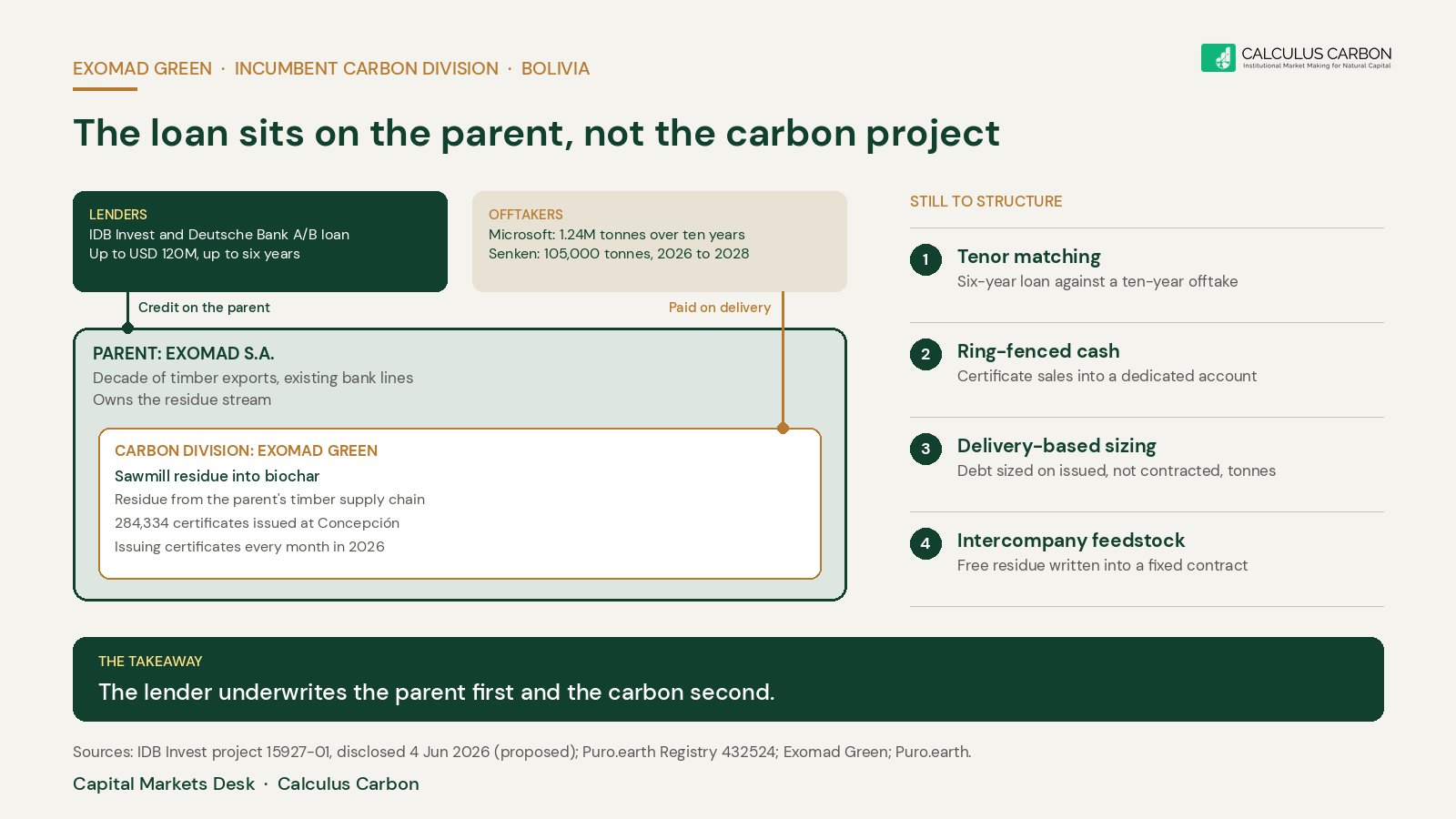
Exomad shows the template. IDB Invest disclosed in June 2026 a proposed secured A/B loan to Exomad S.A., jointly arranged with Deutsche Bank, with a total envelope of up to approximately USD 120M and a tenor of up to six years including a grace period.6 An A/B loan is a structure in which the development bank lends the A portion from its own balance sheet and sells B participations to commercial lenders, who benefit from the development bank's preferred-creditor standing. The disclosure lists USD 32M as IDB Invest's own financing and USD 100M as the syndicated amount.6
Three features matter for any lender reading the file. The borrower is the operating company, not a single-asset project vehicle.6 The facility is supported by long-term offtake agreements and security over key project assets.6 The proceeds fund a programme of three new biochar facilities and the expansion of three existing ones across six Bolivian locations, chosen for proximity to biomass supply.6
The offtake book behind that security is substantial. Microsoft signed a ten-year agreement in May 2025 to buy at least 1.24 million tonnes of removals, following an earlier purchase of 32,000 tonnes in December 2023.4 Senken added a multi-year offtake of 105,000 tonnes across 2026 to 2028, announced in February 2026.5 The facility was still shown as proposed on the IDB Invest page at the time of writing, so the signed terms may differ from the disclosure.6
How Would A Lender Size The Carbon Revenue?
A lender starts from delivered volumes, not contracted ones. The Microsoft agreement averages roughly 124,000 tonnes a year over its ten-year life, which is the contracted ceiling rather than the bankable figure.4 The bankable figure comes from the registry. Between late February and the end of September 2026, the Concepción facility issued eight monthly batches totalling 91,990 certificates, an average of about 11,500 a month, or roughly 138,000 a year from one site on its current run rate.3
That record lets a credit team do something it cannot do for a start-up: set a base-case delivery profile from observed output, apply a haircut for plant downtime and verification delays, and test debt service against the result. Contract prices in these offtakes are not public, so the revenue side of that test sits with the lenders and the company rather than in the disclosure.4,6 The structural point holds regardless of price. A carbon line with a monthly issuance history can be sized as a revenue stream, while a carbon line without one can only be valued as an option.
What Still Has To Be Structured?
Inherited standing lowers the risk a lender has to price. It does not remove the carbon-specific questions, and those questions decide the final terms. Four of them recur in this kind of credit.
The first is tenor matching. A six-year loan against a ten-year offtake leaves a refinancing question in the outer years, and the lender will want to know whether the later deliveries are contracted at prices that cover the plant's running costs.4,6 The second is ring-fencing. If the carbon revenue sits inside the parent's general cash pool, a downturn in timber or palm prices can absorb it. Lenders typically ask for a dedicated collection account for certificate sales and a clear rule on how cash moves up to the parent.
The third is delivery risk. A certificate offtake pays only when certificates are issued, so lenders size debt against a delivery profile, not the headline contract volume. Exomad's monthly issuance record is the strongest answer to that question in the market today.3 The fourth is feedstock pricing inside the group. Residue that is free today becomes a transfer-pricing question once the carbon division is financed separately, and a lender will want the supply arrangement written down as an intercompany contract with a fixed basis.
Sirius sits at an earlier point on the same curve. Its parent provides the feedstock and the operating base, but its own issuance record is months old rather than years.7 For a division at that stage, the realistic first debt is a facility at the parent level secured partly on carbon offtake, rather than standalone non-recourse project finance.
Does The Same Pattern Apply Beyond Biochar?
The archetype travels to any commodity house with a residue stream: sugar mills with bagasse, rice millers with husk, cocoa and coffee processors with shells, and pulp producers with bark. In each case the financing question is the same. The parent's existing credit carries the first loan, and the carbon division earns standalone terms only after it has built its own delivery record.
For lenders and development banks, the practical consequence is a pipeline filter. Incumbents with audited accounts, existing bank lines and an owned residue stream can be financed years earlier than standalone developers with comparable technology, and at a lower cost of capital.
The Read For Institutional Capital
Commodity incumbents are financing carbon removal on their existing credit, with carbon offtake as added security rather than the sole source of repayment. The Exomad facility shows the shape: an operating-company borrower, a development bank and a commercial bank in the same A/B structure, long-term offtake and security over assets. The remaining work is carbon-specific structuring, in particular tenor matching, ring-fenced cash, delivery-based sizing and an intercompany feedstock contract, and that work sets the final price of the debt.
In an incumbent's carbon division, the lender underwrites the parent first and the carbon second.
This piece pairs with the Calculus Carbon company-page LinkedIn post by Saurabh Anand on incumbents monetising byproducts (W39 draft).
Sources
- [1] Exomad Green, company website: facilities, capacity and history. exomadgreen.com
- [2] German Biochar Association, How Carbonfuture supported Exomad Green's journey to become the world's leading biochar supplier. german-biochar.org
- [3] Puro.earth Registry, Exomad Green, Concepción, project 432524 (accessed 2 October 2026). registry.puro.earth
- [4] Exomad Green, Exomad Green announces world's largest biochar carbon removal agreement with Microsoft, 21 May 2025. exomadgreen.com
- [5] Exomad Green, press releases, including the Senken offtake announcement of 12 February 2026. exomadgreen.com
- [6] IDB Invest, Exomad Biochar Production Bolivia, project 15927-01, disclosed 4 June 2026. idbinvest.org
- [7] Puro.earth, First CORCs issued for Sirius Regenerative, LinkedIn, 2026. linkedin.com/company/puro-earth
- [8] Guaicaramo, Quiénes somos (company profile). guaicaramo.com
- [9] Las2orillas, Las familias detrás del negocio de la palma que tiene a Colombia entre los líderes del negocio del aceite. las2orillas.co
- [10] Short-form companion post by Saurabh Anand, Calculus Carbon LinkedIn company page, draft dated 23 September 2026. linkedin.com/company/calculus-carbon