Ghana's 91 Projects and 11 Approvals: A Carbon Pipeline Is Not Financeable Supply
Article 6.2 · Ghana · Project Finance · 14 September 2026
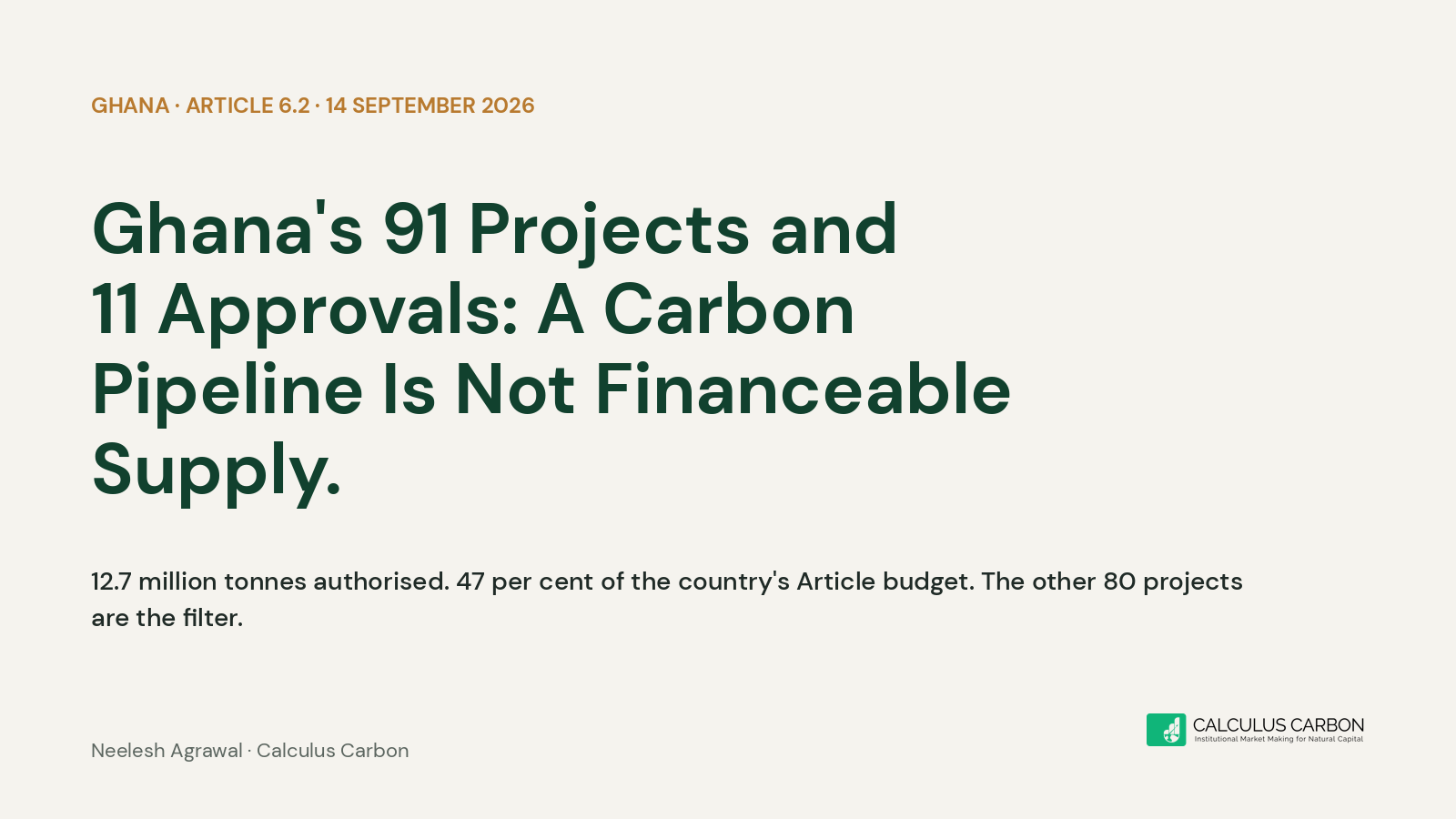
Ghana’s 91 Projects and 11 Approvals: A Carbon Pipeline Is Not Financeable Supply
Ghana’s 10 September 2026 progress report shows 91 projects in the national pipeline and 11 authorised for international transfer under Article 6.2. Those 11 approvals cover 12.7 million tonnes of ITMOs, 47 per cent of the country’s 24 million tonne Article budget. The 80-project gap between pipeline and approval is where project-finance conversations for Global South carbon supply actually live.
The Filter Between Pipeline and Financeable Supply
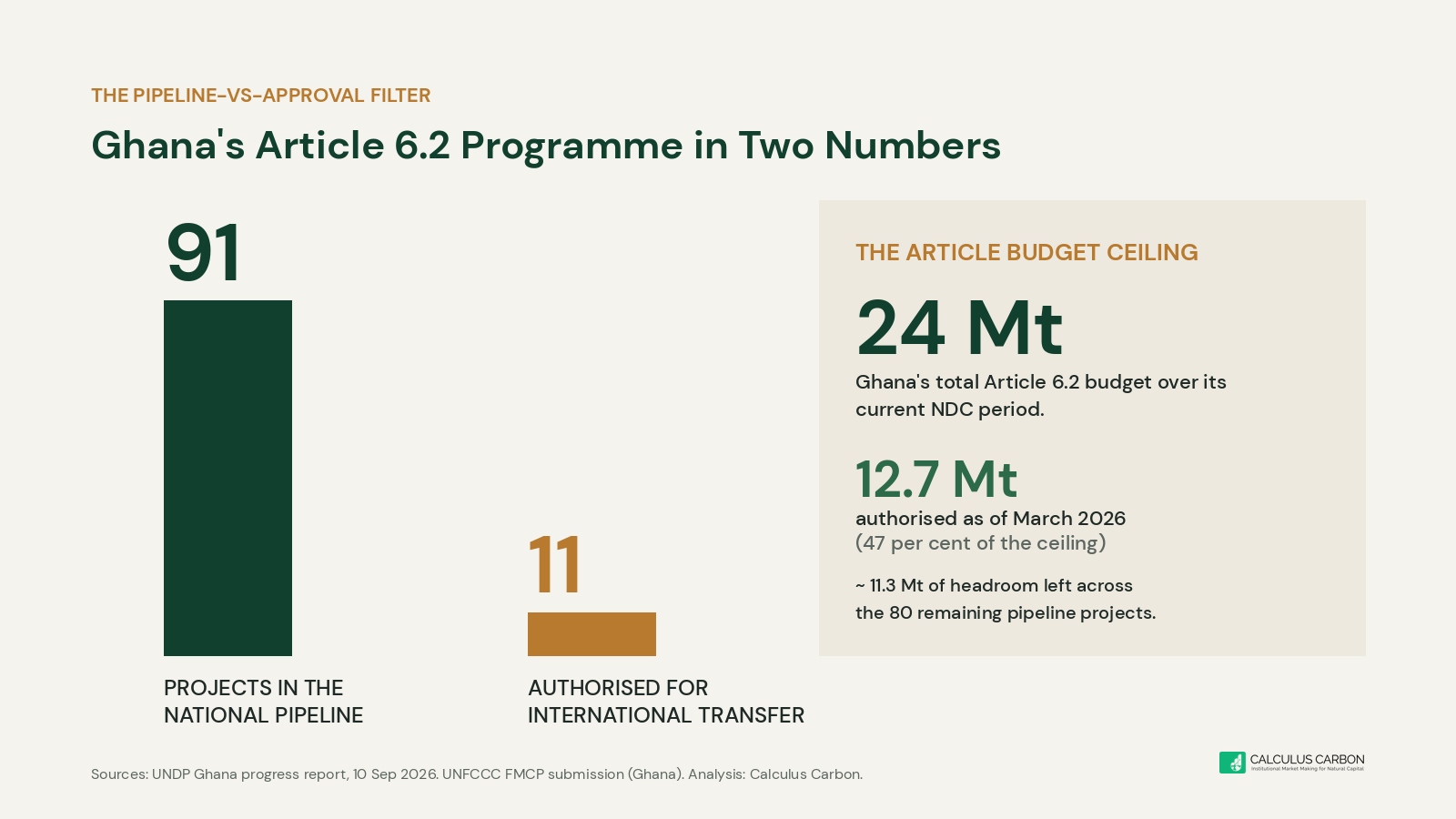
Ghana’s 10 September 2026 progress report from the United Nations Development Programme shows why a project pipeline and financeable carbon supply are not the same thing.1 The country has 91 projects in the national pipeline. Only 11 carry the government approval that lets carbon units cross a border under Article 6.2 of the Paris Agreement.1 Those 11 approvals cover 12.7 million tonnes of authorised Internationally Transferred Mitigation Outcomes, which represents 47 per cent of Ghana’s total Article budget of 24 million tonnes over its current NDC period.1,2 The 80-project gap between pipeline and approval is where project-finance conversations for Global South carbon supply actually live.
What the Report Says
The United Nations Development Programme published “Making the Carbon Market Work for All: Ghana’s 2025-2026 Progress” on 10 September 2026.1 The headline paragraph reports 91 projects in Ghana’s national pipeline, 11 authorised for international transfer, and 12.7 million tonnes of CO2 equivalent in authorised ITMOs, spread across clean cooking, renewable energy, electric mobility, nature-based solutions and waste management.1 The report also flags that Ghana’s 2026 carbon-market regulations are currently under legal review and that the country has growing bilateral cooperation with five counterpart nations.1
The Facilitative Multilateral Consideration submission Ghana filed with the United Nations Framework Convention on Climate Change adds the fiscal frame. Ghana has enshrined the carbon market in domestic law through ACT 1124 of 2025, with sections 149 to 158 governing the carbon market specifically, and the 2026 regulation implementing section 158 is the piece currently under legal review.2 As of March 2026, Ghana had authorised 12.7 million tonnes for international transfer, or 47 per cent of the country’s 24 million tonne Article budget.2 The first live transaction was 11,733 tonnes of ITMOs delivered to Switzerland in 2025, sourced from a cookstove project.2
The Gap Between 91 and 11 in the Underwriting File
A project pipeline is a supply story. Ninety-one projects across five sectors is a real programme, and the fact that Ghana has enshrined the framework in primary legislation is a durability signal that many host-country pipelines cannot match. The lender question sits one layer down from that story. Once a project developer or a special-purpose vehicle for a Ghanaian cookstove, agroforestry, mangrove or clean-cooking programme approaches a debt provider or a mezzanine investor for construction and working-capital finance, the question the credit committee has to answer is not whether the project is in the national pipeline. It is whether the carbon revenue stream the model relies on is contracted, transferable and legally deliverable across the tenor of the loan.
That is where sovereign approval enters the underwriting file. A project without authorisation to transfer its ITMOs internationally cannot sell those units to a foreign compliance buyer under Article 6.2 of the Paris Agreement. The compliance buyer in turn cannot use the units against a national inventory without the host country having applied the corresponding adjustment in its own biennial transparency reporting. Both of those steps sit inside the host government’s decision perimeter, not the project developer’s. A lender pricing a facility against future ITMO offtake needs the authorisation letter and the corresponding-adjustment commitment in the file before the facility can be closed at a term rate that reflects contracted cash flow rather than speculative supply.
The Bankability Filter, Not the Project Count
The 80-project gap in the Ghana report is best read as the country’s current bankability filter in operation. Ninety-one projects passed the national-registration bar. Eleven passed the second bar of sovereign sign-off for international transfer. The remaining 80 sit in a queue whose commercial value is bounded by a set of decisions that have not yet been made. Some of that queue will convert. Some of it will not, either because the underlying methodology cannot survive Ghana’s revised regulatory review, because the sector is not one the host country wants to allocate its Article budget to, or because the ITMO supply the project would generate has been retained for domestic compliance rather than released for export.
That distribution has direct implications for how a project-finance debt provider prices facilities in this market. On the 11 authorised projects, the sovereign risk that historically dominated Article 6.2 discussion has been converted into a specific, dated authorisation letter with a stated tonnage. On the 80 pipeline projects, the sovereign risk remains latent. The credit-committee treatment of the two groups is not the same, and the pricing of debt against future carbon revenue cannot be the same either. In practical terms, a Ghanaian cookstove project with authorisation in hand and a Swiss offtake contract signed can attract senior-secured debt on carbon-revenue offtake at a materially tighter spread than the same project without authorisation, even where the underlying operational plan is identical.
The Article Budget Ceiling
The 24 million tonne Article budget number matters as much as the 12.7 million tonne authorised figure. Ghana has told the UNFCCC that it intends to use voluntary cooperation under Article 6.2 to achieve up to 55 per cent of its conditional absolute emission reductions, which the country has quantified as roughly 24 million tonnes of abatement across its current NDC period.2 That figure sets the ceiling on how much carbon can leave Ghana under Article 6.2 without the country breaching its own NDC accounting. At 12.7 million tonnes of authorisations already issued, Ghana is 47 per cent of the way to that ceiling.2
The remaining headroom is roughly 11.3 million tonnes. The 80 pipeline projects, if all authorised, would almost certainly generate ITMO volumes that exceed that headroom, particularly if any of the larger nature-based programmes come through. That creates an implicit rationing problem inside the sovereign approval process. Not every pipeline project can be authorised, because the sovereign has a legal ceiling on how much it can export before it starts pulling from its own compliance account. Lenders underwriting Ghanaian carbon-revenue debt need to price that rationing risk into any facility that assumes future authorisation as a base case. The pipeline number is comforting but the budget number is binding.
The Regulatory Review Adds a Second Gate
Ghana’s 2026 carbon-market regulation, currently under legal review, is the operational rulebook that sits under ACT 1124.1,2 The regulation is where the mechanics of authorisation, issuance, corresponding-adjustment reporting, revenue capture by the state, and any share-of-proceeds levies will be written. Until it settles, project developers structuring long-tenor carbon-revenue contracts are pricing against a rulebook that could still change on process, cost basis and enforcement discretion. A debt provider looking at a ten to fifteen year facility against a nature-based project in Ghana today is asking the developer to warrant that the eventual regulation will not alter the economics of the ITMO stream materially, and the developer cannot honestly warrant that.
The result is that most institutional debt into Ghanaian carbon-revenue projects is currently either waiting for the regulation to settle or being priced with a specific reservation. Neither is a failure of the market. Both are the correct pricing behaviour when a jurisdiction is mid-transition on its rulebook. The signal for allocators is that the settlement of the regulation is the near-term catalyst that will unlock a second wave of authorisations, and the credit terms available on those authorisations will be tighter than the credit terms available before the rulebook lands.
The Read for Institutional Capital
Ghana is one of the small set of Global South host countries that has done the primary legal work to make Article 6.2 supply real. That work is visible in ACT 1124, in the 12.7 million tonnes of authorisations already issued, and in the first live transfer to Switzerland from a cookstove project.2 The read for institutional capital pricing debt against Ghanaian carbon-revenue projects is that the country is neither the risk-free proposition that the 91-project pipeline suggests nor the speculative one that the pending regulation might imply. It is a jurisdiction with a working authorisation channel, a finite Article budget that will force rationing, and a rulebook in its last mile. The 11 authorised projects are already financeable at private-credit terms. The 80 pipeline projects will convert unevenly, and the pricing of debt on those projects should reflect that conversion risk explicitly rather than treat pipeline inclusion as a proxy for authorisation.
The Ghana example generalises across Global South host countries that are lining up an Article 6.2 programme. The number a lender should track is not the size of the national pipeline. It is the ratio of authorised tonnes to the Article budget ceiling, and the tenor of the local regulation that governs the authorisation process. Both of those numbers are public. Both of those numbers should sit on the front page of the credit memo for any carbon-revenue facility a debt provider is asked to price in that jurisdiction.
Government sign-off is the filter that turns a project pipeline into financeable supply. Ghana has moved eleven projects across that filter and enshrined the framework in primary legislation. The next test is whether the 2026 regulation settles cleanly and whether the country’s remaining 11.3 million tonnes of headroom is allocated across the 80 pipeline projects with enough clarity for a lender to price at term.
This piece pairs with a Neelesh Agrawal LinkedIn short-form scheduled for W38.
Sources
- [1] United Nations Development Programme (Ghana), Making the Carbon Market Work for All: Ghana’s 2025-2026 Progress, published 10 September 2026. undp.org
- [2] United Nations Framework Convention on Climate Change, Facilitative Multilateral Consideration of Progress, Ghana question-and-answer export. unfccc.int
- [3] Ghana Carbon Market Office (Environmental Protection Agency), Ghana Carbon Market Annual Progress Report, August 2026. cmo.epa.gov.gh