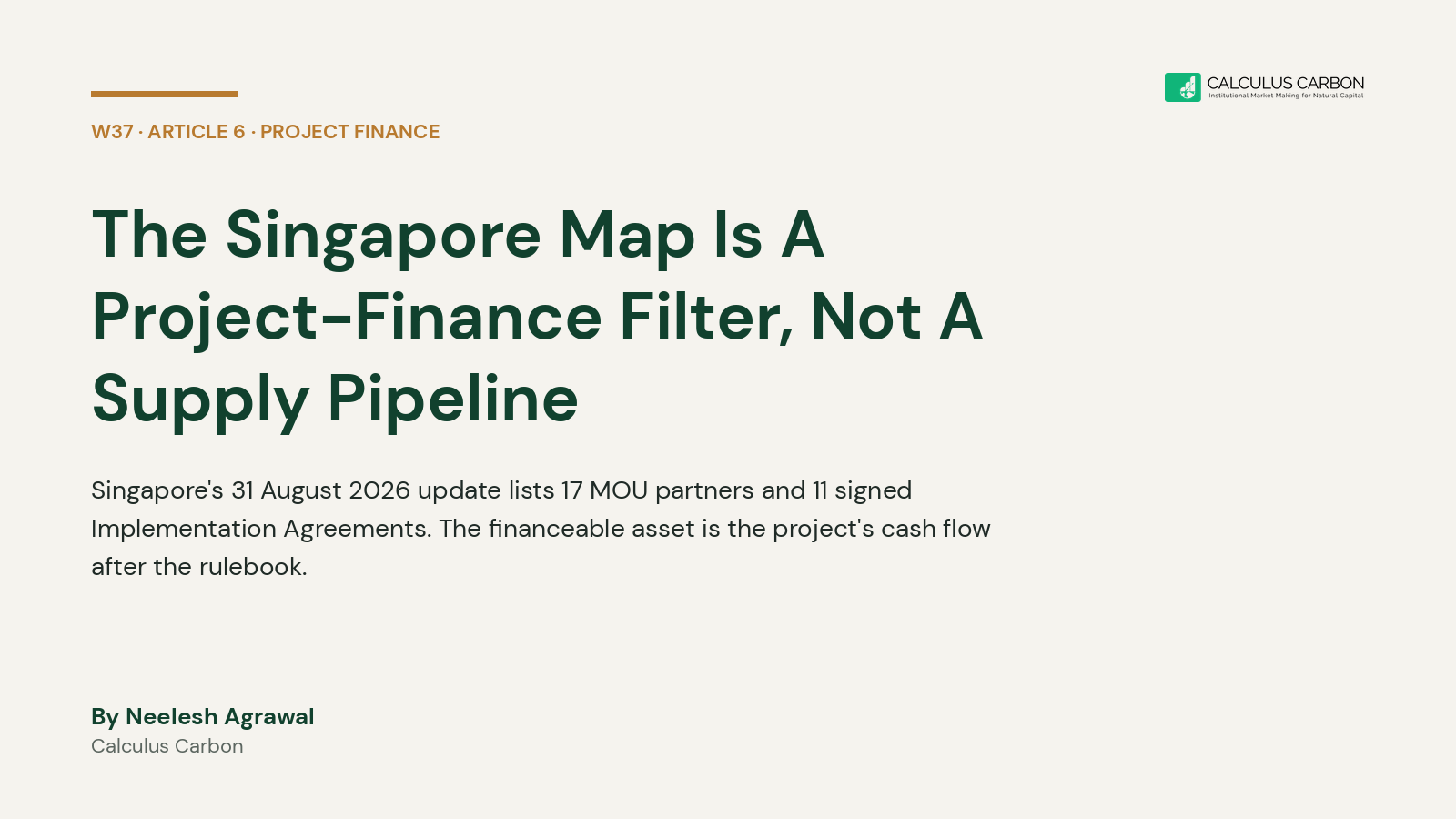
The Singapore Map Is A Project-Finance Filter, Not A Supply Pipeline
Singapore's 31 August 2026 Article 6 page lists 17 partners and 11 signed agreements. The financeable asset is project cash flow after the rulebook, not the country count.
Article 6 · Project Finance · 7 September 2026
The Singapore Map Is A Project-Finance Filter, Not A Supply Pipeline
Singapore’s official Article 6 Cooperation page, last updated 31 August 2026, lists 17 partner countries covered by Memoranda of Understanding and 11 countries with signed Implementation Agreements. The financeable asset is the project’s net cash flow after the rulebook, not the country count on the map.
Thesis
Singapore’s official Article 6 Cooperation page, last updated 31 August 2026, lists 17 partner countries covered by Memoranda of Understanding and 11 countries with signed Implementation Agreements or substantively concluded negotiations.1 The default reading in a chat thread has been that Singapore is broadening the pool of eligible carbon supply for its own compliance regime. That reading conflates legal optionality with financeable revenue. The financeable asset is the project’s net cash flow after the rulebook, not the country count on the map.
The 17-country map tells a developer where Singapore’s demand can, in principle, be paired with a host jurisdiction that will authorise Internationally Transferred Mitigation Outcomes. It does not, on its own, price a single credit or de-risk a single project. That work sits inside four gates the page’s own language makes explicit, and each gate lands in a different line of a project-finance model.1,2
What The 31 August 2026 Page Actually Says
The page separates two counts that the market often blends. The MOU count is 17: Latin America four, Asia six, Africa six, Oceania one. The Implementation Agreement count is 11, of which seven are stated as “Entered into Force”: Bhutan, Chile, Ghana, Mongolia, Peru, Rwanda and Thailand. Paraguay, Papua New Guinea, Vietnam and the Philippines are named on the IA list without a status specified against them.1
The page also states two economic terms that apply to every project authorised under an Implementation Agreement. First, “Singapore’s bilateral agreements will require carbon credit developers to make a monetary contribution equivalent to 5% share of proceeds of the Article 6-authorised carbon credits generated under our Implementation Agreements towards the host countries’ adaptation actions and/or UNFCCC Adaptation Fund.” Second, “2% of Article 6-authorised carbon credits generated are required to be cancelled at issuance.”1 Those are not policy footnotes. They change the price the offtaker receives and the volume that the project actually delivers.
The IA framework is described as bilateral plumbing for “the international transfer of correspondingly adjusted carbon credits (i.e. mitigation outcomes) between host countries and Singapore.” The page is careful to say the IA “sets out the bilateral framework” and that “private sector players can then leverage this framework to develop carbon credit projects that issue ITMOs.”2 The IA is not a project revenue contract. It is the rulebook inside which a project revenue contract can later be signed.
Why Singapore Is A Real Buyer, Not A Signalling Buyer
The demand side decides whether the map has teeth. Singapore’s carbon tax was raised to SGD 45 per tonne of CO2 equivalent with effect from 1 January 2026, with a view to reaching SGD 50 to 80 by 2030.4 Under Singapore’s International Carbon Credit framework, taxable facilities may use eligible international carbon credits to offset up to 5% of their taxable emissions from 2024.4 The Columbia Center on Global Energy Policy note on Singapore records the same 5% ceiling and the seven integrity principles credits must meet to be eligible.6
That combination gives a project finance underwriter a defined buyer-side price ceiling. A facility that can pay SGD 45 in tax, or use an ICC in lieu of that tax up to 5% of taxable emissions, has a rational willingness to pay for a compliant ITMO up to somewhere close to the tax rate, net of transaction cost. That is a real, dated, regulated demand curve, and it is why the 17-country map is worth studying rather than dismissing.
Where The Rulebook Meets The Model
Take the same Global South ARR or IFM project a developer would have modelled two years ago. Now put it through the Article 6 gates.
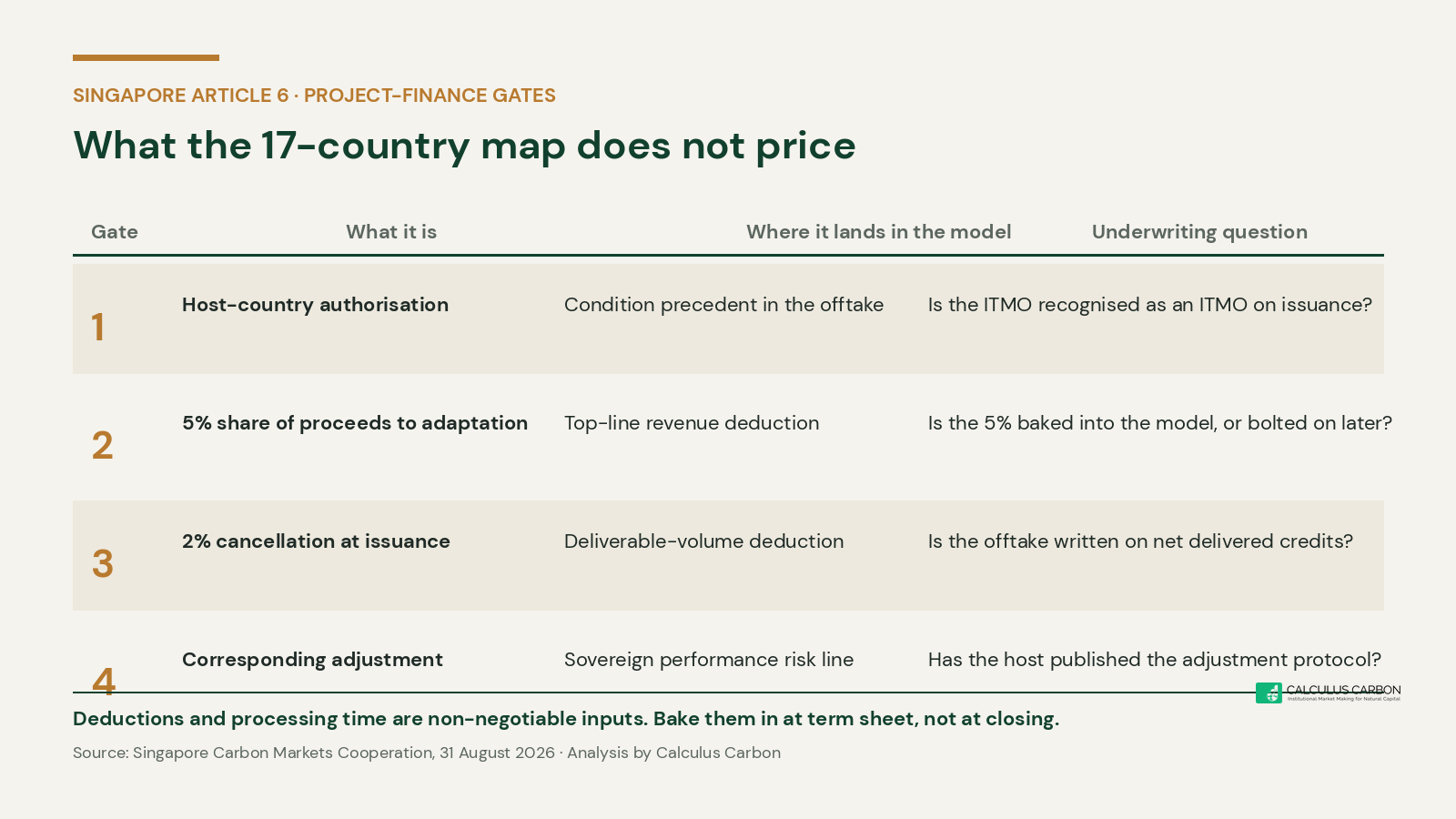
Gate one is host-country authorisation. Under Singapore’s IA framework, host-country authorisation is a specific administrative act. The Ghana country page notes that Singapore and Ghana signed their Implementation Agreement on 27 May 2024 and that the corridor is now “open for project applications.” Ghana’s page also references an “Annex A - Pre-approved List of Offset Programmes and Methodologies” and an authorisation annex.3 That processing sequence sits before any credit is issued. In a project-finance model, this is not a footnote. It is a condition precedent inside the offtake agreement. Missing authorisation means an ITMO does not exist as an ITMO, only as a voluntary credit with a different price ceiling.
Gate two is the 5% share of proceeds to adaptation. The 5% is stated on the Singapore page as a monetary contribution equivalent to 5% of the Article 6-authorised credits generated under the IA.1 From an underwriter’s viewpoint, this is a top-line deduction. If a project models ITMO revenue at USD 30 per tonne on 400,000 tonnes, the 5% contribution reduces headline revenue by USD 600,000 per year at those volumes. It is small in percentage terms and material in absolute terms once it is compounded across a ten-year corridor.
Gate three is the 2% cancellation at issuance. This is a volume line, not a price line. The 2% is deducted from the credits that actually reach the offtaker for delivery against a contract.1 In a project that expects to issue 400,000 tonnes, 8,000 tonnes never reach the buyer. If the offtake contract is written on gross issuance, the developer eats that gap. If it is written on delivered volume, the offtake price has to be structured to accept a stated deliverable ceiling. Either way, the model has to be built with net delivered credits, not gross issued credits.
Gate four is the corresponding adjustment itself. The page describes the IA as the bilateral framework for the “international transfer of correspondingly adjusted carbon credits.”2 A corresponding adjustment is a legal act performed by the host country against its own national accounts. It is the difference between an ITMO and a voluntary credit. It is also, at the moment of financing, an obligation the host government has committed to in a bilateral agreement rather than a right the project holds in its own name. That is a host-country sovereign performance risk, and it prices differently from an operational project risk. On our transaction desk, we route it into a separate line item in the risk register.
What A Country List Cannot Do
The map is the entry ticket. It cannot substitute for four other underwriting steps.
It cannot substitute for a methodology fit. The pre-approved methodology annex sits inside each IA.3 The methodology is where a project’s mitigation outcome, buffer pool, permanence period and baseline are set. Two projects in the same host country under the same IA can price very differently because they use different methodologies.
It cannot substitute for an offtake contract. Singapore’s ICC framework prices a compliant ITMO for a Singapore taxable facility, and other authorised buyers price ITMOs against their own reference points. A project without a signed offtake, or without a serious pipeline of authorised buyers ready to sign, has an option on revenue rather than revenue itself.
It cannot substitute for the debt-service capacity of the cash flow after all four gates. Once the 5% and 2% deductions and the authorisation processing time are baked in, the post-rulebook cash flow has to service senior debt, cover an insurance layer against reversal and delivery, and clear an equity return threshold. If a project clears gates one through four but not debt-service coverage, no lender will fund it.
It cannot substitute for host-country political risk on the corresponding adjustment. A country that has entered an IA has committed to make the adjustment. A country whose IA has entered force has committed and published implementing regulations. A country listed without a stated status has not yet crossed that line.1 Those three states price differently, and a project-finance underwriter models each as a probability distribution rather than a binary.
The Deal Mechanic That Matters
The useful frame for a developer or lender reading the 31 August 2026 page is this. Singapore’s ICC framework is a governed eligibility system with a defined buyer, a defined tax reference price, a defined deduction stack and a defined authorisation process. Every one of those inputs is quantifiable. That is why it is bankable in a way that a voluntary corporate offtake at the same headline price is not. The trade-off is that the deduction stack is real and the authorisation process introduces execution time between contract and cash.
At USD 30 per tonne for a project that expects to issue 400,000 tonnes over a ten-year corridor, the 5% adaptation contribution and the 2% cancellation together reduce the developer’s post-rulebook revenue by roughly USD 800,000 per year, or USD 8 million over the corridor at flat volumes. That is not fatal. On a well-structured senior tranche at conservative debt-service coverage, it is absorbable. It is also non-negotiable and has to be baked into the model at term-sheet stage rather than later. A term sheet that is silent on those deductions is a term sheet that will renegotiate at closing.
The distribution of executed IAs across regions matters for portfolio construction. Of the seven IAs stated on the page as “Entered into Force” on 31 August 2026, Africa carries two (Ghana and Rwanda), Latin America carries two (Chile and Peru) and Asia carries three (Bhutan, Mongolia and Thailand).1 A fund building an Article 6 ITMO portfolio has to weight exposure by IA status and by methodology depth within the country, not by MOU count.
The Read For Institutional Capital
For a lender, the 31 August 2026 page is a checklist of gates each project has to clear before it becomes debt-fundable. Country on the map is table stakes. “Entered into Force” IA is the meaningful signal, and even that is only a rulebook, not a revenue contract. A project without an authorised methodology, without an offtake priced to accept the 5% and 2% deductions on net delivered credits, and without visible host-country authorisation processing timeline is not a project-finance opportunity. It is a development-capital opportunity, priced accordingly.
For a specialist equity or blended fund, the map tells you where the addressable universe sits. It does not tell you which projects in that universe are financeable in the next 12 to 18 months. The bankable subset is materially narrower than the map, and the pricing spread between a project inside the bankable subset and one outside it is wide.
For a developer, the map tells you which corridors to prioritise for methodology qualification and which to leave for later. A project inside a “Entered into Force” IA with a pre-approved methodology and a plausible offtake counterparty is a workable financing case today. A project inside a MOU-only country is a development effort with a longer runway.
The bankability test is not how many flags sit on the map. It is whether the project’s cash flow survives the rulebook.
Paired with a Neelesh Agrawal LinkedIn short-form scheduled for W37.
Sources
- [1] Singapore Carbon Markets Cooperation, Our Article 6 Cooperation, page last updated 31 August 2026. carbonmarkets-cooperation.gov.sg
- [2] Singapore Carbon Markets Cooperation, Singapore’s Article 6 Approach. carbonmarkets-cooperation.gov.sg
- [3] Singapore Carbon Markets Cooperation, Ghana country page (IA signed 27 May 2024). carbonmarkets-cooperation.gov.sg
- [4] National Climate Change Secretariat, Singapore’s Carbon Tax. nccs.gov.sg
- [5] Latham & Watkins, Singapore signs further Implementation Agreements and announces nature-based carbon credit projects. lw.com
- [6] Center on Global Energy Policy, Columbia University, Singapore country brief. energypolicy.columbia.edu