Citi's USD 72M Outcome Bond for Applied Carbon: A Fixed Coupon Exchanged for Delivery-Linked Returns
Citi's USD 72M principal-protected note for Applied Carbon applies the World Bank outcome-bond model to a single commercial project. The structure is replicable where three conditions hold: protected principal, a creditworthy offtaker and an established arranger.
Project Finance · Outcome Bonds · 27 October 2026
Citi’s USD 72M Outcome Bond for Applied Carbon: A Fixed Coupon Exchanged for Delivery-Linked Returns
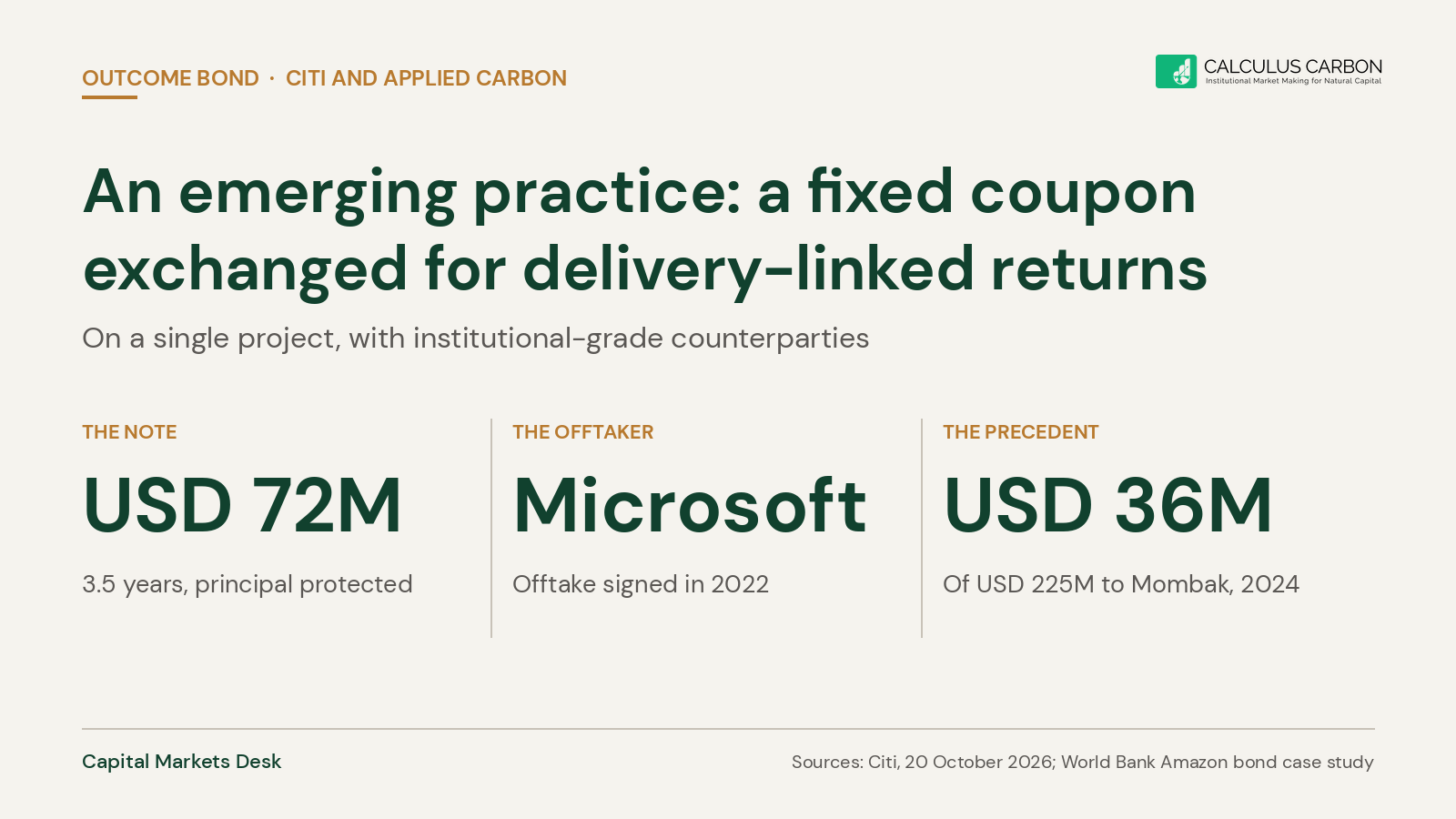
In carbon removal project finance, an emerging practice is to exchange a fixed coupon for delivery-linked returns on a single project, provided institutional-grade counterparties stand behind it. Citi's note for Applied Carbon, closed last week, is the clearest recent example, and its conditions can be reproduced on other projects.
The Read
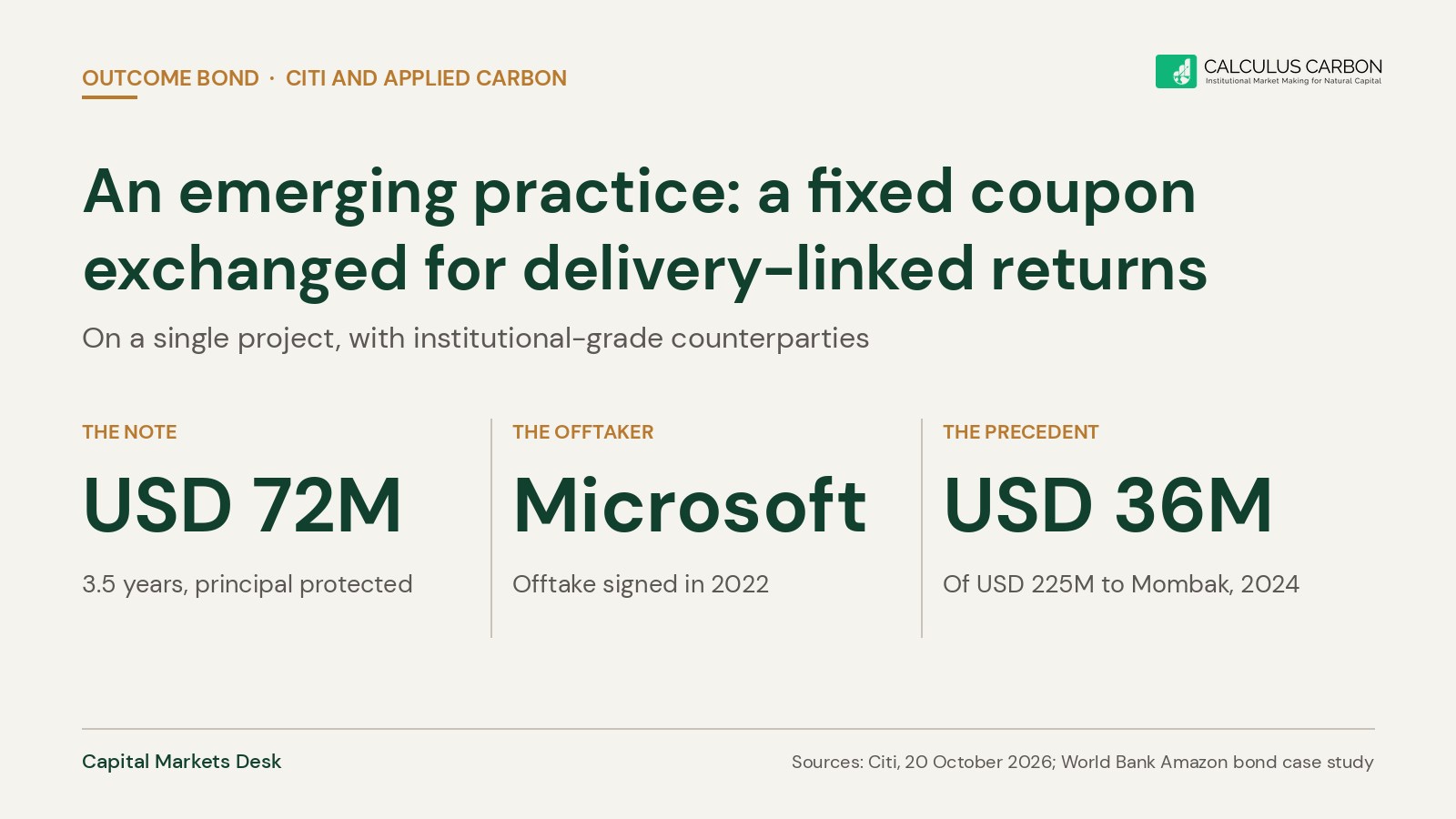
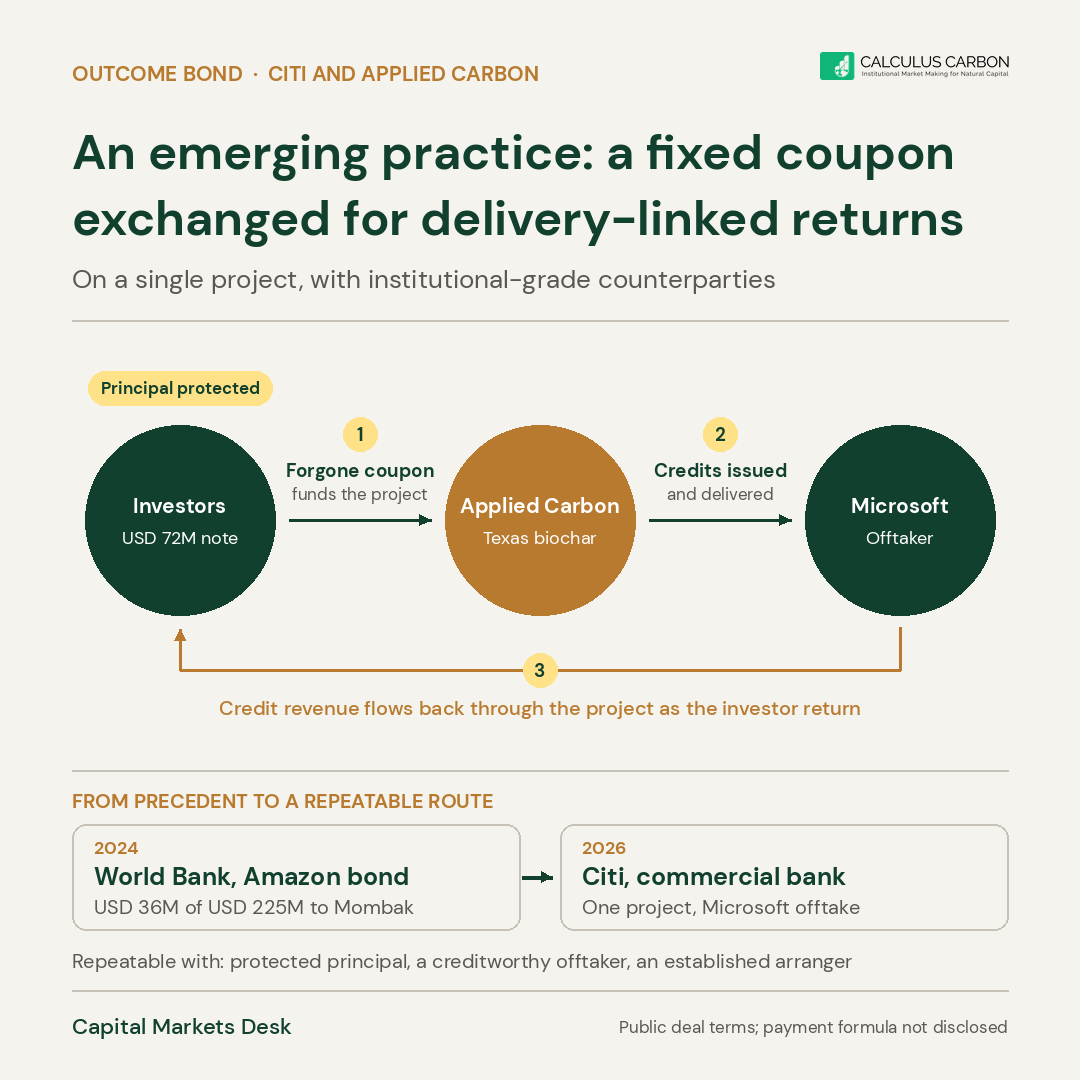
In carbon removal project finance, an emerging practice is to exchange a fixed coupon for delivery-linked returns on a single project, provided institutional-grade counterparties stand behind it. Last week, Citi closed a USD 72M, 3.5-year principal-protected Carbon Removal-Linked Note for Applied Carbon's biochar project in Texas, with Nuveen among the investors.1 Investors forgo the ordinary coupon, an upfront amount finances the project, and their return then comes from payments linked to the issuance and delivery of the project's carbon credits.1 Microsoft signed an offtake with Applied Carbon in 2022 for a portion of those credits.1 The structure is not new, but its use by a commercial bank on one project is, and that is the part a project financier should study.
Does the Investor Take Delivery Risk?
The investor takes delivery risk on the return, not on the principal. Citi describes the note as principal-protected, so the amount invested is repaid at maturity whatever the project delivers.1 The coupon an investor would ordinarily earn is given up at the outset, and its value is directed to the project.1 The investor's return is then the stream of payments linked to credits issued and delivered, which is the only element exposed to the project's performance.
The developer sees the same transaction from the other side. It receives funding before any credits exist and repays that funding from the credits it delivers, so repayment follows performance rather than a fixed amortisation schedule. For an early carbon removal project, that is a closer fit to the cash flow profile than a term loan, which expects scheduled debt service from a project that has not yet issued a tonne.
Is This Structure New?
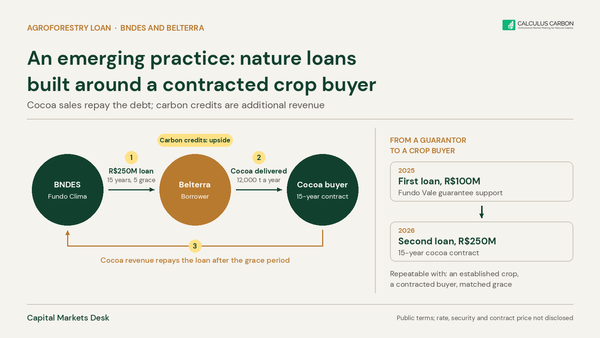
The model comes from the World Bank. In August 2024, the World Bank priced a USD 225M, 9-year Amazon Reforestation-Linked Bond that was fully principal-protected.4 Investors received a fixed coupon of 1.745 per cent, below the rate on an ordinary World Bank bond of similar maturity, and the value of the forgone coupons, about USD 36M, was converted through an interest rate swap into funding for the developer, Mombak.3 Mombak repays through a share of its credit revenue from Microsoft, which funds a variable coupon to investors from 2028.3
The spekboom restoration bond in South Africa followed the same design. It is a USD 120M, principal-protected World Bank bond, with up to USD 25M disbursed to the developer, Imperative, against milestones, and a variable coupon driven by credits purchased by Amazon under pre-agreed terms.6 In both cases the principal was World Bank risk, and the project risk sat only in the variable part of the return.5
The Citi note applies that template outside a multilateral balance sheet. Citi describes it as its first outcome bond tied to verified carbon removals.1 The underlying asset is one developer's project, which is how most nature and removal projects are financed in practice.
Is the Headline USD 72M the Project's Capital?
It is not, and the distinction matters for anyone comparing this with a loan. The note is USD 72M, but the project receives the value of the forgone coupon, not the principal. In the Amazon bond, USD 36M of a USD 225M issue reached the developer.3 In an earlier World Bank plastic waste outcome bond, about USD 14M of a USD 100M headline was upfront project funding.7
Citi has not disclosed how much of the USD 72M reaches Applied Carbon, on what schedule, or the formula that sets investor payments.78 Those terms decide the economics for both sides, and a developer considering a similar structure should establish them first. On public data, Applied Carbon has at least 198,190 tonnes of removals contracted, which gives a sense of the delivery base behind the note.2
Can the Structure Be Repeated on Other Projects?
It can, where three conditions hold. The first is protected principal, which allows conservative fixed income investors to participate and confines their project exposure to the return. The second is a creditworthy offtaker, so that delivered credits convert into cash at a known price; Nuveen cited credits being off-taken by a well-known hyperscaler as part of its rationale.1 The third is an established arranger able to structure the note, place it and administer the flow of payments between the project and investors.
Each of these conditions is available beyond this transaction. Several technology and nature developers now hold long-term offtakes with large corporate buyers, and the arranging role does not depend on a single institution. The structure is therefore better read as a replicable route for funding projects before their first credits are issued than as a one-off transaction.
Should Developers Treat This as an Alternative to Project Debt?
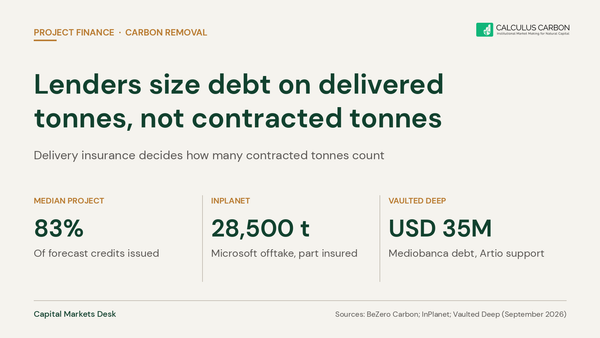
It is better treated as a complement. The amount a project receives is limited to the value of the forgone coupon, which on the World Bank precedents has been a fraction of the headline issue.37 That makes the structure well suited to funding early deployment before credits are issued, while larger capital needs at scale are still likely to require project debt sized on delivered volumes.
Four questions frame the assessment for a developer or an investor. The first is the share of the note that reaches the project and the milestones that govern disbursement. The second is the payment formula and the treatment of a delivery shortfall. The third is the credit and tenor of the offtake that underpins the return. The fourth is the source of principal protection, which determines the investor base the note can reach.
In carbon removal project finance, an emerging practice is to exchange a fixed coupon for delivery-linked returns on a single project, provided institutional-grade counterparties stand behind it, and the conditions that made Citi's note work can be reproduced on other projects.
This note is for information only and is not investment advice.
Sources
- [1] Citi, Citi Closes $72 Million Carbon Removal-Linked Note to Support Applied Carbon Biochar Project, press release, 20 October 2026. citigroup.com
- [2] ESG Dive, Citi closes first-of-its-kind $72M bond for biochar project, 23 October 2026, citing CDR.fyi contracted volumes. finance.yahoo.com
- [3] World Bank, Amazon Reforestation-Linked Outcome Bond, case study. thedocs.worldbank.org
- [4] World Bank, Investors Support Amazon Reforestation Through Record Breaking USD 225 Million World Bank Outcome Bond, press release, 13 August 2024. worldbank.org
- [5] IFR, Scaling a sustainable outcome, March 2025. ifre.com
- [6] World Bank, Spekboom Restoration Outcome Bond, questions and answers. thedocs.worldbank.org
- [7] BC ESG, When Can an Outcome Bond Fund Carbon Removal Equipment Before the Credits Exist?, October 2026. bcesg.org
- [8] CarbonCredits.com, Citi's $72 Million Carbon Removal Deal Bets on Biochar, October 2026. carboncredits.com