The Forward Market and the Delivery Market Are Not the Same
Cumulative CDR forward offtakes have reached 48.5 million tonnes against 2.65 million tonnes of issuances since 2022. The 18x gap is now the pricing question that allocators, buyers, and developers have to sit with.
CDR · H1 2026 · Allied Offsets
The Forward Market and the Delivery Market Are Not the Same
Cumulative CDR forward offtakes have reached 48.5 million tonnes against 2.65 million tonnes of issuances since 2022. The 18x gap is now the pricing question that allocators, buyers, and developers have to sit with.
The Number the Market Has to Sit With
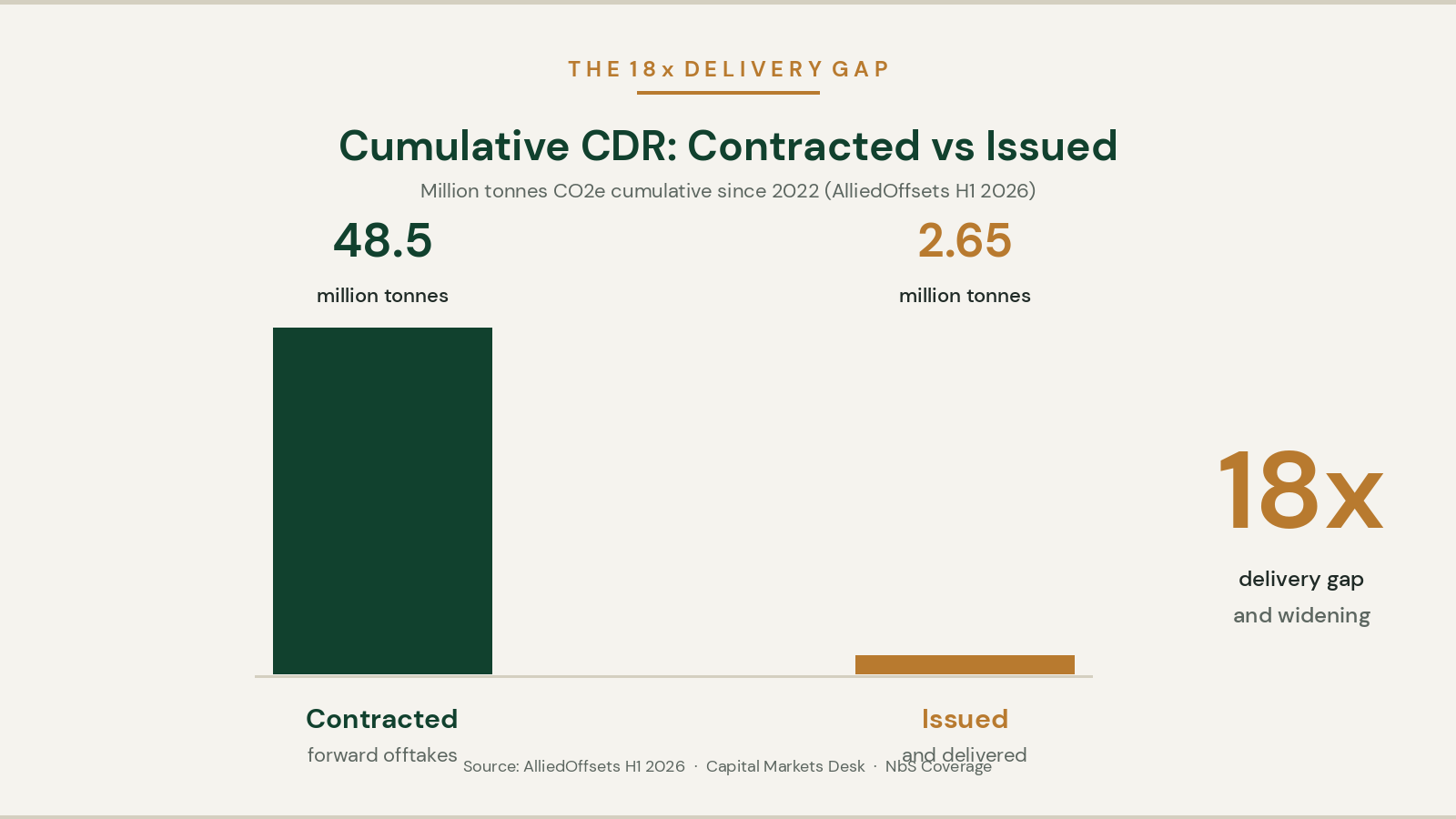
Cumulative carbon dioxide removal forward offtakes have reached 48.5 million tonnes since 2022. Actual issuances stand at 2.65 million tonnes over the same period. The delivery gap is roughly 18x, and it has been widening every quarter. AlliedOffsets, which tracks the full lifecycle from contract signature to registry issuance, calls this an 18x delivery deficit. Carbon Direct, in its 2026 state-of-the-market report, describes over 90 million tonnes of contracted or committed CDR demand for future delivery against a spot market that remains a fraction of that.1,6
That is the number the CDR market has to sit with.
The instinct on a headline like "48.5 million tonnes of forward offtakes" is to read it as evidence that CDR is scaling. The instinct is wrong. Forward offtakes are contracts. Issuances are tonnes that exist. The distance between the two is the market's live delivery-risk position, and until it closes it is not a supply signal, it is a promise.
Frontier's Strategy Shift Says the Same Thing
On 17 June 2026, Frontier announced US$915 million in new commitments, taking its total to US$1.8 billion. The framing in the coalition's own release matters more than the headline dollar figure. Frontier is narrowing its purchasing from the wide-net advance market commitment it launched in 2022 to a concentrated portfolio of 10 to 15 companies. Contracts will run 8 to 10 years, with delivery windows extending as far as 2040. New buyer Anthropic joins Stripe, Google, Shopify, Salesforce, and H&M Group.3,4
Frontier reviewed 500-plus companies to get here. Roughly US$698 million has already been contracted across 50-plus projects. Seven portfolio companies delivered about 23,000 tonnes in 2025, roughly twice the prior year, and Frontier forecasts 50,000-plus tonnes for 2026.4,5 The gap between the coalition's total commitment and delivered volume is, on Frontier's own portfolio, itself an order-of-magnitude story.
The coalition that invented the CDR advance market commitment has effectively stopped acting as an AMC. It has moved to acting as a term-sheet writer. That is the honest read of the strategy shift. The wide-net role, the price-discovery role, the reviewing-500-companies role, has been substantially completed. The next role, the one Frontier is now stepping into with 8-to-10-year concentrated offtakes, is underwriting.
What This Means for the Price of a Forward Tonne
The market has spent three years pricing forward CDR credits primarily on a durability premium. Direct air capture at US$516 per tonne. Biochar at US$135. Enhanced rock weathering somewhere in between. The full public durable-method range in July 2026 runs from roughly US$61 to US$1,330 per tonne. Buyers have been paying for the promise of the pathway.1,2
The delivery gap says that pricing needs a second axis. A tonne contracted for 2029 delivery from a pathway with a 99.9 percent delivery gap to date, which is where direct air capture sits, cannot logically clear at the same price as a tonne delivered in 2026 from a pathway with a track record. Biochar is that pathway with a track record. It accounts for approximately 57 percent of all-time CDR issuances and 53 percent of all-time retirements. Enhanced rock weathering is the next candidate. Offtake volumes moved from 10,000 tonnes in 2022 to 470,000 tonnes in 2025, and issuances in 2026 are already tracking to surpass the full-year 2025 volume.1,2
The price a buyer is willing to pay for a 2029 tonne should reflect the odds that the tonne exists in 2029. Today, most forward pricing does not carry that discount visibly. That is the first pricing gap the market has to close.
The Underwriting Question Has to Shift Too
If pricing is one side of the adjustment, underwriting is the other. Ten-year offtake contracts, of the kind Symbiosis Coalition and Frontier are writing, look like project-finance instruments. They are not, at least not yet, structured that way.
A project-finance-grade offtake would carry vintage-graded coupons. Delivery in Year 1 would be underwritten differently from delivery in Year 8. Year 1 might sit near the spot price of the pathway. Year 8 would sit at a discount reflecting the delivery-risk band of that vintage. The offtake would trade as a strip of vintage coupons, not as a single-price commitment.
Instead, most CDR offtakes today are priced at a blended level across the delivery window. The buyer takes the delivery risk uniformly. That is what has to change. A hedge fund or commodity trading desk that already writes forward paper against oil delivery, or aluminium delivery, or gas delivery, understands vintage risk instinctively. Once these desks enter the CDR forward market seriously, the blended-price offtake will not survive. It will be re-priced into vintage strips.
The Read for Institutional Capital
Three consequences follow for allocators, private-credit underwriters, and DFI treasury desks looking at CDR forward books.
First, a project developer's forward offtake volume is not a proxy for enterprise value. A US$50 million contracted forward book on a pathway with a 99 percent delivery gap is not the same as a US$50 million contracted forward book on a pathway with a 40 percent delivery gap. The two enterprises should carry different equity values, different debt capacity, and different insurance cost. Diligence has to underwrite the delivery vintages inside the offtake, not just the top-line dollar volume.
Second, the delivery gap creates a private-credit opportunity in the middle of the CDR capital stack. A developer with a signed 10-year offtake at a defensible price has a payment stream. The stream is not bank-grade today because delivery risk is not yet decomposed into vintages. Once it is, a private-credit desk can lend against Year 1 through Year 3 coupons at one advance rate, and Year 4 through Year 7 at a lower advance rate, and leave Year 8-plus to equity. That is a plumbing job the market has not yet done, and it is where the next generation of CDR project finance sits.
Third, buyers who move first on vintage-graded offtakes will secure supply cheaper than buyers who continue to price blended. The delivery discount, priced correctly on Year 1 tonnes, is a bargain relative to a blended price that already carries an implicit late-vintage penalty. The market has been paying the penalty without collecting the discount, because the two sides of the vintage curve have not been separated.
The Structural Read
The forward market and the delivery market are not the same. That is the single sentence that reframes the last three years of CDR headlines. Every headline US$1.8 billion Frontier commitment, every ten-year Symbiosis offtake, every signed forward book at Sylvera's US$12.25 billion 2025 total, now needs to be read against the delivery curve of the pathway involved, and priced accordingly. A tonne is not a tonne until it is issued.8
Frontier's Growth AMC pivot is the coalition acknowledging this in its own portfolio. It has narrowed to fewer companies, extended contract tenors, and moved from seeding to underwriting. The advance-market-commitment era is closing. The delivery-underwriting era is beginning.
Allocators who read the CDR forward book as tonnes coming online will keep overpaying for late vintages. Allocators who read it as a series of vintage-graded contracts will start pricing the delivery discount, and lending against the front of the curve.
The forward market and the delivery market are not the same. That gap is now the pricing question.
This is a personal note from Neelesh Agrawal, CEO at Calculus Carbon. Views expressed are personal and do not represent the firm's transaction positions. Primary sources are listed below.
Sources
- [1] AlliedOffsets H1 2026 CDR market report, via Carbon Credits. carboncredits.com
- [2] Invert Insights, Global Carbon Market Trends (AlliedOffsets cross-check). invert.world
- [3] CTVC, Pushing the Frontier for Carbon Removal. ctvc.co
- [4] ESG Dive, Frontier Climate adds Anthropic to CDR buyers group, makes new financing pledge. esgdive.com
- [5] Data Center Dynamics, Frontier consortium to invest a further US$915M into carbon removal tech. datacenterdynamics.com
- [6] Carbon Direct, 2026 State of the Voluntary Carbon Market report. carbon-direct.com
- [7] Currence, H1 2026 Carbon VC Investment Report. currence.ai
- [8] Sylvera, State of Carbon Credits. sylvera.com